

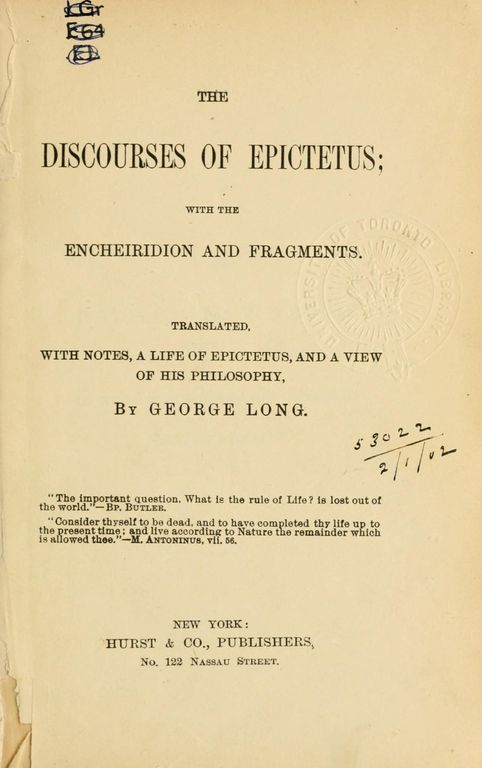
The discourses of Epictetus
with the Encheiridion and fragments.
Introduction: The Slave Who Taught Emperors
Introduction: The Slave Who Taught Emperors
Nova: Welcome to Aibrary, the show where we excavate the wisdom of the past to build a better future. Today, we are diving into a text that has shaped leaders, thinkers, and everyday people for nearly two millennia: The Discourses of Epictetus. Imagine this: a man born into slavery in Hierapolis, who later gains his freedom, sets up a philosophy school, and whose students include the future Roman Emperor Hadrian. That man is Epictetus, and his teachings, captured by his devoted student Arrian, are raw, direct, and utterly uncompromising.
Nova: : That is an incredible origin story, Nova. It immediately tells you this isn't some ivory-tower philosophy. This is wisdom forged in hardship. When I look at the sheer volume of the —it’s massive, unlike the concise —I wonder, what made these informal lectures so compelling that Arrian felt compelled to transcribe them so diligently?
Nova: That compulsion is the key. Arrian, who later became a renowned historian and general, recognized that Epictetus wasn't just reciting doctrine; he was actively coaching people through life's messes. The are essentially transcripts of live therapy sessions, philosophical boot camps if you will. They aren't polished essays; they are direct answers to real people struggling with fear, ambition, and disappointment. The central promise, which we'll unpack today, is that happiness—true, unshakeable tranquility—is entirely achievable, regardless of your external circumstances.
Nova: : Tranquility sounds like a luxury item in our current world. We’re bombarded by news, notifications, and endless demands. So, what’s the hook? Why should a modern listener, dealing with spreadsheets and social media feeds, care about a Stoic teacher from the Roman Empire?
Nova: Because Epictetus cuts through the noise with a single, revolutionary division. He gives us the ultimate filter for stress. He tells us, very early on, that everything in life falls into one of two buckets. If you can master that distinction, you master your peace. That’s the foundation of the entire work, and it’s what we’re dedicating our first deep dive to. Are you ready to separate what’s yours from what isn't?
Nova: : Absolutely. Let's start with the man himself, because his background seems inseparable from his message. Tell us more about the journey from slave to sage.
The Unlikely Source of Enduring Wisdom
The Man and the Messenger: From Chains to Clarity
Nova: Epictetus was born around 50 AD, likely in Hierapolis, Phrygia, and spent his early life as a slave in Rome, serving Epaphroditus, a powerful freedman of Emperor Nero. The very fact that he was a slave is crucial. He knew firsthand what it meant to have your body, your time, and your very existence controlled by another person. This wasn't abstract theory for him; it was lived reality.
Nova: : That context is staggering. Most philosophical texts we study come from the elite—the landed gentry, the senators, the emperors, like Marcus Aurelius. Epictetus is coming from the absolute bottom rung of the social ladder. Did he gain his freedom before or after he started studying philosophy?
Nova: He gained his freedom later, but crucially, he studied under Musonius Rufus, one of the most respected Stoic teachers of the time. When Domitian expelled philosophers from Italy around 93 AD, Epictetus relocated to Nicopolis in Greece and opened his own school. It was there, teaching in these informal lecture settings, that Arrian found him. Arrian wasn't just a student; he was a historian, someone who understood the value of accurate record-keeping. He wrote down the —eight books worth of material—precisely because he feared the spoken word would vanish.
Nova: : So, we are reading the notes of a very dedicated student, not the final manuscript of the philosopher. Does that change how we should approach the text? It feels more immediate, less polished than, say, Seneca’s letters, which were written specific people.
Nova: Exactly. The immediacy is its power. It’s conversational, sometimes repetitive, because Epictetus was drilling concepts into his students over and over again, like a coach. He wasn't writing for posterity; he was trying to change behavior. He often uses very blunt, almost abrasive language to shock his students out of complacency. He’d say things like, “If you want to improve, be content to be thought foolish and dull with regard to external things.” That’s not gentle encouragement; that’s a challenge to your ego.
Nova: : That bluntness is refreshing, but it also requires a translator, or at least a good modern edition, to bridge the gap. I’ve read that the, or the Handbook, is essentially a summary of the compiled by Arrian later. Is the the essential text, or is the enough for the casual reader?
Nova: The are the essential text, without a doubt. The is the CliffsNotes, the distilled essence. But the give you the and the through context, through examples, through the back-and-forth. For instance, in the, Epictetus spends pages dissecting what it means to be a good human being in a specific situation—how to handle a rude comment, how to treat your family, how to approach death. The just gives you the rule: 'Some things are up to us, others are not.' The show you the wrestling match required to actually live that rule.
Nova: : It sounds like the are the full workout, and the is just the warm-up routine. I’m fascinated by the idea that this former slave was teaching people how to handle power. Did he ever directly address the Roman elite who were his audience?
Nova: Constantly. He often used hypothetical scenarios involving emperors or powerful officials to drive home his point that external status is irrelevant to inner freedom. He taught that the only true master you serve is your own faculty of judgment. He even famously said that if you are a slave, you must perform your duties well, but remember that your true self—your —remains free. That’s a radical concept of liberation that transcends social class. It’s why his philosophy resonated so deeply with people who felt powerless, whether they were slaves or emperors feeling the crushing weight of responsibility.
Nova: : So, the structure of the book itself—these recorded lectures—forces us into a participatory role. We are eavesdropping on a masterclass. It makes the philosophy feel less like ancient history and more like an active conversation we’ve just walked into. This leads perfectly into the core mechanism he uses to achieve that freedom: the division of everything in life.
The Most Important Distinction in Stoicism
The Unshakeable Core: Prohairesis and the Dichotomy of Control
Nova: Let’s get straight to the heart of Epictetus’s teaching, the bedrock upon which everything else rests: the Dichotomy of Control. He states it plainly in 1.22: “Some things are in our control and others are not.” This isn't just a suggestion; it’s the fundamental law of Stoic physics and ethics.
Nova: : I know the phrase, but I always struggle with the practical application. What exactly falls into the 'in our control' category? Is it just my thoughts?
Nova: It is precisely your thoughts, your judgments, your desires, and your aversions. Epictetus calls this faculty. Think of as your inner citadel, your moral compass, your executive decision-maker. It is the faculty by which you assent to or reject impressions. Nothing external—your body, your wealth, your reputation, whether you win the lottery, whether the traffic light turns green—is in your control. These are indifferent things, governed by fate or the actions of others.
Nova: : So, if I get fired tomorrow, the firing itself is not in my control. But my to being fired—my judgment that this is a catastrophe, my decision to lash out in anger, or my choice to calmly update my resume—that is entirely? That’s where the battle is fought?
Nova: Precisely. And this is where the modern application shines. We spend 99% of our mental energy trying to control the uncontrollable—the stock market, other people’s opinions, the weather. Epictetus says that effort is wasted energy that leads directly to anxiety and frustration. He famously said, “If you want to be happy, stop caring about things that are not up to you.” It’s a radical redirection of focus.
Nova: : But Nova, what about effort? If I’m an athlete, I have to control my training, my diet, my practice schedule. Isn't that 'in my control'? If I stop caring about the outcome, won't I just become lazy and accept mediocrity?
Nova: That’s the most common and sophisticated challenge to Stoicism, and Epictetus addresses it beautifully. You control the, the, and the. You control the quality of your training session today. You do control whether you win the championship, whether you get injured in the final minute, or whether the judges favor your opponent. Your job is to execute the process perfectly—to be the best possible version of yourself —and then, when the result comes, you accept it as an external event, like the rain or the sun. The virtue lies in the execution, not the trophy.
Nova: : That reframes ambition entirely. It moves the goalpost from an external reward to an internal standard of excellence. I’m picturing my to-do list now. Everything that says 'Achieve X' is external. Everything that says 'Apply myself diligently to Y' is internal. It’s a powerful re-categorization tool.
Nova: It is. And the reason is so sacred is that it’s the only thing that cannot be taken from you, even by the most tyrannical emperor. They can chain your body, but they cannot force you to agree that your situation is bad, unless you choose to assent to that impression. As Epictetus put it, “No man is free who is not master of himself.” This mastery over your inner faculty is the only true freedom, and it’s why he spent so much time on the next concept: managing the impressions that bombard that faculty.
Why Events Don't Hurt Us, Our Judgments Do
Impressions: The Battlefield of the Mind
Nova: If is the general, then 'impressions' are the enemy scouts constantly trying to breach the walls of our mind. Epictetus teaches that external events are morally neutral. They are just data. It is our to the impression these events create that causes all our emotional turmoil.
Nova: : This is where the famous quote comes in, right? Something like, “It is not things themselves that disturb men, but their judgments about these things.” I think that quote is perhaps the most quoted Stoic line, but it’s so easy to say and so hard to live when you’re genuinely upset.
Nova: It is the hardest part. Let’s break down an example. Say you are walking down the street and someone publicly insults you. The event is: Sound waves hit your ear conveying negative words. That’s neutral. The impression that rushes in is: 'I have been dishonored. This is terrible. I must retaliate.' If you immediately to that second thought—if you accept it as an objective truth that you be angry—then you suffer. Epictetus insists you must pause between the impression and the assent.
Nova: : The pause. That’s the space where gets to work. It’s like having a security checkpoint for every thought that tries to enter your mind. What questions should we be asking at that checkpoint?
Nova: Epictetus gives us several tests. The first is the Dichotomy test: Is this insult in my control? No. Therefore, my reaction is my only concern. The second test is to strip the impression down to its bare facts. Instead of 'My rival got the promotion I deserved,' you rephrase it as, 'My rival received a title and a salary increase. That is all.' By removing the emotional overlay—the judgment of 'deserved' or 'unfair'—the event loses its power to disturb you.
Nova: : That stripping process sounds exhausting, though. Isn't that intellectualizing away genuine human feeling? If I’m genuinely hurt by a betrayal, am I supposed to just calmly analyze the sound waves?
Nova: That’s a fair challenge. Epictetus is not advocating for becoming an unfeeling robot. He’s advocating for feeling. He says it’s fine to feel a natural stirring—a shock, a momentary sadness—because that’s part of our nature. But the distress, the rage, the resentment, the decision to carry that burden around—that is the result of a faulty judgment that you to. He wants you to feel the initial jolt, acknowledge it, and then immediately ask your rational faculty: 'Is this impression true, necessary, and helpful?' If the answer is no, you dismiss it, just as you would dismiss a false report.
Nova: : So, the goal isn't to stop feeling, but to stop unnecessarily by refusing to endorse the negative story we tell ourselves about the event. This connects back to his idea of living in harmony with nature. If nature dictates that things change, then my judgment that change is bad must be unnatural, right?
Nova: Exactly. Nature dictates that things are indifferent. If you judge that losing money is 'bad,' you are judging against the nature of things, because money is external. If you judge that being sick is 'bad,' you are judging against the nature of your body, which is mortal. The only thing that is truly 'bad' is the corruption of your —the moment you choose to be unjust, cowardly, or intemperate. That is the only thing you should fear, and that is the only thing you have the power to prevent. This focus on internal moral character is what makes the a manual for virtue, not just stress management.
From Theory to Daily Ethical Action
The Practice of Philosophy: Virtue as the Only Good
Nova: We’ve established the mechanism: control what you can, manage your assent to impressions, and accept everything else. Now, what is the of all this disciplined mental work? For Epictetus, the answer is singular: Virtue. Virtue—which encompasses practical wisdom, justice, courage, and temperance—is the sole good.
Nova: : That’s a very high bar. In our world, success is often measured by wealth, influence, or happiness derived from pleasure. Virtue seems abstract by comparison. How does he make virtue feel like the most practical, desirable goal?
Nova: He grounds it in self-respect and consistency. If you value your character, you must act consistently with that value, regardless of the payoff. For example, justice isn't about getting a fair legal ruling; it’s about to act justly toward your neighbor, even if they are acting unjustly toward you. Courage isn't the absence of fear; it’s choosing to do what is right, even when you feel fear because the action itself is within your control, but the feeling of fear is not.
Nova: : So, if I’m facing a difficult choice at work—say, I can take a shortcut that benefits me financially but involves lying to a client—the Stoic calculation is simple: The financial gain is external and indifferent. The act of lying corrupts my, which is the only true good. Therefore, I must not lie, even if it means losing the money.
Nova: Precisely. And the beauty is, once you make that choice based on internal virtue, the outcome—losing the money—becomes an indifferent external event that cannot truly harm your well-being. You have preserved your inner freedom. Epictetus stresses that this practice must be constant. He doesn't want you reading the once a year; he wants you to be testing your judgments every hour. He urges students to use their philosophical training in every mundane interaction.
Nova: : I recall reading about his views on roles and duties. He categorizes life into different roles—son, citizen, friend, teacher. Does he suggest we should prioritize one role over another?
Nova: He says you must perform the duties appropriate to the role you currently inhabit, but always subordinate those duties to the overarching role of being a rational, moral human being. For instance, you have a duty to your family, but if fulfilling a family request requires you to violate justice or temperance, your duty to virtue always wins. He frames it as a hierarchy: First, maintain your moral faculty; second, fulfill your social roles; third, manage your body and external possessions. This hierarchy prevents us from sacrificing our core integrity for temporary external gain or social approval.
Nova: : It’s a complete internal realignment. It moves the source of satisfaction from things to a certain way. It sounds like the ultimate form of self-sufficiency. If I can maintain my virtue, I need nothing else to be content. This is why the text has survived, right? It offers a complete operating system for human life that doesn't rely on external validation or changing the world around you.
Nova: It does. And it’s why thinkers like Descartes, centuries later, found themselves echoing these very principles. The offer a robust, practical framework for resilience. It’s not about being emotionless; it’s about ensuring your emotions serve your reason, not the other way around. It’s about realizing that the only thing truly worth fighting for is the integrity of your own will.
Conclusion: The Unconquerable Will
Conclusion: The Unconquerable Will
Nova: We’ve journeyed through the life of a former slave who became one of history's most profound moral teachers. We saw how Arrian preserved these vital, raw lectures, giving us access to the core of Stoic practice.
Nova: : And the core, as we’ve seen, boils down to that powerful, liberating distinction: the Dichotomy of Control. Everything external—your job, your health, the opinions of others—is indifferent. Everything internal—your choices, your judgments, your assent—is the only thing that matters, because that is your, your unconquerable will.
Nova: The key takeaway for anyone starting this journey is to stop rehearsing external outcomes and start rehearsing internal responses. When something upsets you, don't ask, 'Why did this happen to me?' Ask, 'What is my judgment about this event, and is that judgment serving my virtue?' If you can pause between the impression and the assent, you have already won the battle Epictetus fought every day.
Nova: : It’s a philosophy of radical responsibility. You are responsible for your character, and nothing else. That’s a heavy burden, but it’s also the greatest freedom. If we want to live a life of inner tranquility, we must stop outsourcing our happiness to fate and start owning our judgments.
Nova: Indeed. Epictetus reminds us that we are all actors in a play written by a divine director. We don't choose the role, but we absolutely choose how well we play the part assigned to us. The are the ultimate script guide for playing that part with dignity and excellence.
Nova: : A powerful lesson from a powerful source. Thank you, Nova, for guiding us through the wisdom of the former slave who taught the world how to be truly free.
Nova: Thank you for challenging the concepts and keeping us grounded. This wisdom is not meant to be admired; it’s meant to be used. This is Aibrary. Congratulations on your growth!