

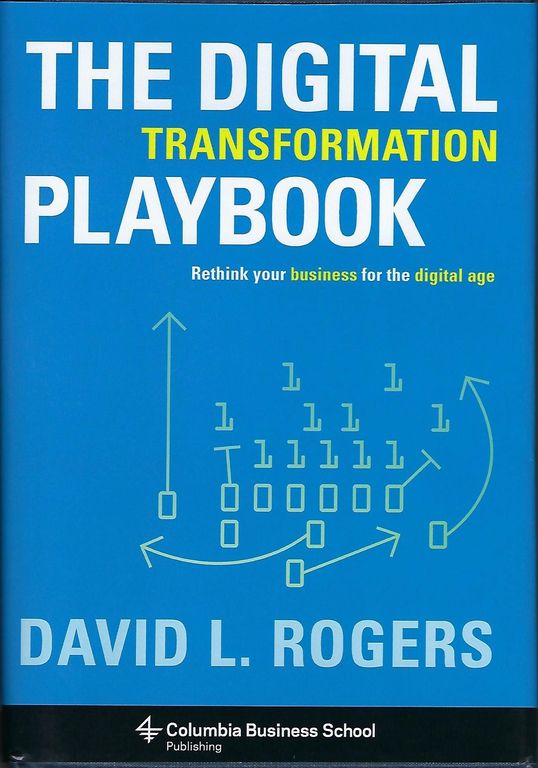
The digital transformation playbook : rethink your business for the digital age
Introduction: Beyond the Buzzword
Introduction: Beyond the Buzzword
Nova: Welcome back to the show! Today, we are diving deep into a book that cuts through the noise of every boardroom meeting: David L. Rogers' "The Digital Transformation Playbook." I want to start with a provocative statement I found in my research: Digital transformation is not about updating your technology; it is about upgrading your strategic thinking.
Nova: : That is a massive distinction, Nova. Most executives hear 'digital transformation' and immediately think about cloud migration, new ERP systems, or maybe even AI adoption. They see it as an IT project with a massive budget. Why is Rogers so adamant that the strategy, the, has to come first?
Nova: Exactly. Rogers, a Columbia Business School faculty member, argues that if you just bolt new tech onto an old, flawed strategy, you just get an expensive version of the old failure. He says transformation is about fundamentally rethinking your business assumptions in the digital era. It’s a complete strategic overhaul, not just a software patch.
Nova: : So, this isn't just about being 'digital-first' in marketing; it's about being 'digital-first' in the DNA of the company. If I'm a listener running a traditional manufacturing firm, what's the first thing I need to unlearn based on this playbook?
Nova: You need to unlearn the idea that your value chain is linear and fixed. Rogers forces you to look outward at how digital forces are reshaping the entire ecosystem. He distills this massive concept into a framework that is surprisingly manageable, focusing on five key areas. We're going to break down those five domains right after the break, because understanding them is the key to unlocking real, lasting change.
Nova: : I’m ready to rethink everything. Let’s see how Rogers turns this abstract concept into an actionable playbook.
Key Insight 1: Rethinking the Core Five
The Five Domains of Disruption: Where Strategy Must Evolve
Nova: Alright, we're back, and we're tackling the heart of the Playbook: the Five Domains of Digital Transformation. Rogers identifies these as the strategic battlegrounds where digital forces are most intensely reshaping business. The first one is Customers.
Nova: : Customers. Seems simple enough, but how does digital change the fundamental assumption about who our customer is and how we serve them?
Nova: It moves beyond simple segmentation. Rogers emphasizes the Customer Network. Think about Starbucks. They didn't just build an app; they created a network where the customer is constantly interacting with the brand, ordering ahead, earning rewards, and even providing feedback directly into the operational loop. It’s about engaging the of customers, not just serving individuals.
Nova: : That makes sense. The customer is now part of the production process, in a way. What’s the second domain? Competition, I assume?
Nova: Precisely. Domain two is Competition. The digital age blurs industry lines. You’re no longer just competing with the company across the street; you’re competing with platform players and adjacent industries that suddenly have a digital entry point. Think about how Amazon disrupted everything from grocery stores to healthcare logistics.
Nova: : So, the competitor might be a company that doesn't even look like a competitor today. It forces you to constantly scan the horizon for digital entrants who might be using a completely different business model to steal your value.
Nova: Exactly. And this leads directly into Domain Three: Data. This isn't just about having a data warehouse. Rogers frames data as a strategic asset that must be leveraged for innovation and customer insight, not just for reporting last quarter's sales. It’s about using data to predict needs before the customer even articulates them.
Nova: : I feel like we’re building a picture here. We’re looking at who we serve, who we fight, and what fuel we use. What about the fourth domain?
Nova: Domain Four is Innovation. In the digital age, innovation can’t be siloed in an R&D department. It has to be continuous, rapid, and often comes from small, iterative experiments. Rogers stresses that the organization must be structured to for this constant, low-cost failure and learning.
Nova: : That’s where many legacy companies stumble. They have processes built for perfection, not for speed and iteration. If you’re not failing small and fast, you’re not innovating digitally.
Nova: You’ve hit the nail on the head. And finally, Domain Five: Value. This is where you synthesize everything. How do you redefine your value proposition when your customers, competitors, and data streams have all shifted? It’s about moving from selling a product to delivering an outcome or an experience, often through a platform model.
Nova: : So, Customers, Competition, Data, Innovation, and Value. These five domains aren't separate tasks; they are five interconnected lenses through which every single strategic decision must be viewed now. If one domain is weak, the whole structure is vulnerable.
Nova: That’s the power of the framework. It forces holistic strategic thinking. It’s a complete map of the new digital territory.
Key Insight 2: The Playbook's Practical Toolkit
From Domains to Action: The Nine Strategic Tools
Nova: Now that we have the map—the Five Domains—we need the compass and the shovel. This is where Rogers introduces the practical side: the Nine Key Strategic Planning Tools. These tools are designed to help leaders actually the rethinking required in those five domains.
Nova: : Nine tools sounds like a lot to master, but I’m guessing they map back to the domains. Can you give us an example of a tool that forces that strategic shift?
Nova: Absolutely. Let's look at the Customer Network Strategy Generator. This tool forces you to map out the entire ecosystem around your customer—not just the direct buyer, but influencers, partners, and even adjacent services. It moves you away from a simple B2C or B2B view to a complex network view.
Nova: : That sounds like a massive shift in perspective. For a traditional retailer, their 'network' might have been their supply chain partners. Now, their network includes social media influencers and third-party delivery apps.
Nova: Precisely. Another powerful tool, likely tied to the Data and Innovation domains, is the one focused on defining the 'Digital Value Template.' This helps you move past incremental improvements and think about entirely new ways to create value using digital assets. Are you selling access, enabling a transaction, or curating an experience?
Nova: : I recall reading that Rogers emphasizes that these tools are meant to be used iteratively, right? Not as a one-time strategic planning event, but as a continuous loop.
Nova: That’s crucial. The Playbook isn't a binder you put on a shelf. It’s a set of living documents. For instance, when looking at the Competition domain, you might use a tool to analyze platform business models—how companies like Uber or Airbnb create value by connecting supply and demand without owning the assets. That analysis then feeds directly into how you redefine your own Value Proposition.
Nova: : It sounds like the tools are designed to surface blind spots. If you use the tool for analyzing your Data assets, you might realize you are sitting on a goldmine of behavioral data that you are currently treating as a cost center for compliance, rather than a revenue driver for innovation.
Nova: Exactly. The tools are diagnostic and generative. They force leadership teams to have difficult, specific conversations about they will compete digitally, rather than just agreeing that they compete digitally. For example, one tool might focus on setting 'Direct Objectives' versus 'Higher-Order Objectives'—making sure your digital efforts serve a purpose beyond just hitting a quarterly metric.
Nova: : So, the nine tools are the operational language for translating the high-level strategic shifts in the five domains into concrete organizational mandates. It’s the difference between saying 'We need to be more innovative' and having a template that shows you exactly what your next three innovation experiments should look like.
Nova: That’s the essence of the Playbook. It bridges the gap between the 'why' and the 'how' of digital transformation, making it less of a mysterious transformation and more of a structured, albeit challenging, strategic project.
Key Insight 3: Learning from the Transformation Leaders
Case Studies: The Digital Giants in Action
Nova: Researching this book brought up some fantastic real-world examples of companies that have successfully navigated these five domains. We saw names like Starbucks, Disney, Walmart, and Domino's Pizza pop up repeatedly as models of successful strategic digital change.
Nova: : Domino's is fascinating because they are fundamentally a logistics and technology company that happens to sell pizza. How does Rogers’ framework explain their success?
Nova: Domino's is a textbook example of mastering the Value and Customer domains. They realized their core value wasn't the pizza itself, but the. They invested heavily in technology—the 'Pizza Tracker' being a famous early example—to manage customer expectations through data transparency. They turned the delivery process into a visible, trackable service.
Nova: : So, they used Data to enhance the Customer Network experience, which redefined their Value Proposition from 'fast food' to 'reliable convenience.' That’s a perfect illustration of the domains overlapping.
Nova: It is. Let’s look at Starbucks, another giant. They didn't just digitize loyalty points. They used their mobile app to fundamentally change their Customer Network. By allowing mobile ordering and payment, they reduced friction at the point of sale, which is a massive competitive advantage in a high-volume, low-margin interaction like coffee buying.
Nova: : And that directly impacts the Competition domain, right? If I can skip the line because I ordered on the app, I am less likely to walk into a competitor's store that still requires me to queue up.
Nova: Exactly. Now, consider a more traditional sector like retail, say Walmart. They faced existential threats from Amazon. Their transformation wasn't just about launching an e-commerce site. It involved leveraging their massive physical footprint as a competitive advantage—using stores as micro-fulfillment centers. That’s a strategic shift in the Value and Competition domains, enabled by massive Data infrastructure.
Nova: : It’s interesting how these established players didn't just copy Silicon Valley startups. They used their existing assets—Starbucks' locations, Walmart's real estate, Domino's existing delivery infrastructure—and their value proposition around those assets using digital tools.
Nova: That’s the key takeaway for any established business. Rogers isn't telling you to become a startup; he’s telling you to use the digital playbook to make your existing assets strategically relevant for the next decade. It’s about strategic, not just replacement.
Nova: : It sounds like the common thread among these successes is that they treated digital transformation as a company-wide strategic mandate, not a side project for the IT department. They used the five domains to guide their investments, ensuring every dollar spent on tech served a higher strategic purpose defined by the customer and the market.
Key Insight 4: Overcoming Organizational Inertia
The Roadblocks: Why Transformation Stalls
Nova: We’ve covered the ideal state—the five domains and the nine tools. But Rogers also dedicates significant attention to what stops companies dead in their tracks. He identifies five major barriers that prevent strategy from becoming reality.
Nova: : I’m bracing myself. I suspect the first one is always 'culture,' but what are Rogers' specific, actionable barriers?
Nova: He lists them clearly: Vision, Priorities, Experimentation, Governance, and Capabilities. Vision is the first hurdle. If leadership can't articulate a compelling, new strategic vision that digital thinking, the organization defaults to the old way of doing things.
Nova: : So, if the CEO says, 'We need to be more digital,' but can't explain how that changes the P&L or the customer promise, the vision fails. It’s too vague.
Nova: Precisely. Then comes Priorities. Digital transformation requires resources, and if the budget still heavily favors maintaining legacy systems over funding new digital experiments, the priorities are misaligned. You can't transform if you're still funding the past at 90%.
Nova: : That’s the classic resource allocation trap. What about Experimentation? That sounds like a cultural barrier, but how does Rogers frame it strategically?
Nova: He frames it as a process failure. If your governance structure demands a five-year ROI projection for every initiative, you will never fund the small, rapid experiments needed to learn about Data or Innovation in the new domains. Successful transformation requires governance that supports agile, iterative testing.
Nova: : So, Governance needs to evolve from being a gatekeeper of risk to an enabler of calculated risk-taking. That’s a tough sell in many established firms.
Nova: It is. And finally, Capabilities. This isn't just about hiring data scientists. It’s about ensuring the organization—from the front lines to the C-suite—has the fluency to understand and act on the insights from the five domains. Do your managers understand how a platform business model works, even if they aren't building one?
Nova: : It’s a full organizational literacy requirement. If we put this all together, Rogers is essentially saying that digital transformation is a continuous management discipline, not a one-time project. The barriers are organizational habits that actively resist the strategic shifts required by the five domains.
Nova: Exactly. The Playbook is a guide to dismantling those habits using the structured approach of the nine tools, all while keeping the five domains in sight. It’s about building an organization that is structurally resilient to the next wave of digital change, whatever that may be.
Conclusion: The Continuous Strategic Evolution
Conclusion: The Continuous Strategic Evolution
Nova: We’ve covered a lot of ground today, moving from the high-level philosophy that digital transformation is about strategy, not just technology, right down to the practical nine tools for execution.
Nova: : The biggest takeaway for me is the interconnectedness of the Five Domains: Customers, Competition, Data, Innovation, and Value. You can’t just fix one in isolation. A change in how you view your Customer Network immediately impacts your Value Proposition and forces you to re-evaluate your Data strategy.
Nova: Absolutely. And the key message for our listeners, especially those in established companies, is to stop waiting for the perfect technology solution. Rogers provides the blueprint to start the strategic work. Use the tools to challenge your current assumptions about your market and your business model.
Nova: : It’s a call to action to become strategically proactive rather than reactively adopting the latest tech trend. The goal isn't to complete the transformation; the goal is to become a company that is of continuous transformation.
Nova: That’s the perfect synthesis. The Playbook is less about achieving a final digital state and more about embedding strategic agility into the organizational DNA. It’s about building resilience against the next disruption, which, let’s be honest, is always just around the corner.
Nova: : A powerful framework for navigating an uncertain future. Thank you, Nova, for breaking down David Rogers' essential guide.
Nova: My pleasure. Keep challenging those underlying assumptions, listeners. This is Aibrary. Congratulations on your growth!