The Network State Trap: Why Geopolitics Needs Your Strategic Mind.
Golden Hook & Introduction
SECTION
Nova: Forget everything you thought you knew about nations, borders, and how power actually works. The rules are changing under our feet, and if you’re not paying attention, your strategic insights might already be obsolete.
Atlas: Whoa, Nova, that’s quite the opening. Are you saying the very foundations of geopolitics are crumbling? Because for anyone building secure systems or envisioning resilient futures, that’s a pretty stark warning.
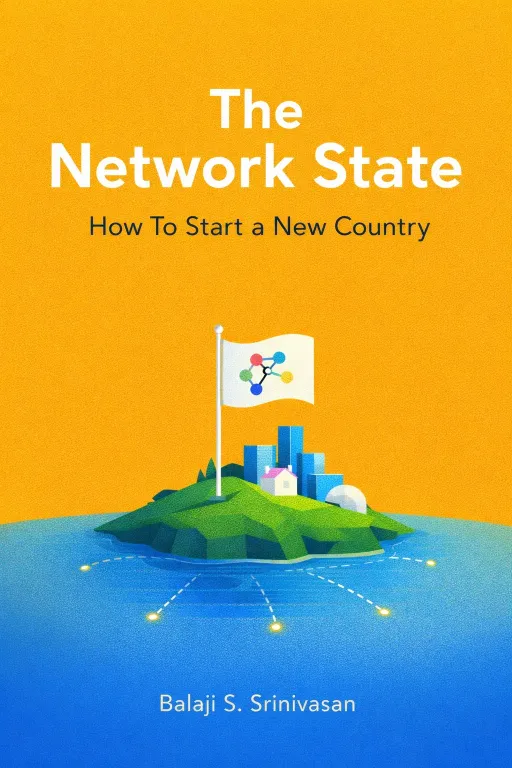
Nova: Exactly, Atlas! We’re not talking about minor tweaks; we’re talking about a paradigm shift. Today, we’re dissecting two seismic books that force us to confront this new reality: Balaji Srinivasan’s 'The Network State,' which offers a visionary, and often polarizing, look at digital sovereignty, and 'The Dictator's Handbook' by the renowned political scientists Bruce Bueno de Mesquita and Alastair Smith, which lays bare the brutal, universal mechanics of power, from ancient empires to modern corporations.
Atlas: Srinivasan, the former CTO of Coinbase, is known for his radical foresight in tech, and Bueno de Mesquita is famous for his predictive models in political science. It’s a fascinating pairing, almost like looking at two different ends of the same spectrum of power.
Nova: Absolutely. These authors aren't just speculating; they're dissecting the very DNA of power itself, one from the hyper-futuristic angle of digital communities, and the other from the timeless, cold logic of how leaders actually stay in power. And that naturally leads us to our first deep dive: the audacious concept of the network state.
The Network State: Digital Sovereignty vs. Traditional Borders
SECTION
Nova: So, Balaji Srinivasan proposes a future where online communities, leveraging crypto and AI, can actually form new sovereign entities. He calls them 'network states.' Imagine a group of like-minded individuals, scattered across the globe, who coalesce online around a shared purpose, a moral innovation, a common culture. They build a decentralized economy, develop internal governance, achieve critical mass, and eventually, purchase land, or even an island, to gain physical sovereignty recognized by existing nations.
Atlas: Wait, are you saying a Reddit forum could eventually become its own country? That sounds a bit out there. How does this 'cloud country' secure anything? Who defends its digital borders, let alone its physical ones? For someone focused on building resilience, this feels like a massive attack surface.
Nova: Well, it’s not quite a Reddit forum, but the principle is similar. Think of it as a startup society. They start with a strong online culture, a shared value system, often encoded in blockchain, and a collective vision. Their 'citizens' contribute digitally, building a robust internal economy. The 'security' initially comes from the decentralized, encrypted nature of their systems and the collective commitment of their members. Their 'borders' are digital, defined by who has access to their protocols and who adheres to their social contract. And when they do acquire land, their digital strength would ideally give them leverage in traditional geopolitics.
Atlas: Okay, so the initial 'sovereignty' is more about digital self-governance and economic independence. But for a true 'state,' you need physical control, a monopoly on force. How does a network state, for instance, protect against a cyberattack from a hostile nation-state, or even a physical invasion once they’ve acquired land? That seems like a massive vulnerability.
Nova: That’s the critical challenge, isn't it? Srinivasan acknowledges this. The idea is that their digital wealth, cryptographic resilience, and global distributed network of citizens could offer a new form of deterrence or leverage. Imagine a network state with a multi-trillion-dollar digital economy; attacking it physically could trigger a global financial backlash, or its decentralized nature makes it incredibly hard to 'decapitate' like a traditional state. It's about shifting the balance of power from geographic control to digital and economic influence.
Atlas: That’s a fascinating reframe. So, for architects building governance models today, the impact is immense. It forces us to think beyond traditional territorial integrity and consider the integrity of networks, data, and decentralized consensus. What kind of security models would even apply to something like this? It's almost like a new layer of geopolitical strategy.
Nova: Exactly. It’s forcing us to ask: What if the future of power isn't about controlling land, but controlling the most compelling digital networks and their underlying protocols? It impacts everything from data sovereignty to the very concept of citizenship.
The Dictator's Handbook: The Timeless Rules of Power
SECTION
Nova: But even in this brave new digital world, power still needs to be managed, right? Which brings us to a far older, far more brutal truth about governance, laid out in 'The Dictator's Handbook.' Bueno de Mesquita and Smith argue that leaders, across all political systems – democracies, dictatorships, even a hypothetical network state – operate under universal rules to maintain control. It all boils down to who they need to keep happy to stay in power.
Atlas: Ah, the 'selectorate' theory. I’ve heard about this. So, it's not about ideology or even popularity, but about the cold, hard calculus of who holds the keys to your survival as a leader.
Nova: Precisely. They define three crucial groups: the, the, and the. A leader’s entire strategy revolves around rewarding their winning coalition enough to keep them loyal, often at the expense of everyone else.
Atlas: So, whether it's a king showering his nobles with land, or a CEO giving stock options to key executives, or even a benevolent leader in a network state allocating governance tokens to early contributors, the mechanism is the same: identify your winning coalition and keep them incentivized. That's actually really inspiring for understanding any complex system, not just national politics.
Nova: That’s the genius of it. Take a look at the internal politics of a major tech company, for instance. The CEO needs to keep the board and key investors happy to retain their position. Their decisions, while framed as being for the 'good of the company', are often optimized to deliver returns or strategic wins that satisfy that smaller, crucial group. Similarly, in a traditional monarchy, the king’s winning coalition might be a handful of powerful dukes or generals. Their loyalty is bought through land, titles, or shared spoils.
Atlas: That makes me wonder, how would this apply to a network state? If its governance is decentralized, how does a 'leader' or a core founding team maintain control without falling into these same 'dictator's handbook' traps? Could a truly decentralized network state even a winning coalition, or would it inherently resist that dynamic?
Nova: That's a brilliant question, Atlas. A truly decentralized network state, by design, would attempt to minimize the winning coalition to as close to the nominal selectorate as possible—meaning everyone has a meaningful say. But even in DAOs, we see 'whales' or early contributors holding a disproportionate amount of influence, effectively forming a de facto winning coalition. The principles still apply. The game of power simply adapts to the new playing field.
Atlas: So, the form changes, but the underlying drive to secure power by managing incentives remains constant. It’s almost like the network state provides a new platform for these timeless power dynamics to play out, perhaps with new rules, but the same fundamental game.
Nova: Exactly. The core lesson here is that understanding these timeless dynamics helps you analyze political entity, traditional or novel. Whether you're building a new governance model for an AI system, designing resilience into critical infrastructure, or strategizing for a multinational corporation, recognizing who needs to be kept happy, and why, is paramount.
Synthesis & Takeaways
SECTION
Nova: So, what we’ve seen today is that Balaji Srinivasan asks us to imagine a future where the of sovereignty is radically different, built on digital networks and shared values, challenging the very notion of territorial states. But then, 'The Dictator’s Handbook' swoops in to remind us that no matter the form, the of power—how it’s acquired, maintained, and wielded—adheres to incredibly consistent, often brutal, rules centered on managing a winning coalition.
Atlas: It’s a powerful combination. For our listeners who are architects, sentinels, and futurists, this isn't just academic. It means your strategic mind needs to operate on two levels. You need to understand the cutting-edge, the potential for network states to disrupt existing structures, and also the ancient, unchanging logic of power that will inevitably shape these new entities. The future of geopolitics isn't just about borders; it’s about networks and the incentives that bind them.
Nova: Absolutely. It’s about building responsible, secure systems not just for today's world, but for a future where the very definition of a 'state' is in flux. You can’t secure what you don’t understand, and ignoring these shifts leaves your strategic insights incomplete.
Atlas: So, the call to action here is clear: look beyond the surface. When you're designing a system, building a team, or analyzing a political landscape, don't just see the formal structures. Dig into the incentive structures. Who is the winning coalition in this scenario? What motivates them? Because understanding that, whether in a cloud country or a traditional one, is your greatest strategic advantage.
Nova: Wise words, Atlas. That’s a powerful lens to apply to any challenge.
Atlas: Indeed. This is Aibrary. Congratulations on your growth!