

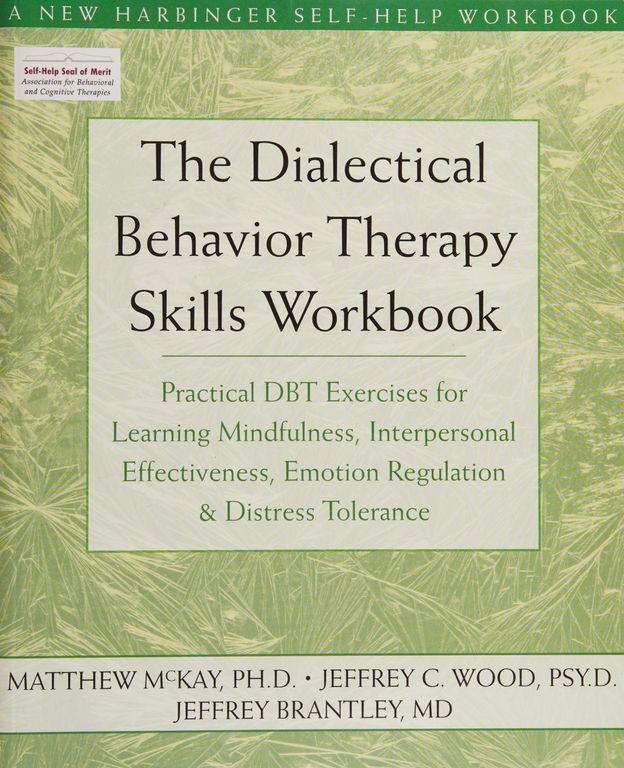
The dialectical behavior therapy skills workbook
Practical DBT Exercises for Learning Mindfulness, Emotional Regulation, Interpersonal Effectiveness, and Distress Tolerance
Introduction
Nova: Have you ever felt like your emotions were a tidal wave, just completely sweeping you off your feet before you even realized the tide was coming in? For a lot of people, that is not just a metaphor. It is a daily reality. But what if there was a literal instruction manual for navigating those storms? Today, we are diving into a book that has become a lifeline for millions: The Dialectical Behavior Therapy Skills Workbook by Matthew McKay, Jeffrey Wood, and Jeffrey Brantley.
Nova: That is a perfect way to put it. This workbook takes the complex, clinical world of Dialectical Behavior Therapy, or DBT, and brings it down to earth. Originally, DBT was developed by Marsha Linehan to treat Borderline Personality Disorder, which is characterized by extreme emotional instability. But what McKay and his colleagues realized is that these skills are actually universal. Whether you are dealing with clinical depression or just getting way too stressed out by your morning commute, these tools work.
Nova: We are going to decode all of that. We will look at the four core pillars of DBT: mindfulness, distress tolerance, emotion regulation, and interpersonal effectiveness. By the end of this, you will see why this workbook is considered the gold standard for taking back control of your life.
Key Insight 1
The Foundation: Wise Mind and the Dialectic
Nova: Before we get into the specific skills, we have to talk about the word dialectical. It sounds like something out of a philosophy textbook, doesn't it? But in the context of this workbook, it is actually a very simple, powerful concept. It is the idea that two seemingly opposite things can both be true at the same time.
Nova: Exactly. It is the balance of acceptance and change. If you focus only on change, you feel judged and overwhelmed. If you focus only on acceptance, you stay stuck. The workbook teaches you to walk that middle path. And the primary tool for doing that is what they call the Wise Mind.
Nova: Most of us live in one or the other. When you are in Emotion Mind, you might say something hurtful in an argument because you are angry, even if you know it will make things worse. When you are in Reasonable Mind, you might ignore your feelings entirely and burn out because you are treating yourself like a robot. The workbook uses mindfulness exercises to help you find that Wise Mind center.
Nova: It creates a gap. Between the feeling and the reaction, there is a tiny space where you can choose what to do. That is the foundation of everything else in the book. If you can't observe your emotions through mindfulness, you can't use any of the other skills because you are already swept away by the wave.
Key Insight 2
Distress Tolerance: The Emergency Brake
Nova: So, once you have that foundation of mindfulness, the workbook moves into what I call the emergency brake: Distress Tolerance. These are the skills you use when you are already in a crisis and you just need to survive the next five minutes without making things worse.
Nova: It is! TIPP stands for Temperature, Intense exercise, Paced breathing, and Paired muscle relaxation. The Temperature part is wild. They literally suggest splashing ice-cold water on your face or holding an ice cube. It triggers the mammalian dive reflex, which instantly slows down your heart rate. It is a physical hack to force your nervous system out of fight-or-flight mode.
Nova: That is where skills like STOP come in. S-T-O-P. Stop, Take a step back, Observe, and Proceed mindfully. It is about hitting the pause button. McKay also talks a lot about Radical Acceptance. This is one of the hardest skills in the whole book. It is the idea of accepting a painful situation without trying to fight it or complain that it is unfair.
Nova: That is the common misconception. Radical Acceptance isn't approval. It is just acknowledging the facts of reality so you can decide what to do next. If you are stuck in a massive traffic jam and you spend the whole time screaming at the steering wheel about how unfair it is, you are still stuck in traffic, but now you are also miserable and your blood pressure is through the roof. Radical Acceptance is saying, I am in traffic. This is the reality. Now, how do I want to spend this time?
Nova: Exactly. And they provide these great lists of self-soothing techniques using the five senses. Smelling a candle, listening to a specific playlist, or even just feeling the texture of a soft blanket. It sounds simple, but when your brain is on fire, these sensory anchors keep you grounded in the present moment instead of spiraling into the past or future.
Key Insight 3
Emotion Regulation: Turning Down the Volume
Nova: If Distress Tolerance is the emergency brake, Emotion Regulation is the thermostat. This is about long-term maintenance. How do we stop the waves from getting so big in the first place? McKay and his co-authors focus on identifying and labeling emotions, which research shows actually reduces their intensity.
Nova: Because bad is vague. If you can identify that you feel neglected rather than just angry, your brain can start to look for a specific solution. The workbook also introduces the concept of reducing vulnerability. They use the acronym PLEASE. It covers physical health, balanced eating, avoiding mood-altering substances, sleep, and exercise.
Nova: Exactly. You are more vulnerable to emotional outbursts. The workbook treats your body like the container for your emotions. If the container is cracked and shaky, the emotions are going to spill out. Another huge skill in this section is Opposite Action. This is one of my favorites because it is so counterintuitive.
Nova: Precisely. Emotions come with action urges. Anger wants to attack. Fear wants to hide. Sadness wants to withdraw. If the emotion is justified and helpful, you follow the urge. But if the emotion is out of proportion or not helping you reach your goals, you do the exact opposite. By changing your behavior, you actually start to change the emotion itself. You don't wait to feel better to take action; you take action to feel better.
Nova: It really is. And the book also talks about building positive experiences. They have this massive list of pleasurable activities, from big things like taking a trip to tiny things like wearing a favorite shirt. The idea is to build up your emotional bank account so that when a withdrawal happens, you don't go into debt.
Key Insight 4
Interpersonal Effectiveness: The Social GPS
Nova: The final piece of the puzzle is Interpersonal Effectiveness. This is where the rubber meets the road. How do you take all this internal work and use it to navigate relationships? Because let's be honest, other people are often the biggest triggers for our emotional storms.
Nova: It is a script for communication. D-E-A-R stands for Describe, Express, Assert, and Reinforce. You describe the facts, express how you feel, assert what you want, and reinforce why it is good for the other person to help you. Then M-A-N is about the delivery: stay Mindful, Appear confident, and be willing to Negotiate.
Nova: Right. GIVE is about maintaining the relationship. It stands for being Gentle, acting Interested, Validating the other person, and using an Easy manner. It is for those times when the relationship is more important than getting your way. And FAST is about maintaining your self-respect. Fair, no Apologies, Stick to values, and Truthful.
Nova: It really helps with that feeling of being misunderstood. A lot of emotional distress comes from feeling like we can't get our needs met. By giving people the literal words to use, McKay and his team empower them to change their social environment. It is not just about managing your own brain anymore; it is about effectively navigating the world.
Nova: You are not wrong! Validation is the ultimate de-escalation tool. When people feel heard, their emotional volume drops. The workbook shows you how to do that for others and, just as importantly, how to do it for yourself. Self-validation is the antidote to that inner critic that tells you your feelings are wrong or stupid.
Conclusion
Nova: We have covered a lot of ground today, from the ice-cold water of distress tolerance to the structured scripts of interpersonal effectiveness. The Dialectical Behavior Therapy Skills Workbook is more than just a book; it is a comprehensive system for building what Marsha Linehan calls a life worth living.
Nova: If there is one takeaway from this workbook, it is that emotional regulation is a skill, not a personality trait. You aren't just a dramatic person or a sensitive person who is stuck that way forever. You can learn these tools. You can practice them. And over time, the storms don't feel quite so scary because you know exactly which sail to pull and which anchor to drop.
Nova: Well said. If you are looking for a place to start, maybe just pick one skill we talked about today. Maybe it is the Wise Mind, or maybe it is just taking a few paced breaths the next time you feel a spike of stress. Small steps lead to big changes.
Nova: Thank you for joining us on this journey through the DBT Skills Workbook. This is Aibrary. Congratulations on your growth!