

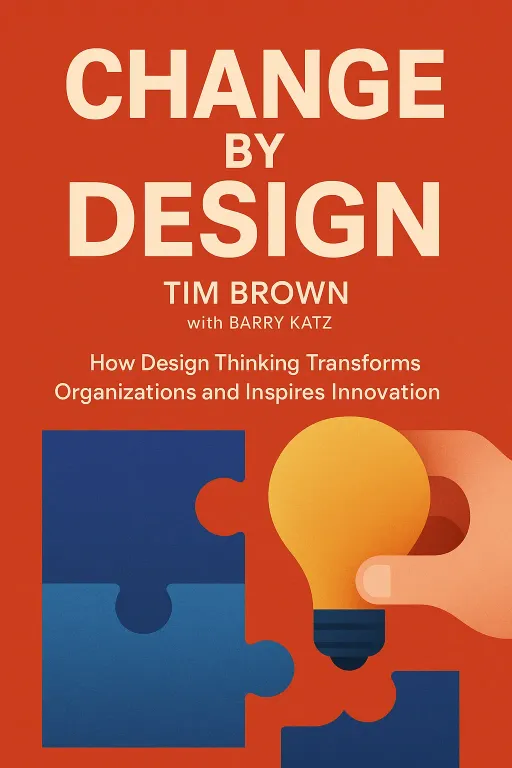
Stop Guessing, Start Designing: The Guide to Human-Centered Innovation
Golden Hook & Introduction
SECTION
Nova: Most brilliant ideas are destined to fail. That's not pessimism; it's a cold, hard truth of innovation. We often champion genius, but overlook the single, most critical ingredient for success.
Atlas: Whoa, "destined to fail"? That's a pretty bold claim, Nova. I imagine many of our listeners, who are constantly pushing for new solutions and navigating uncertainty, might find that a bit disheartening. What's the hidden factor we're missing?
Nova: It's the human element, Atlas. The profound lack of real understanding of the people we're trying to serve. And today, we're unpacking a guide that flips that script: Stop Guessing, Start Designing: The Guide to Human-Centered Innovation. This book draws heavily from the pioneering work of minds like Tim Brown, who envisioned Design Thinking tackling complex societal issues, and the legendary Don Norman, who relentlessly championed design that genuinely works for people.
Atlas: I’m curious about that, because for leaders aiming to transform systems, the stakes are incredibly high. Guessing isn't an option. So, the book is essentially saying that even the most innovative concepts can crumble if they're not built on a foundation of genuine human understanding?
Nova: Precisely. We're going to dive deep into why that happens, and then, how Design Thinking offers a powerful, structured roadmap for purposeful problem-solving and creating genuine, lasting impact.
The Blind Spot of Innovation: Why Ideas Fail Without Empathy
SECTION
Nova: Think about it: innovation isn't just about the 'eureka!' moment. It's about solving a problem. But if you're solving an problem, or solving a problem in a way that doesn't fit the user's life, that brilliant concept becomes an expensive paperweight. Don Norman, whose work is foundational to this idea, argues that good design is often invisible. You don't notice it because it just. Bad design, however, is glaringly obvious because it creates frustration.
Atlas: I totally know that feeling! I imagine a lot of our listeners have wrestled with technology that promises simplification but delivers a headache, or a new process that makes things more complicated instead of less. But how does this "invisible bad design" manifest for a strategic innovator dealing with, say, a city planning project or a new public health initiative, rather than just a confusing coffee machine?
Nova: That's a fantastic question, Atlas. Let's take a hypothetical. Imagine a city decides to implement a state-of-the-art smart waste management system. It's got AI-powered sensors, optimized routes, the works. On paper, it's brilliant, promises huge cost savings and environmental benefits. But they didn't really talk to the sanitation workers, or observe how residents actually dispose of waste.
Atlas: Oh boy, I can see where this is going.
Nova: Exactly. The new smart bins are too heavy for elderly residents to open, the sensor system is constantly triggered by raccoons, and the complex digital interface for the sanitation crew adds ten steps to their daily routine. The brilliant AI-powered system becomes a logistical nightmare, leading to overflowing bins, missed collections, and frustrated citizens. The was good, the was cutting-edge, but the utterly failed the human element at every touchpoint.
Atlas: Wow, that's kind of heartbreaking. It’s not just a product failure; it's a failure of public service, a waste of taxpayer money, and it erodes trust in innovation itself. So, the "good idea" isn't the problem, but the to the human using it is? That's a powerful distinction.
Nova: It really is. It demonstrates that innovation without empathy is just guessing. And guessing, especially when you're a purposeful leader aiming for world-changing impact, is a luxury no one can afford. This is why Nova's Take on the subject emphasizes that by focusing on the end-user's experience, you ensure your innovations solve real problems, not just imagined ones.
Atlas: So, how do we stop guessing and start designing solutions that actually work for people, especially when the problems are as complex as urban waste or healthcare? What's the practical roadmap for that?
Design Thinking: A Compass for Purposeful Problem-Solving
SECTION
Nova: That naturally leads us to our second core idea: Design Thinking. It’s not just a buzzword; it's a structured, human-centered approach outlined by thinkers like Tim Brown, who championed its application beyond product design to complex societal problems. It's a roadmap that guides you from understanding a problem to creating a truly impactful solution through an iterative process.
Atlas: I’m curious, Nova. For someone who's used to strategic planning and grand visions, "Design Thinking" might sound a bit… fluffy, or perhaps too focused on consumer products. Isn't that just a fancy term for common sense, or worse, just another corporate buzzword? How does it actually help a leader trying to transform an entire system, rather than just design a new app?
Nova: That's a fair challenge, Atlas, and it's a common misconception. The beauty of Design Thinking is its structured approach to empathy. It generally involves five phases: Empathize, Define, Ideate, Prototype, and Test. It begins with truly understanding the people you're designing for – their needs, their frustrations, their aspirations – often through deep observation and conversation.
Atlas: Like the tiny step in the book, observing someone affected by an issue without judgment.
Nova: Exactly! Let's illustrate this with another hypothetical. Imagine a non-profit trying to improve access to healthy food in underserved communities. A traditional approach might be to just build a new food bank or offer cooking classes. But a Design Thinking approach would start by. They'd spend time with community members, observing their daily routines, understanding their transportation challenges, their cultural food preferences, and their financial constraints.
Atlas: That makes sense. They're not just assuming what people need; they're it. What happens after they gather all that information?
Nova: Through that empathy, they might the problem differently. Instead of "lack of food," it might be "lack of convenient, culturally appropriate, affordable healthy food options that fit busy schedules." This leads to, where they brainstorm wild, creative solutions without judgment. Perhaps it's mobile farmers' markets that visit neighborhoods, or community kitchens where residents share skills and resources.
Atlas: That's a great way to put it. So, you're not just solving for "food," but for the entire human experience around food.
Nova: Precisely. Then they move to – quickly building low-fidelity versions of these ideas. Maybe it's a mock-up of the mobile market route or a simple schedule for the community kitchen. And here's the crucial part: they these prototypes with the actual community members, gathering feedback, learning what works and what doesn't, and then iterating. They fail fast, learn faster, and refine the solution until it truly meets the defined need.
Atlas: That's actually really inspiring. It’s a complete shift from top-down guessing to bottom-up designing. For purposeful leaders, this offers a framework for navigating uncertainty by continuously learning from the people they aim to serve. It transforms those grand visions into actionable, iterative steps. It also addresses the 'Mindset' growth recommendation of embracing the journey of discovery, and 'Action' by breaking down grand visions.
Synthesis & Takeaways
SECTION
Nova: Absolutely. Design Thinking is a discipline for turning empathy into impact. It's about moving from understanding a problem deeply to crafting actionable, relevant solutions. As Nova's Take reminds us, by consistently focusing on the end-user's experience, you ensure your innovations solve real problems, creating genuine, lasting value.
Atlas: It’s clear that the biggest barrier to a breakthrough isn't a lack of ideas, but often a lack of true observation and genuine connection to the people whose lives we're trying to improve. This isn't just about designing better products; it's about designing a better future.
Nova: And the beauty is, you can start small. The book offers a fantastic tiny step: Identify a recurring issue in your work. Then, spend just 30 minutes observing someone affected by it, without judgment. Just watch, listen, and learn.
Atlas: I love that. What if the biggest barrier to your next breakthrough isn't a lack of ideas, but a lack of true, unfiltered observation? That simple act of watching can unlock insights that no amount of boardroom strategizing ever could.
Nova: It’s a powerful reminder that the most profound innovations often begin with the most humble act: truly seeing another human being.
Atlas: A truly transformative insight for anyone looking to make a real difference.
Nova: This is Aibrary. Congratulations on your growth!