

Leadership by Design: Shaping Teams with Creative Thought.
Golden Hook & Introduction
SECTION
Nova: What if everything you thought you knew about leadership was fundamentally flawed? Not because you're a bad leader, or because you lack vision, but because you're approaching it from the wrong design?
Atlas: Whoa, that's a bold claim right out of the gate, Nova. "The wrong design?" I feel like a lot of our listeners, especially those building something new or trying to steer a team towards innovation, are probably thinking, "What design are you even talking about?"
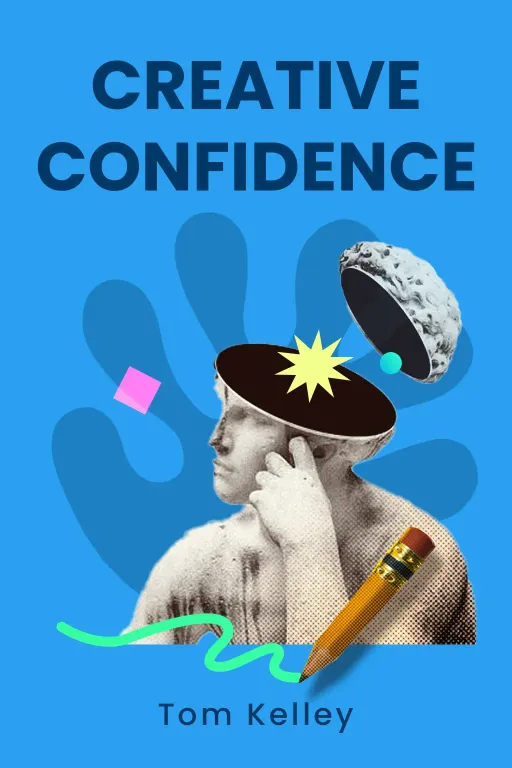
Nova: Exactly! That's the blind spot. We often think of leadership as a set of behaviors or strategies, but rarely as an act of intentional design. We're talking about "Leadership by Design: Shaping Teams with Creative Thought." And today, we're drawing incredible inspiration from two foundational texts: "Creative Confidence" by Tom Kelley and David Kelley, and "The Design of Everyday Things" by Don Norman.
Atlas: Those are some heavy hitters. I'm curious how books about, well, and tie into leading people.
Nova: They tie in beautifully, Atlas. You see, the Kelley brothers, Tom and David, are veterans of IDEO, one of the most influential design firms globally, and co-founders of Stanford University's renowned d. school. Their work isn't just theory; it's forged in the crucible of real-world innovation. And Don Norman, a cognitive scientist by training, practically pioneered the field of user-centered design, shifting our focus from how products work to how people interact with them. His insights transformed industrial design and user experience.
Atlas: Okay, so these aren't just abstract thinkers; they're people who fundamentally understand how humans interact with the world and with each other. I can see how that might be relevant.
Nova: Absolutely. Today, we're going to dive deep into this from two perspectives. First, we'll explore how leaders can cultivate creative confidence across their teams, then we'll discuss how designing better systems and processes can naturally encourage innovation.
Cultivating Creative Confidence as a Leadership Design Principle
SECTION
Nova: Let's start with a pervasive myth, Atlas, one that stifles more potential than any budget cut: the idea that creativity is a rare gift, bestowed upon a chosen few. The Kelley brothers, in "Creative Confidence," blow that out of the water. They argue it's a skill, a muscle, something anyone can develop.
Atlas: I guess that makes sense, but for a leader who's trying to innovate, isn't it easier to just hire "creative types" and let them do their thing? Why bother trying to coax creativity out of someone who thinks they're "not creative"?
Nova: That's the exact trap, isn't it? It’s a self-fulfilling prophecy. When leaders believe creativity is innate, they design systems that only value the "designated creatives," inadvertently telling everyone else to stay in their lane. This creates a blind spot where vast wells of potential go untapped. Imagine a brilliant engineer with an innovative process improvement idea who never speaks up because they've been told their role is just to execute.
Atlas: Oh, I've been there. I totally know that feeling. The pressure to "stay in your box." It builds walls, doesn't it?
Nova: It absolutely does. The Kelley brothers recount stories from IDEO and the d. school that are just revelatory. They talk about exercises where people, convinced they had no artistic bone in their body, were guided through simple design challenges. Think about a group of engineers, initially resistant, tasked with redesigning a hospital experience. By breaking down the problem, encouraging rapid prototyping, and fostering an environment where "failure" was simply a step towards learning, these self-proclaimed non-creatives consistently came up with incredibly inventive solutions.
Atlas: So, it's like designing the soil, not just planting the seeds? How does a leader actually "design" that sense of permission, especially when the stakes are high, when you're building something that needs to last, and failure feels like a huge setback?
Nova: That's the crux of it. Designing permission isn't about accepting incompetence; it's about shifting the definition of failure. It’s a deliberate leadership choice to model vulnerability. One way is to share your early, messy attempts at a solution or a creative idea. When a leader says, "Here's my rough sketch for this new project, it's probably terrible, but it's a start," it grants implicit permission for the team to bring their own rough ideas to the table without fear of judgment.
Atlas: That's actually really inspiring. It means the leader has to go first, right? Show that it's okay to not have all the answers, to be in that messy, generative phase.
Nova: Exactly. It's about designing a culture where experimentation is rewarded, where "learning" is seen as a valuable output, not just "successful delivery." It’s a subtle but powerful redesign of the team's psychological environment, transforming it from a performance arena into a learning lab. This is crucial for anyone who wants to build holistically, not just for the short term, but for sustainable innovation.
Designing Systems and Processes for Seamless Innovation
SECTION
Nova: And that notion of designing the environment, Atlas, naturally leads us to the second key idea we need to talk about: the "invisible architecture" of our teams, inspired by Don Norman's insights in "The Design of Everyday Things."
Atlas: Invisible architecture? That sounds a bit abstract. What does "designing everyday things" have to do with leading a team, especially for someone focused on tangible outcomes and sustainable practices? I’m thinking about physical buildings, not team dynamics.
Nova: That's a great question, and it's where the genius of Norman shines. He argues that when we struggle with a product—say, a confusing coffee machine or a door that's hard to open—we blame ourselves. "I'm so stupid," we think. But Norman says, no, it's usually bad design. The is poorly designed, leading to "user error."
Atlas: Right, like those push/pull doors that have no clear indication and you end up looking silly.
Nova: Precisely! Now, apply that to leadership. How many times do we blame our team for not being "creative enough," or "collaborative enough," or for "poor communication"? But what if the problem isn't the, but the? What if our "everyday things" – our meetings, our communication channels, our decision-making processes – are poorly designed, leading to "team error"?
Atlas: Oh man, that's kind of heartbreaking. I imagine a lot of our listeners are nodding vigorously right now, thinking of that one recurring meeting that feels like a black hole for productivity and creative energy.
Nova: It's a classic example. A typical meeting often has no clear agenda, no defined roles, no mechanism for divergent thinking, and no clear decision-making process. It's a poorly designed "thing." And then we wonder why people disengage or why innovative ideas don't emerge. Norman would say, "The meeting is broken, not the people attending it."
Atlas: So, going back to our deep question – how can a leader redesign, say, a project kick-off? What's one "everyday thing" they can change to explicitly encourage divergent thinking and creative contribution from every member, instead of just the loudest voices?
Nova: One incredibly effective design principle is to start with a "brain-dump" round where no ideas are judged. Instead of immediately diving into solutions, dedicate the first 10-15 minutes to rapid, individual idea generation, silently or verbally, with a strict rule: no criticism, no evaluation. Everyone contributes. Then, use a "yes, and..." building exercise where ideas are expanded upon, rather than shot down. This is a deliberate design choice to optimize for creative output over immediate consensus. It’s creating a clear pathway, a visible handle on the “door” of creativity.
Atlas: That sounds like a simple, yet profound shift. It's like you're designing the process to force creativity into existence, rather than hoping it magically appears. And it directly addresses that "deep question" about redesigning a meeting. This isn't just about making things efficient; it's about making them for innovation.
Nova: Exactly. It's about recognizing that our processes are just as much a "design" as any product we create. And if we, as leaders, want to cultivate innovation and creativity, we have to intentionally design the environment, the mindsets, and the "things" our teams interact with every single day. It's a holistic approach to leadership.
Synthesis & Takeaways
SECTION
Nova: Ultimately, Atlas, what Kelley and Norman show us is that leadership isn't just about vision or charisma. It's an act of intentional design. It’s about being a conscious architect of the environments, the processes, and the psychological safety nets that allow creativity to flourish.
Atlas: It's a powerful shift, realizing that our processes and our mindset are just as "designed" as any product. And if we don't like the outcome, we can redesign them. It gives you agency, doesn't it? As a leader, you're not just managing, you're the very conditions for success and impact.
Nova: Precisely. Whether you're building a groundbreaking product or fostering a sustainable team culture, you are, in essence, a designer. The power comes from conscious design, from moving beyond the blind spot and into a deliberate, creative approach to leadership. It’s about taking responsibility for the invisible architecture of your team.
Atlas: So, for our listeners, what's one "everyday thing" in your team's interaction—maybe a meeting, a communication channel, or even a feedback loop—that you could redesign this week to unlock a little more creative confidence, a little more seamless innovation? That’s a challenge I think many of us, especially those driven by impact and legacy, can take on right away.
Nova: That's a fantastic question to leave our listeners with. It’s about starting small, making one intentional design choice, and observing the ripple effect.
Atlas: And seeing how that shapes your team, and ultimately, your legacy.
Nova: Indeed.
Atlas: This is Aibrary. Congratulations on your growth!