

How to Create Solutions Without Getting Stuck in Analysis Paralysis
Golden Hook & Introduction
SECTION
Nova: Atlas, quick! Problem-solving.
Atlas: Headache. Whiteboard. Usually more headache.
Nova: Ideas.
Atlas: Excitement. Then... dust bunnies.
Nova: Solutions.
Atlas: Elusive. Or, if I'm honest, sometimes just... more problems.
Nova: Oh, I know that feeling all too well, those brilliant ideas that sparkle in your mind, then somehow just… fade away, never quite making it to reality. It's a universal frustration, isn't it?
Atlas: Absolutely. I imagine a lot of our listeners, the curious explorers and practical seekers among us, have experienced that chasm between a great concept and actually making it work. You want to build something impactful, but sometimes the sheer scale of the problem just… paralyzes you.
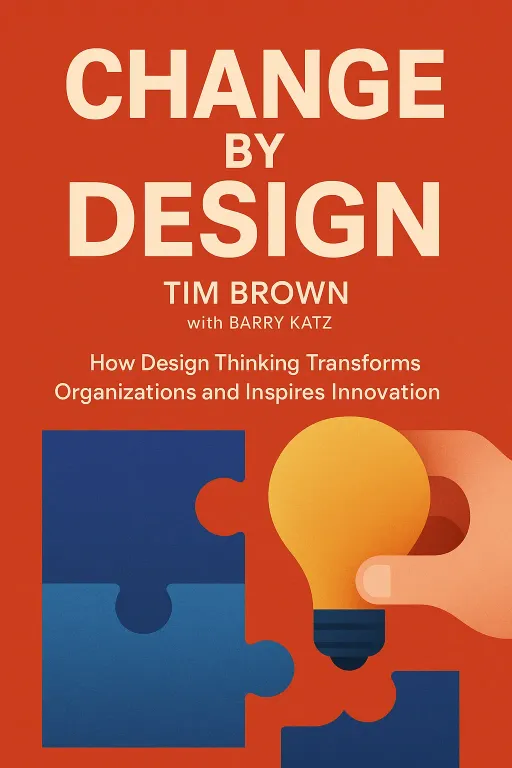
Nova: Precisely. And that's exactly what we're tackling today, drawing profound insights from two seminal works that have reshaped how we think about bringing ideas to life: "Change by Design" by Tim Brown and "The Design of Everyday Things" by Don Norman.
Atlas: Ah, Don Norman! His work is foundational. I mean, he practically invented the concept of user-centered design, showing us why doors are confusing and why good design often goes unnoticed because it just.
Nova: Exactly. And Tim Brown, as the executive chair of IDEO, one of the world's most acclaimed design and innovation consultancies, literally put Design Thinking on the map for the business world. Both books received widespread acclaim for making complex design principles accessible and actionable, though Norman himself has offered some nuanced critiques on the popularization of 'design thinking' later on, which is fascinating.
Atlas: That makes me wonder, then, what's missing when our great ideas just become those dust bunnies you mentioned? What's the core problem they're addressing?
The Chasm Between Ideas and Action: Understanding Analysis Paralysis
SECTION
Nova: Well, the core problem is a cold, hard fact: ideas are powerful, but without a clear, structured path to turn them into action, they remain just that—ideas. We often dive straight into solutions without truly understanding the problem or, critically, the experiencing that problem.
Atlas: So basically you’re saying it's not enough to have a lightbulb moment; you need a blueprint for the wiring.
Nova: That’s a perfect analogy! Think about a startup team I observed once. They had this incredible idea for an educational app. Their goal was to revolutionize learning for high school students. They spent months in a conference room, whiteboarding features, debating technical specs, arguing over the color scheme of the app icon. They envisioned this sleek, feature-rich platform.
Atlas: Sounds like every tech startup ever. What went wrong?
Nova: They never once actually spoke to a high school student. Or a teacher. Or a parent. They assumed they knew what students needed. So, they built this incredibly complex app, packed with every feature they could think of. When they finally launched it, it was clunky, overwhelming, and students simply didn't engage with it. It didn't solve their problems; it solved the problems the developers they had.
Atlas: Oh man, that's kind of heartbreaking. All that effort, all that passion, and it just fizzled because they were designing in a vacuum. I can totally see how that would happen. For our listeners who are trying to solve complex organizational issues, or even just a persistent family problem, how do you even begin to untangle that? It feels like the bigger the problem, the more likely you are to get lost in the weeds of analysis paralysis.
Nova: That’s it. Analysis paralysis is that feeling of being overwhelmed by options, information, or the sheer complexity of a problem, leading to inaction. It’s a common frustration for "Practical Seekers" who want to something but can't see the first step. The brilliance of both Brown and Norman is that they show us a way out of that loop by starting not with the solution, but with the human.
Design Thinking: The Human-Centered Blueprint for Breakthroughs
SECTION
Nova: And that naturally leads us to the answer that Tim Brown and Don Norman's work points to: Design Thinking. It’s a flexible, iterative framework that transforms insights into impactful, user-validated solutions.
Atlas: Okay, so it’s not just a buzzword, it's an actual method? I’m curious, what does 'structured' really mean here? Isn’t problem-solving supposed to be organic and creative?
Nova: It’s both, actually. Design Thinking isn't about stifling creativity; it's about channeling it effectively through a series of human-centered phases. Tim Brown outlines them beautifully: Empathize, Define, Ideate, Prototype, and Test.
Atlas: What does 'Empathize' really look like beyond a survey? For someone in a non-design role, how do they actually that?
Nova: That’s a great question, and it's the most crucial step. Empathizing means truly understanding the people you're designing for—their experiences, their needs, their motivations, both spoken and unspoken. It's about stepping into their shoes.
Atlas: Like how? Give me an example.
Nova: Imagine you're designing a new healthcare service for elderly patients. Instead of just sending out questionnaires, you might spend a day shadowing them—observing their daily routines, talking to their caregivers, sitting in their waiting rooms, and listening to their frustrations. You might discover that their biggest pain isn't just medical, but profound loneliness, or the struggle to navigate complex digital systems.
Atlas: Wow, that’s actually really inspiring. So, 'Empathize' is about deep, qualitative understanding, not just quantitative data. What's next?
Nova: Once you've empathized, you 'Define' the problem. This isn't just "patients need better care"; it's a specific, human-centered problem statement, like "Elderly patients need a way to feel connected and supported within their community, beyond just their medical appointments."
Atlas: That’s a great way to put it. It frames the problem in a way that opens up new possibilities for solutions.
Nova: Exactly. Then comes 'Ideate,' where you brainstorm as many creative solutions as possible, no idea is too wild. For our elderly patients, this might be anything from new community programs, to simplified communication apps, to home visitation services.
Atlas: So, you're not just iterating on one idea, but generating a wide range of possibilities?
Nova: Precisely. And this is where Don Norman's insights about affordances and feedback become so powerful, especially in the next two stages: 'Prototype' and 'Test.' You take a few of your best ideas and quickly build rough, inexpensive prototypes. For our healthcare service, this could be a simple role-play of a new service interaction, or a paper mock-up of a new communication tool.
Atlas: So you’re saying you don't build the whole app or program; you just build the simplest version to see if it works?
Nova: Yes! You make the invisible visible, as Norman would say. And then you 'Test' these prototypes with real users—our elderly patients. You observe how they interact, gather their feedback, and crucially, you. This feedback loop is essential. Norman emphasizes that good design makes its functionality obvious and provides immediate feedback. If users are struggling, the design is flawed, not the user.
Atlas: That makes sense. It’s kind of like building a bridge one plank at a time, and testing each plank before you put your whole weight on it. It ensures that the solution isn't just elegant, but genuinely useful and intuitive for the person using it. And it sounds like a perfect antidote to that analysis paralysis, because it forces you to something, even if it's small.
Nova: Exactly, Atlas. It's an iterative process. You learn from testing, refine your understanding of the problem, and then go through the cycle again. It's a continuous conversation with the user, ensuring your solution evolves to truly meet their needs. It’s why both these books are so highly rated—they provide a roadmap for human-centered innovation.
Synthesis & Takeaways
SECTION
Nova: So, what we've learned from Tim Brown and Don Norman is that Design Thinking isn't just a fancy methodology for designers. It's a powerful mindset shift that empowers anyone to move from abstract ideas to tangible, user-validated solutions. It protects us from analysis paralysis by giving us a structured yet flexible way to understand, experiment, and refine.
Atlas: That’s actually really inspiring. It means that even for complex problems, you don't have to have all the answers upfront. You just need to know who you're trying to help and commit to understanding their world.
Nova: Right. It’s less about having the perfect solution from day one, and more about having a robust process to discover and refine the solution, one that truly resonates with the human needs at its core. It’s about building bridges between ideas and action, one empathetic step at a time.
Atlas: I love that. So, for our listeners, that tiny step we always talk about? Instead of getting stuck in thinking about your next big idea, take a small problem you're currently facing. Then, try to define the 'user'—who is affected by this problem?—and their core 'need' before you jump to any solutions.
Nova: It’s powerful, practical wisdom for anyone who wants to turn their brilliant ideas into real-world impact.
Atlas: Absolutely.
Nova: This is Aibrary. Congratulations on your growth!