

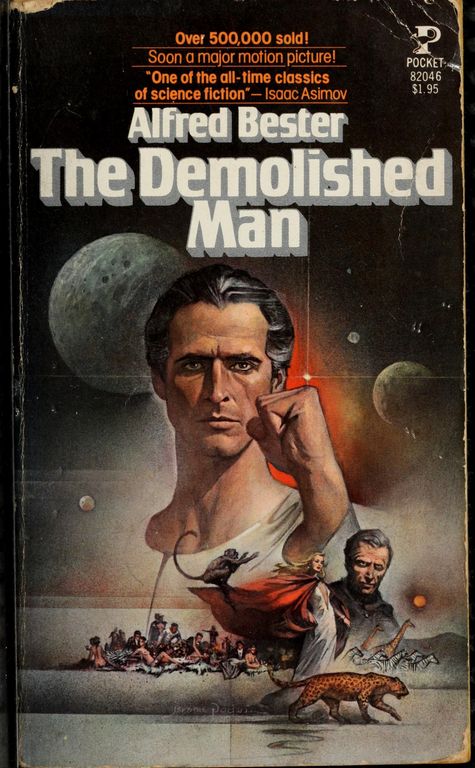
The Demolished Man
Introduction
Nova: Imagine a world where your deepest secrets, your darkest urges, and even your grocery list are public knowledge. Not because of social media, but because the person standing next to you can literally hear your thoughts. That is the world of Alfred Bester's 1953 masterpiece, The Demolished Man.
Nova: That is exactly the point. In this future, there has not been a premeditated murder in over seventy years. Until a man named Ben Reich decides he is going to be the one to break that streak. This book actually won the very first Hugo Award for Best Novel, and it basically laid the groundwork for everything from Philip K. Dick to modern cyberpunk.
Key Insight 1
The World of the Peepers
Nova: To understand the story, we have to look at the society Bester built. It is run by Espers, or Peepers, as the non-telepaths call them. They are organized into a strict guild with three levels. You have your P3s, who can only catch surface flashes. Then the P2s, who are the professional class, like lawyers or mid-level managers. And then you have the P1s.
Nova: Exactly. There are only a few hundred of them in the world. A P1 can peel back the layers of your mind like an onion. They can see your childhood traumas, your hidden motivations, things you have even hidden from yourself. The protagonist's rival, Lincoln Powell, is one of these P1s. He is a high-ranking police officer.
Nova: You would think so! But Bester is brilliant because he shows us the social etiquette of telepathy. It is considered incredibly rude, almost like a physical assault, to deep-peep someone without a legal reason. There is this fascinating tension between the Peepers and the Normals. The Normals are terrified of them, and the Peepers have their own internal politics and ethics.
Nova: Precisely. And Ben Reich is a Normal, but he is also one of the wealthiest, most powerful men in the solar system. He runs Monarch Enterprises, and he is losing a corporate war to a man named Craye D'Courtney. Reich is desperate, he is having these terrifying nightmares about a Man With No Face, and he decides the only way out is to eliminate his competition.
Key Insight 2
The Perfect Crime and the Earworm
Nova: This is where Bester's genius really shines. Reich knows he can't just hide his thoughts through willpower. So he goes to a professional songwriter and asks for the most infectious, annoying, unshakeable jingle ever written.
Nova: It is! The jingle goes: Tension, apprehension, and dissension have begun. It has this repetitive, driving rhythm. Reich just loops it in his head over and over. Whenever an Esper tries to scan him, all they hear is this loud, obnoxious song drowning out everything else. It is like psychic white noise.
Nova: Right. And he does it at a high-society party, using a sophisticated game of Sardines as cover. He manages to kill D'Courtney, but there is a witness: D'Courtney's daughter, Barbara. She flees into the night, traumatized into a catatonic state. Now it becomes a cat-and-mouse game between Reich and Lincoln Powell.
Nova: Oh, he knows. Within minutes of meeting Reich, Powell is certain. But here is the catch: in this future, telepathic evidence is not admissible in court. You can't just say, I heard him think about the murder. You need objective, physical proof. Powell has to prove how Reich did it, why he did it, and find the witness, all while Reich is using every resource of his multi-billion dollar empire to stop him.
Key Insight 3
The Man with No Face
Nova: As the investigation goes on, the book shifts from a police procedural into a deep psychological thriller. Remember that Man With No Face Reich keeps dreaming about? It turns out to be the key to everything. Bester was heavily influenced by Freudian psychoanalysis, which was huge in the fifties.
Nova: Exactly. Powell realizes that Reich's hatred for D'Courtney isn't rational. It is pathological. As Powell digs deeper into Reich's mind, he discovers that Reich and D'Courtney are actually father and son. Reich didn't know this consciously, but his subconscious did.
Nova: And the Man With No Face is Reich's own conscience, or his ego, trying to warn him or punish him. The book uses these amazing typographic tricks to show how telepathic conversations work. The text will weave across the page, or words will be layered on top of each other to show multiple people thinking at once.
Nova: It really does. It makes the mind feel like a vast, chaotic landscape. And as Reich gets more desperate, he starts to lose his grip on reality. He is not just fighting the police; he is fighting his own mind. He starts seeing the Man With No Face in the real world. He is literally being haunted by his own guilt, even though he thinks he is remorseless.
Key Insight 4
Demolition and the Legacy
Nova: Eventually, Powell catches up to him. But the ending is what really sticks with people. In this society, they don't have the death penalty. They don't even really have prisons in the way we think of them. They have Demolition.
Nova: It is terrifying. Demolition is a total psychic stripping. They take the criminal and they systematically peel away every layer of their personality, every memory, every habit, until there is nothing left but a blank slate. It is a psychic reset to infancy.
Nova: The book presents it as a mercy, though. They believe that a man like Reich has a strong, capable mind that just went wrong. By demolishing him, they can rebuild him into a productive, happy member of society. The final scenes show Reich being led away, essentially a newborn in a grown man's body, ready to start over.
Nova: It really is. And you can see the influence of this book everywhere. The Psi Corps in Babylon 5 is a direct descendant of Bester's Esper Guild. In fact, there is a character in that show named Alfred Bester as a tribute. The gritty, corporate-dominated future influenced the entire Cyberpunk movement. Bester took the shiny, optimistic sci-fi of the 40s and dragged it into the dark, psychological shadows of the 50s.
Conclusion
Nova: The Demolished Man is more than just a sci-fi mystery. It is a study of how our environment shapes our morality. In a world where you can't hide, the only way to be a villain is to become a master of self-deception. Ben Reich thought he could beat the system by drowning out his thoughts, but he couldn't drown out his own soul.
Nova: That is the question Bester leaves us with. Are we the masters of our minds, or are we just waiting to be demolished and rebuilt by the world around us? If you haven't read it, the typographic experiments alone make it worth the price of admission. It is a fast-paced, psychedelic trip through the 24th century.
Nova: Tension, apprehension, and dissension, Leo! It is already there. Thank you for joining us on this deep dive into a sci-fi classic.