

The Silent Language: Mastering Non-Verbal Cues for Influence
Golden Hook & Introduction
SECTION
Nova: Atlas, quick question: If your left eyebrow could talk, what do you think it would say about our listeners right now, tuning in to Aibrary?
Atlas: Oh, it would probably be slightly raised, maybe a little skeptical, definitely curious, and perhaps just a tiny bit overwhelmed by their inbox or their complex caseload.
Nova: That’s incredibly specific, and probably spot-on! It brings us perfectly to today’s topic: "The Silent Language: Mastering Non-Verbal Cues for Influence." Because while we’re busy processing words, there’s a whole other conversation happening beneath the surface, isn't there?
Atlas: There absolutely is. And for anyone navigating complex interactions, whether it's a difficult patient inquiry or a high-stakes negotiation, understanding that unspoken dialogue is an absolute game-changer. It’s like having a secret decoder ring for human behavior.
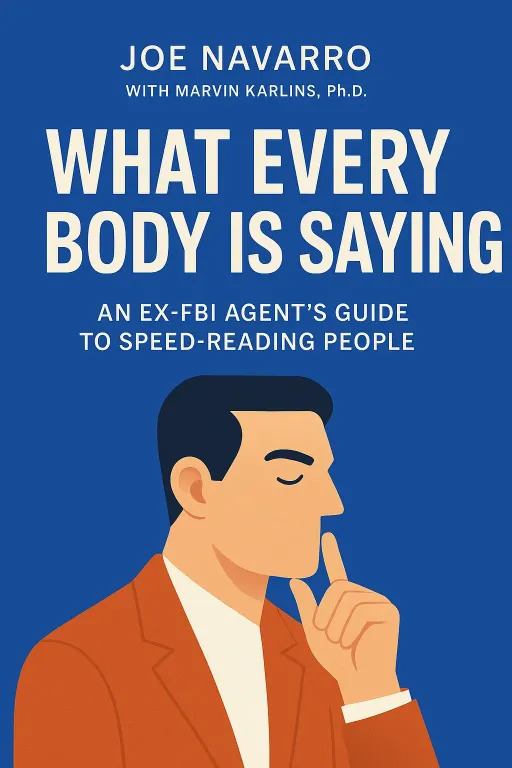
Nova: Precisely. And today, we’re tapping into two profound sources for that decoder ring. First up, we have "What Every Body Is Saying" by Joe Navarro, a former FBI agent specializing in counterintelligence and behavioral analysis. His unique background means his insights aren't just theoretical; they’re battle-tested in situations where misreading a signal could have dire consequences.
Atlas: That’s fascinating. How does an FBI agent’s perspective on body language differ from, say, a traditional psychologist's or a communications expert’s? I imagine the stakes were constantly sky-high for him.
Nova: They were, and that’s what makes his work so potent. His system was developed to detect deception and understand human behavior in critical, often life-or-death, situations. It's about survival and truth detection. Then, we’ll broaden our scope with "The Definitive Book of Body Language" by Allan Pease and Barbara Pease. This widely acclaimed guide offers a more comprehensive, foundational understanding that’s popularized body language for millions. Together, these two perspectives give us a full spectrum view of how to read the silent language.
Atlas: So, we’re going from high-stakes truth detection to a broader, more universal understanding. That sounds like a powerful combination for anyone looking to truly master communication.
Nova: It is. And we’re going to begin with Navarro’s approach, diving into the power of non-verbal clusters.
The Power of Non-Verbal Clusters: Reading Beyond the Single Tell
SECTION
Nova: Think of it this way: a single musical note doesn't make a symphony, right? You need a combination of notes, rhythms, and instruments to create a full, meaningful piece. Navarro argues that non-verbal cues work the same way. A lone gesture, like someone crossing their arms, might mean anything – they're cold, they're comfortable, they're defensive.
Atlas: Exactly. I’ve always heard "crossed arms means they're closed off," but sometimes I just cross my arms because it’s comfortable, or I’m thinking. It always felt like an oversimplification.
Nova: It is. Navarro emphasizes looking for of tells. It's about observing multiple non-verbal behaviors happening simultaneously, or in quick succession, to establish a consistent message. When someone says "yes" with their words, but their shoulders slump, their head slightly shakes, and they touch their neck, that's a cluster loudly whispering "no."
Atlas: That’s a far more nuanced approach. So, it's not about a single "tell" that gives everything away, but a whole chorus of signals.
Nova: Precisely. He breaks it down into categories. For example, —gestures we use to comfort ourselves when stressed or uncomfortable. Think about someone touching their neck, fiddling with jewelry, smoothing their clothes, or stroking their hair. On their own, they might mean little. But if you see a cluster—someone answering a question, and while they're talking, they touch their neck, then cross their legs, and their feet start to tap—that's a strong cluster indicating discomfort or even deception.
Atlas: That makes me wonder about high-stakes negotiations. Everyone in that room is under pressure. How do you distinguish genuine discomfort or fear from, say, a strategic poker face, or just the natural anxiety of the moment? Is it possible to fake these clusters?
Nova: That’s a brilliant question, and it’s where Navarro’s FBI training truly shines. The key is establishing a. You observe someone when they are relaxed and comfortable, discussing mundane topics. That's their normal. Then, you look for deviations from that baseline when a sensitive topic comes up. Are they suddenly exhibiting pacifying behaviors they weren't before? Is their body language incongruent with their words? It’s not about analyzing every single movement, but noticing the and the of those changes across multiple cues.
Atlas: So, it’s like an analyst looking for anomalies in data. You need the normal distribution to spot the outliers. That makes a lot of sense. And what about those leg movements you mentioned? They seem less conscious.
Nova: They are! Leg and foot movements are often the most honest parts of the body because we exert less conscious control over them. Navarro highlights several: if someone's feet are pointed towards the exit, it might indicate a desire to leave. If their legs are rocking rapidly, it could be impatience or anxiety. Conversely, if their legs are splayed wide in a relaxed, open posture, it often signals comfort and a sense of belonging. The more comfortable we are, the less restricted our lower body tends to be.
Atlas: That’s incredible. I mean, we're so focused on facial expressions or hand gestures, but the feet? That’s a whole new layer of insight. So, if I'm observing a team member who says they're fully on board with a new project, but their feet are pointed towards the door and they’re subtly rocking, I should probably dig a little deeper into their true feelings.
Nova: Absolutely. That cluster—verbal affirmation, but restless, exit-oriented leg movements—is a powerful signal that their words and their true intentions might not align. It's about reading the full symphony, not just the melody.
Body Language Universals vs. Cultural Nuances: The Global Dictionary of Silent Signals
SECTION
Nova: And that naturally leads us to a broader, but equally critical, aspect of this silent language: the comprehensive guide offered by Allan and Barbara Pease. While Navarro gives us the high-definition lens for truth detection, the Peases provide the dictionary for understanding the sheer breadth of body language across contexts.
Atlas: Okay, so if Navarro is the FBI profiler, who are the Peases in this analogy?
Nova: They’re the cultural anthropologists and linguists of the body. Their work is widely acclaimed for making body language accessible. They explore both the universal gestures that transcend culture – like a genuine smile, a surprised expression, or the universal signs of fear or sadness – and the more culturally specific nuances.
Atlas: Ah, the universal vs. the local dialect. That’s crucial for anyone working in a global environment or even just diverse teams. I mean, the "OK" sign means positive affirmation in some cultures, but can be a grave insult in others.
Nova: Precisely. And the Peases meticulously document these. They highlight how body language can either perfectly support what's being said, or, more interestingly, directly contradict it, revealing the hidden meaning. Imagine someone saying, "I'm perfectly fine with that decision," but their shoulders are hunched, their arms are crossed tightly, and their head is slightly down. The words are positive, but the body is screaming "no."
Atlas: That incongruence is where the real power lies, isn't it? As an analyst, you're always looking for discrepancies, for data points that don't align. Here, the body is the ultimate data point. But how do you navigate that cultural minefield? If I'm leading a remote team with members from five different countries, am I expected to memorize a global dictionary of gestures?
Nova: Not necessarily memorize every single gesture, but cultivate awareness. The Peases emphasize focusing on the broader, universal signals of comfort and discomfort first, regardless of culture. Open postures, relaxed movements, expansive gestures—these generally signal comfort, trust, and engagement across most cultures. Closed-off postures, fidgeting, shrinking movements—these often signal discomfort, defensiveness, or disinterest, even if the specific expression changes.
Atlas: So, start with the universal human experience of comfort and discomfort, and then layer on cultural specifics if you know them. That seems like a practical roadmap.
Nova: Exactly. And they also delve into the power of mirroring. When two people are in rapport, they often unconsciously mirror each other's body language. It's a sign of agreement and connection. If you’re trying to build rapport, subtly mirroring someone’s posture or gestures can be incredibly effective, but it has to be authentic, not robotic.
Atlas: That’s a fascinating insight, especially for building trust in sensitive conversations. It’s like a silent affirmation of "I'm with you."
Nova: It is. The Peases' work really underscores that body language isn't just about reading others; it's about understanding how our own silent signals impact our interactions and influence. Are we projecting confidence, openness, and trustworthiness, or are we inadvertently sending signals of defensiveness or disinterest?
Synthesis & Takeaways
SECTION
Nova: So, bringing these two giants together, we have Navarro giving us the surgical precision for detecting subtle truths through clusters, and the Peases providing the comprehensive, cross-cultural dictionary for understanding the broader landscape of non-verbal communication.
Atlas: It’s truly about perceiving the full spectrum of communication, isn't it? It’s not just about what’s said, but what’s, and what those unspoken cues reveal about true intentions, agreements, or even hidden fears. For leaders and negotiators, this isn't a soft skill; it’s a hard strategic advantage.
Nova: Absolutely. It’s about cultivating what I call a "third eye" for the unspoken. And for our listeners who are constantly navigating complex information and trying to influence outcomes, what’s the one tiny, actionable step they can take this week to start mastering this silent language without becoming a full-time FBI profiler?
Atlas: I think the key is to shift focus. In your next meeting, whether it’s a team huddle or a one-on-one, try focusing less on the exact words being spoken. Instead, deliberately observe three non-verbal cues from each person.
Nova: And what should they be looking for within those three cues?
Atlas: Look for a. See if those three cues—maybe a hand gesture, a facial micro-expression, and a leg movement—tell a consistent story. Are they all signaling discomfort, or engagement, or disinterest? Or are they contradicting the spoken words? That’s where the real insight for a resilient analyst or a strategic negotiator lies. It’s about building that muscle of observation.
Nova: Exactly. It's about developing that heightened awareness. It’s a skill that builds empathy, sharpens your intuition, and gives you an undeniable edge in any interaction, from the boardroom to the living room. It's truly a pathway to more authentic connections and more effective influence.
Atlas: Because sometimes, the loudest messages are the ones never spoken.
Nova: Absolutely. And that's all for today's deep dive into the silent language of influence.
Atlas: This is Aibrary. Congratulations on your growth!