

Beyond the Words: Unmasking Hidden Meanings in Human Interaction
Golden Hook & Introduction
SECTION
Nova: Most people think they know how to communicate. They focus on words, on crafting the perfect sentence. But what if I told you that over 90% of what you are saying has nothing to do with the words coming out of your mouth?
Atlas: Oh man, I love that. So, the words are just the tip of the iceberg, then, like the conscious veneer over a much deeper, hidden ocean?
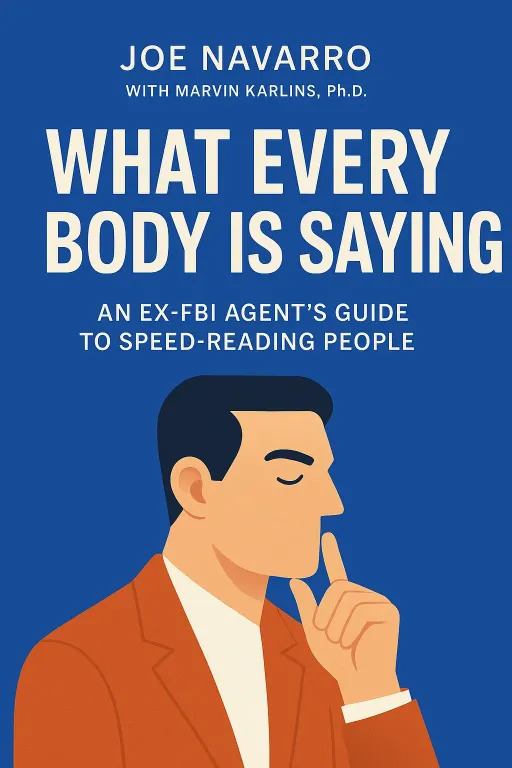
Nova: Exactly. Today, we are ripping back the curtain on that silent, powerful 90%, diving deep into the world of non-verbal communication. Our inspiration comes largely from the groundbreaking work of former FBI agent Joe Navarro and his book, "What Every Body Is Saying." His insights come directly from his experience spotting deceptive behaviors in high-stakes environments, which is just incredible. We are also drawing from Allan and Barbara Pease's seminal work, "The Definitive Book of Body Language."
Atlas: That's fascinating, especially coming from an FBI agent who literally had to read people for a living. It gives it such a practical, real-world edge, not just abstract theory. So, what's the core truth they uncover that most of us completely miss in our daily interactions?
Nova: The cold, hard fact, Atlas, is that words can deceive, but the body rarely lies. It is a silent storyteller, constantly broadcasting our true intentions and emotions, often without us even knowing it.
The Silent Storyteller: Decoding Non-Verbal Cues for True Intentions
SECTION
Nova: Navarro, in particular, breaks down non-verbal cues into what he calls 'tells'—signals that reveal comfort, discomfort, deception, or honesty. But here's the crucial part: he emphasizes observing of behaviors, not isolated movements.
Atlas: So you are saying one gesture alone is not enough to make a judgment? Like, someone crossing their arms does not automatically mean they are closed off or defensive? Because I feel like that is a common misconception.
Nova: Precisely. It is about context and clusters. Think of it like a detective building a case. One piece of evidence is rarely a conviction. But if you see crossed arms, they are leaning away from you, their feet are pointed towards the door, they are perhaps touching their neck—a common pacifying behavior—then you have a strong cluster indicating discomfort or a desire to disengage. It is the combination that paints the true picture.
Atlas: That makes perfect sense. It’s like looking for patterns, not just individual dots. Can you give us a vivid example of a 'tell' that often goes completely unnoticed, something we might be doing ourselves without realizing?
Nova: Absolutely. One of Navarro's most compelling observations is around pacifying behaviors. When we are stressed, anxious, or uncomfortable, our bodies unconsciously try to soothe us. This could be touching our neck, stroking our hair, rubbing our arms, or even fiddling with jewelry. It is an unconscious way for our limbic system—our emotional brain—to calm itself down. I remember a case Navarro described where a suspect, under intense questioning, continuously rubbed their thigh. Verbally, they were calm, composed, even defiant, but their body was screaming distress, a clear pacifying signal.
Atlas: Wow, that’s powerful. So, the verbal and non-verbal can be completely out of sync, and the body is often the more honest messenger. It is almost like a subconscious confession.
Nova: Exactly. The Peases expand on this, providing a comprehensive guide to universal body language signals. They talk about everything from the subtle shifts in hand gestures to the intricate dance of eye movements. Their work really helps build a foundational framework for interpreting human communication, noting that while some signals are universal, you still need to consider cultural nuances.
Atlas: I am curious, how does this ability to read these signals help us detect inconsistencies? Is it about spotting outright lies, or is it something more subtle, more about understanding underlying emotions?
Nova: It is often much more subtle and profoundly insightful. It is about revealing hidden psychological states. Someone might verbally assure you, "I am absolutely fine," but their shoulders are hunched, their eyes are darting around the room, and their hands are clasped tightly, perhaps even clenching. That inconsistency is a massive signal. It tells you there is underlying anxiety, discomfort, or perhaps even a deep fear that their words are simply not expressing. It is not necessarily deception, but it is certainly a hidden truth that impacts the interaction.
From Observation to Insight: Mastering the Art of Non-Verbal Interpretation
SECTION
Nova: That naturally leads us to the second key idea, Atlas: moving from simply these signals to truly them and applying that insight. It is about becoming a truly meticulous observer, a forensic linguist of the body.
Atlas: Okay, so how do we train ourselves to notice these things without becoming, you know, a bit creepy, or just staring at people awkwardly? What's a practical entry point for someone starting out?
Nova: That is the art of it. It starts with conscious observation, choosing one or two specific areas to focus on. The Peases talk about establishing a baseline—how someone normally behaves when they are comfortable and relaxed. Then you look for deviations from that baseline. And here is a tiny, incredibly powerful step our listeners can take today: for the next 24 hours, observe people's feet during conversations.
Atlas: Feet? Really? I have to admit, I have never thought about feet as a primary source of information. That sounds a bit out there.
Nova: Yes, feet are incredibly honest. They are often overlooked and are the furthest from our brain, so we do not consciously control them as much as our facial expressions or hands. Navarro points out that our feet often point to where our true interest lies, or where we truly want to go. If someone's feet are pointed towards the door, even if they are still talking to you and smiling, their limbic system is signaling a clear desire to leave.
Atlas: That is incredible! So, if I am in a meeting and someone's feet are tucked under their chair, pointed at the exit, they are probably done with the conversation, even if they are nodding along politely. It is like their body is already halfway out the door.
Nova: Exactly. Or, if they are talking directly to you, but their feet are angled towards someone else across the room, their interest might be elsewhere, or they are subconsciously trying to engage with that person. It is a powerful, often unconscious, indicator of true engagement or disinterest, a window into their priorities.
Atlas: That is a great practical insight, a real deconstruction of a common scenario. And this is not just about spotting discomfort or deception, it is also about building rapport, right? If you see someone mirroring your posture, for example.
Nova: Absolutely. Mirroring, or isopraxism, is a strong indicator of rapport and connection. When people are comfortable and genuinely connected, they unconsciously adopt similar postures and gestures. It is a non-verbal way of saying, "I am with you," or "I understand you." Learning to read these signals allows you to understand when you have truly connected with someone, or when you need to adjust your approach to build that bridge. It is about becoming a more effective communicator yourself.
Synthesis & Takeaways
SECTION
Nova: So, what we have really explored today, Atlas, is how understanding non-verbal communication transforms every interaction from a simple exchange of words into a rich, multi-layered dialogue. It is about gaining an unparalleled advantage in discerning true intentions and emotions, becoming a modern-day mythic explorer of human behavior.
Atlas: It is more than just reading minds; it is about connecting disparate pieces of information—the verbal and the non-verbal—to get to a deeper, more holistic truth. For anyone who dissects complexity, values empirical observation, and is driven by uncovering hidden meanings, this is a goldmine of insight.
Nova: It truly is. It is about becoming a more meticulous, more empathetic observer of the human condition. And the tiny step of observing feet is just the beginning. Once you start paying attention, you will see a whole new world of communication unfold before you, a world where the unspoken often speaks the loudest.
Atlas: That is actually really inspiring. It is about moving beyond surface phenomena to deeply explore fundamental principles of human interaction, giving us profound insights into how we truly communicate, and how we can better understand each other, even across cultures.
Nova: Precisely. So, our challenge to you, our astute listeners, is to take that tiny step. Observe. See what hidden truths emerge when you start looking beyond the words and truly listen to what the body is saying.
Atlas: And share what you discover! We would love to hear your insights.
Nova: This is Aibrary. Congratulations on your growth!