

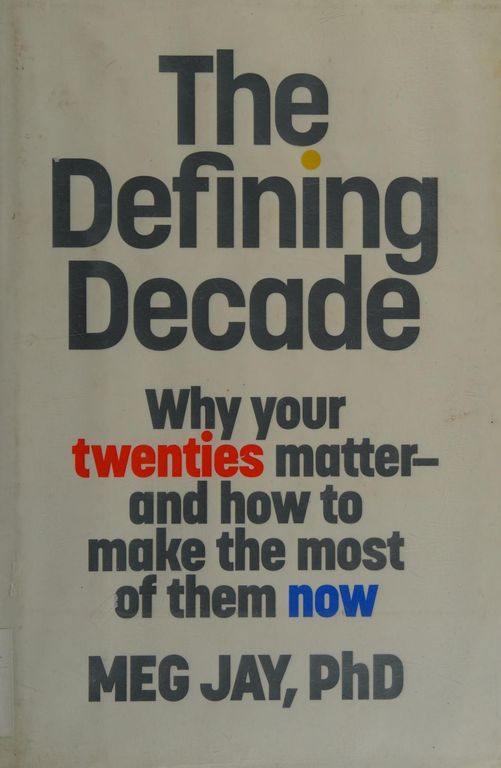
The defining decade
Introduction: Debunking the Twenties Myth
Introduction: Debunking the Twenties Myth
Nova: Welcome to Aibrary, the show where we distill the world's most important ideas into actionable insights. Today, we are tackling a book that throws cold water on the most comforting lie of modern adulthood: 'The Defining Decade' by clinical psychologist Dr. Meg Jay.
Nova: : That lie, Nova, is that our twenties are a time for carefree exploration, a sort of extended adolescence where nothing really counts until you hit thirty. It’s the '30 is the new 20' mantra we hear everywhere.
Nova: Exactly. Jay’s entire premise is that this cultural narrative is not just wrong, it’s actively damaging. She argues that your twenties are, statistically and neurologically, the most pivotal decade of your entire adult life. She says they are not a throwaway decade; they are the defining decade.
Nova: : That’s a bold claim. If I’m in my twenties right now, I feel like I’m constantly being told to 'figure it out later.' What’s the hard evidence she uses to shake us out of this complacency?
Nova: The evidence is staggering. Jay points to research showing that 80 percent of life's most defining moments—the moments that shape your career, your partner, your sense of self—happen by age 35. Think about that. If you’re 25, you’ve already lived through the majority of the moments that will dictate the trajectory of your next fifty years.
Nova: : Wow. Eighty percent by 35. That flips the script entirely. It means the decisions I’m making right now about my job, my friendships, even my apartment lease, are carrying way more weight than I thought.
Nova: They are carrying exponential weight. And that’s what we’re diving into today. We’re going to explore her three main pillars: Career, Love, and Identity, and why intentionality in your twenties beats drifting every single time. Are you ready to stop sliding and start deciding?
Nova: : Absolutely. I need to know how to build 'Identity Capital' before I accidentally build a life I don't want. Let's dive into the science behind why this decade is so powerful.
Key Insight 1: The Brain is Still Under Construction
The Power of Plasticity: Why Your Twenties Are a Biological Superpower
Nova: Let's start with the biology, because this is where Jay grounds her argument. We often think of our brains as fully formed by our early twenties, right? Like a finished piece of software.
Nova: : That’s the common assumption. You graduate college, you’re an adult, your personality is set. You can still learn things, sure, but the core structure is locked in.
Nova: Jay says that’s a myth. She emphasizes that the prefrontal cortex—the part of the brain responsible for planning, complex decision-making, and impulse control—is still developing well into the mid-twenties, sometimes even later. This means your brain is uniquely plastic right now.
Nova: : So, this plasticity isn't just about learning a new language; it’s about fundamentally shaping you are and you think?
Nova: Precisely. It’s the last great window for massive personal change without needing massive, painful intervention later on. If you spend your twenties practicing avoidance, procrastination, or negative self-talk, you are literally wiring those pathways into your mature brain structure.
Nova: : That’s terrifyingly concrete. It's like laying down the electrical grid for your entire adult life, and if you only install cheap, faulty wiring, everything down the line flickers.
Nova: A perfect analogy. And this ties directly into her concept of 'Identity Capital.' She argues that the things you do now—the skills you acquire, the challenges you overcome—are investments that compound. If you avoid challenging work because it’s hard, you aren't just avoiding a tough quarter; you're missing out on compounding identity capital.
Nova: : Identity Capital. That’s a term I want to unpack. It sounds like a bank account for your self-worth, but built on action, not just feeling good about yourself.
Nova: It is. It’s the collection of skills, experiences, relationships, and credentials that make you a more valuable person in the marketplace and in life. And the best time to build that capital is when your brain is most receptive to new learning and habit formation.
Nova: : So, if I’m 23 and I take a job that pays slightly less but has an incredible mentor and forces me to learn a complex new software system, that’s a better investment than a cushy, easy job that pays 20% more?
Nova: Jay would say, unequivocally, yes. Because the salary is a temporary gain, but the skill set and the network you build—that’s capital that appreciates over decades. You are literally investing in the future version of yourself.
Nova: : It forces you to think long-term, which is the opposite of what our culture encourages. We’re trained to optimize for the next paycheck or the next social media post.
Nova: And that leads us perfectly into the career chapter. Because if you understand the brain science, you understand why the choices you make about work in your twenties are so profoundly impactful. It’s not just about money; it’s about neurological scaffolding.
Key Insight 2: The First Job is a Launchpad, Not a Destination
Career Capital: Choosing Growth Over Comfort
Nova: Let's talk careers. Jay is very clear: don't wait for passion to strike. Passion often follows competence. The goal in your twenties is to acquire as much Identity Capital as possible, and the workplace is the primary factory for that.
Nova: : I remember reading that she advises against the 'exploration' mindset where people hop jobs every year looking for the perfect fit. She calls that 'drifting.'
Nova: Exactly. Drifting is the enemy. She contrasts the 'Explorer' mindset with the 'Explorer with a Map' mindset. The Explorer just wanders aimlessly, hoping to stumble upon a treasure. The Explorer with a Map is actively seeking specific skills, mentors, and challenges that build capital.
Nova: : But what about the economic reality? Many people in their twenties are saddled with debt and need to prioritize salary just to survive, let alone thrive. How does Jay address that tension?
Nova: She doesn't ignore it, but she reframes the cost. She’d argue that the cost of building capital is far higher in the long run. Imagine two people, both starting at $50,000. Person A takes the easy job, learns nothing new for five years. Person B takes the harder job, learns advanced data analytics, and builds a strong professional network. By age 30, Person B’s capital allows them to jump to $85,000, while Person A might only get a $5,000 raise.
Nova: : That’s the compounding effect in action. The initial sacrifice pays massive dividends because the skills are transferable and valuable.
Nova: She also stresses the importance of 'weak ties'—your acquaintances, not your best friends. Your weak ties are often the source of new opportunities. If you’re constantly moving jobs or staying in your comfort zone, you aren't building that diverse network of weak ties that opens doors later.
Nova: : I always thought networking was this sleazy, forced activity. Jay makes it sound like a natural byproduct of being engaged and competent.
Nova: It is. If you are genuinely trying to learn and contribute, people want to connect with you. She emphasizes that the first few jobs should be viewed as apprenticeships, even if they don't have that title. Are you learning? Are you being challenged? Are you meeting people who are 10 years ahead of you?
Nova: : And if the answer is no, even if the pay is decent, you’re essentially taking a pay cut on your future self. It’s a tough pill to swallow when you’re looking at rent.
Nova: It is. But the core message is: Be intentional about you are learning, not just you are working. Don't let your twenties be defined by inertia. Inertia is the default setting for the uninspired twentysomething. You have to actively fight it.
Nova: : So, instead of asking, 'What job do I want forever?' the better question is, 'What skills do I need to acquire in the next two years to make my 30-year-old self unstoppable?'
Nova: Precisely. And that intentionality is what separates those who thrive from those who feel stuck when they hit their thirties.
Key Insight 3: The Danger of Relationship Inertia
Love and Commitment: Deciding, Not Sliding
Nova: Now we move to perhaps the most controversial area: love and relationships. Jay takes aim at the idea that you should 'date around' until you’re 30, treating commitment as something to be postponed indefinitely.
Nova: : This is where I think a lot of people push back. We’re told to 'find ourselves' before we find someone else. Why is delaying commitment so dangerous, according to her research?
Nova: She points to the data on cohabitation and marriage timing. She cites studies showing that couples who move in together they are seriously committed—before they have a shared vision or have discussed the 'wicked problems' of life—have significantly higher divorce rates later on. They 'slide' into commitment rather than 'decide' on it.
Nova: : Sliding versus deciding. That’s a powerful dichotomy. What does 'sliding' look like in practice?
Nova: Sliding is when you keep moving in together because it’s convenient, or you stay in a relationship because breaking up is awkward, or you avoid the hard conversations about money, kids, or career moves because you’re afraid of conflict. You let inertia carry you into a major life decision.
Nova: : So, the relationship just accumulates momentum without ever passing a conscious checkpoint of, 'Yes, this is the person I choose, despite the known flaws and challenges.'
Nova: Exactly. And Jay argues that your twenties are the prime time to develop the skills to. Deciding requires confrontation, communication, and clarity—all things that build Identity Capital in the relationship sphere.
Nova: : She also touches on the idea that if you spend your twenties avoiding commitment, you might find yourself deeply dissatisfied later. I recall a statistic about those who avoided commitment in their dating lives.
Nova: Yes, that’s a striking one. A study she references found that of those who remained single—who dated or hooked up but avoided serious commitments throughout their twenties—a massive 80 percent were dissatisfied with their dating lives later on, and only about 10 percent didn't wish they had a partner.
Nova: : Eighty percent dissatisfaction! That’s a huge red flag against the 'wait until you’re ready' philosophy. It suggests that the skills of forming deep bonds are learned through practice, not through passive waiting.
Nova: They are learned through practice, and that practice needs to happen when your brain is most capable of forming those deep, secure attachments. If you wait until 35, when your brain is less plastic and your life is more complicated with established routines and perhaps children, those relationship challenges become exponentially harder to solve.
Nova: : It sounds like the advice isn't 'marry young,' but rather, 'be intentional about your relationships now, whether that means committing fully or ending things cleanly so you can find the right person.'
Nova: That’s the nuance. It’s about agency. Don't let the relationship happen you. Decide what you want, communicate it, and if the other person isn't on the same page, you need the courage to walk away and keep searching, rather than sliding into a mediocre partnership out of fear of being alone.
Actionable Takeaways for Intentional Living
Conclusion: From Drift to Design
Nova: We’ve covered a lot of ground today, from neurological plasticity to the pitfalls of relationship inertia. If we boil down Dr. Meg Jay’s 'The Defining Decade' into a single, actionable mandate, what is it?
Nova: : It has to be: Stop treating your twenties as a dress rehearsal. Every choice—the job you take, the people you invest time in, the habits you form—is setting the foundation for the next fifty years. The biggest takeaway for me is the concept of Identity Capital: actively seek out experiences that make you more competent, more connected, and more confident.
Nova: I agree. And to build on that, I want to emphasize the counter-intuitive nature of her advice. Don't wait for confidence to act; act to gain confidence. Don't wait for passion to find a career; build competence to unlock passion. And don't slide into commitment; decide with intention.
Nova: : It’s about embracing the difficulty. Jay makes it clear that this decade feel hard because you are doing the heavy lifting of life design. If it feels easy, you’re probably drifting.
Nova: That’s a fantastic summary. For our listeners who feel overwhelmed, remember the 80% rule: 80% of your defining moments happen by 35. You are not behind; you are right on time to start building. Pick one area—career, love, or personal growth—and commit to one intentional decision this month, rather than letting inertia decide for you.
Nova: : That’s the perfect call to action. Move from passive acceptance to active design. It’s about taking ownership of the fact that these years are, indeed, defining.
Nova: They are defining, and they are fleeting. Don't waste the superpower of your plastic brain. Thank you for joining us on this deep dive into the crucial years. We hope this has given you the push you needed to stop waiting for life to happen to you.
Nova: : Indeed. We’ve armed you with the research; now go build that capital.
Nova: This is Aibrary. Congratulations on your growth!