

The decision book
Introduction
Nova: Did you know that the average adult makes about thirty-five thousand conscious decisions every single day? That is roughly two thousand decisions per hour, or one every two seconds while we are awake. It is no wonder we all feel a bit of decision fatigue by the time we have to choose what to watch on Netflix.
Atlas: Thirty-five thousand? That sounds like a full-time job in itself. I feel like I spent half of those just deciding whether to hit the snooze button or not this morning. But that is the thing, right? We are constantly choosing, yet most of us have no system for it. We just wing it.
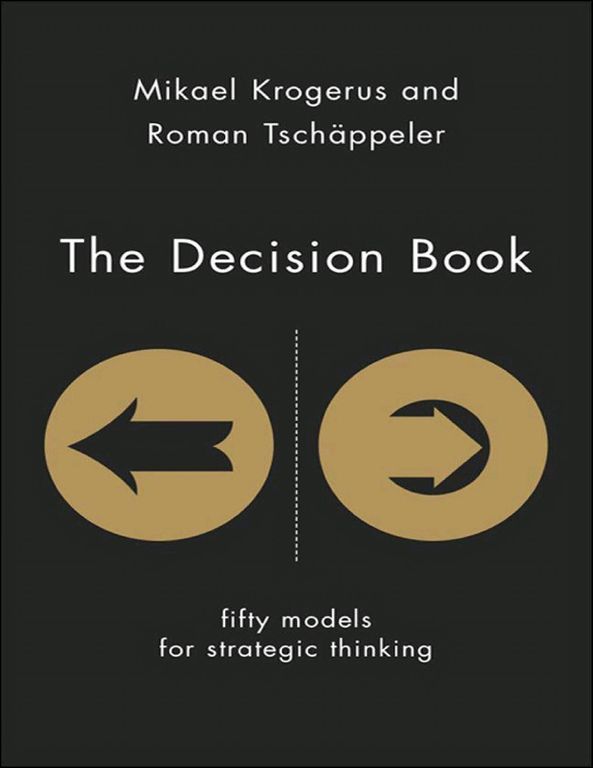
Nova: Exactly. And that is where Mikael Krogerus and Roman Tschäppeler come in. They wrote this fascinating, compact little guide called The Decision Book: Fifty Models for Strategic Thinking. It is essentially a visual toolkit designed to help us stop winging it and start using the same frameworks that top CEOs and strategists use, but applied to our actual lives.
Atlas: I have seen this book. It looks like a little black notebook, right? Almost like a Moleskine. It does not look like your typical dense business tome. So, are they actually saying we can solve our mid-life crises with a 2x2 matrix?
Nova: In a way, yes. They argue that while models are not reality, they are executive summaries of complex situations. They help us strip away the noise so we can see the signal. Today, we are going to dive into some of their most iconic models and see if they can actually make those thirty-five thousand daily choices a little less exhausting.
Atlas: I am ready. I need all the help I can get before I have to decide what to have for dinner.
Key Insight 1
The Art of the Minimalist Model
Nova: Before we get into the specific models, we have to talk about the philosophy behind the book. Mikael Krogerus is a journalist and Roman Tschäppeler is a creative producer. They are not academic theorists. They are distillers. Their whole goal was to take these complex MBA-style frameworks and make them visual and fast.
Atlas: I like that. Usually, when people talk about strategic thinking, my brain immediately goes to expensive consultants in suits and 100-page slide decks. You are saying they have boiled that down?
Nova: Precisely. The book is divided into four main sections: how to improve yourself, how to understand yourself better, how to understand others better, and how to improve others. It is very pragmatic. They start from the premise that most of us are overwhelmed by information but starved for wisdom.
Atlas: That hits home. We have more data than ever, but I do not feel any more certain when I am making a big career move or even just trying to manage my schedule. Why do they think models are the answer specifically?
Nova: They use a great analogy. Imagine you are in a new city without a map. You can wander around and eventually find your way, or you can look at a map which simplifies the terrain into lines and dots. The map is not the city, but it is a hell of a lot more useful than a photograph of every single brick. Models are the maps for our decisions.
Atlas: So, it is about simplification. But is there a danger there? If you simplify too much, do you not lose the nuance of real life?
Nova: That is the big critique of models, and the authors address it. They say a model does not provide the answer; it provides a structure for you to find your own answer. It is a way to organize your thoughts so you are not just circling the same drain of indecision. One of the first models they introduce is something called the Eisenhower Matrix, which most people think they know, but few actually use correctly.
Atlas: Oh, I have heard of that one. It is the urgent versus important thing, right? But honestly, in my life, everything feels both urgent and important. How do they suggest we break that cycle?
Nova: The authors point out that we often fall into the trap of the urgent. We react to the ping of a notification or a last-minute request because it feels pressing. But the Eisenhower Matrix forces you to draw a box. You have four quadrants: Urgent and Important, Not Urgent but Important, Urgent but Not Important, and neither. The secret sauce is the Not Urgent but Important quadrant. That is where growth happens. That is exercise, long-term planning, and building relationships.
Atlas: And I am guessing most of us ignore that box because nobody is screaming at us to do it today.
Nova: Exactly. The book teaches you that if you do not consciously schedule time for that quadrant, the urgent-but-unimportant tasks will eat your entire life. It is a simple 2x2 square, but seeing it on paper makes it harder to lie to yourself about how you are spending your time.
Key Insight 2
Understanding Your Internal Tug-of-War
Atlas: Okay, so that is time management. But what about those bigger, more emotional decisions? Like, should I quit my job? Or should I move to a new city? Those are not really about urgency; they are about fear and desire. Does the book have a model for that kind of internal mess?
Nova: It does, and it is one of my favorites. It is called the Rubber Band Model. Imagine you are standing between two poles, and you have a giant rubber band around your waist. One pole represents what is holding you back, and the other represents what is pulling you forward.
Atlas: That is an interesting visual. Usually, we just do a pros and cons list, which feels very dry. How is this different?
Nova: A pros and cons list is often binary. It is positive versus negative. But the Rubber Band Model asks two different questions: What is holding me? And what is pulling me? The holding part is not necessarily a con. It might be security, a good salary, or a sense of belonging. The pulling part is the attraction of the new.
Atlas: So it is not just good versus bad. It is why am I staying versus why do I want to go?
Nova: Right. It acknowledges that there are valid reasons for both. Sometimes we feel guilty for wanting to leave a good situation. The model helps you realize that the tension is natural. If the pull is stronger than the hold, you move. If the hold is stronger, you stay and stop agonizing over it. It validates the emotional weight of both sides.
Atlas: That feels much more human. It is less about being a robot weighing weights and more about acknowledging that we are stretched in different directions. What about when you are stuck in a situation where you feel like you are failing? Is there a model for analyzing your own weaknesses without just feeling like a failure?
Nova: They suggest using the SWOT Analysis, but applying it to yourself. SWOT stands for Strengths, Weaknesses, Opportunities, and Threats. Usually, companies use this to analyze their market position, but Krogerus and Tschäppeler say you should do it for your personal life.
Atlas: That sounds a bit corporate. How do I look at my own life as a SWOT analysis?
Nova: Think of it this way. Strengths and Weaknesses are internal. They are about you. Your skills, your habits, your personality. Opportunities and Threats are external. They are about the world around you. Maybe a new technology is a threat to your current job, but an opportunity for a new one. By mapping it out, you stop seeing a weakness as just a personal flaw and start seeing it as a strategic factor you can manage.
Atlas: So if I am a terrible public speaker, that is a weakness. But if my industry is moving toward more video content, that becomes a serious threat if I do not address it. I see how that connects the internal to the external.
Nova: Precisely. It turns self-reflection into a strategy session. It takes the sting out of it because you are looking at it like a puzzle to be solved rather than a character judgment.
Key Insight 3
The BCG Matrix for Your Life
Atlas: I remember seeing something about a BCG Matrix in the book. I think I learned about that in a marketing class once. It had stars and dogs in it? How on earth does that apply to a person?
Nova: The BCG Matrix, or the Boston Consulting Group Box, is traditionally used for product portfolios. You have Stars, Cash Cows, Dogs, and Question Marks. But in The Decision Book, they suggest using it to evaluate how you spend your energy and resources across different projects or even hobbies.
Atlas: Wait, so I am a product now? Okay, walk me through the categories. Who are the Stars?
Nova: Stars are the things you do that have high growth potential and you already have a high share of success in. These are your big wins. You should invest heavily here. Cash Cows are the things that are stable. They do not require much growth, but they provide the resources for everything else. Maybe that is your steady day job that pays the bills but is not necessarily your passion.
Atlas: Okay, I get those. But what about the Dogs? That sounds harsh.
Nova: Dogs are the low-growth, low-return activities. These are the things that take up time but give you nothing back. Maybe it is a toxic friendship or a hobby you have outgrown but still do out of habit. The model says: get rid of them. Liquidate the Dogs.
Atlas: I love that. Sorry, I cannot come to your brunch, you are a Dog in my BCG Matrix. And the Question Marks?
Nova: Question Marks are the wild cards. High growth potential, but you have a low share right now. This is a new skill you are just starting to learn. You do not know yet if it will become a Star or a Dog. The strategy here is to either invest big to turn it into a Star or cut it loose before it becomes a Dog.
Atlas: It is a really cold-blooded way to look at your life, but honestly, it is probably necessary. We all have those Question Marks we have been flirting with for years without actually committing.
Nova: That is the power of the visual. When you plot your life onto that grid, you often realize you have way too many Question Marks and not enough Stars. It forces a decision. The book is full of these. They even cover the Prisoner's Dilemma to help you understand why people do not cooperate even when it is in their best interest.
Atlas: I have heard of that one from game theory. Two prisoners, if they both stay silent they get a light sentence, but if one rats the other out, they go free while the other gets the book thrown at them. It usually leads to both ratting each other out and getting a worse result than if they just trusted each other.
Nova: Exactly. And the authors apply this to everyday trust issues. Like, why do colleagues compete instead of collaborating? Or why do couples get into cycles of blame? It shows that sometimes our individual rational choices lead to a collective disaster. Understanding the model helps you see the trap before you fall into it. It encourages you to be the one who breaks the cycle and chooses cooperation.
Key Insight 4
The Pitfalls of Knowledge and the Power of Choice
Atlas: We have talked about all these tools for making choices, but does the book talk about the choices we already made that we might be regretting? Because that is a huge part of decision fatigue, just ruminating on the past.
Nova: It does. They dive into Cognitive Dissonance. This is that uncomfortable feeling when your actions do not match your beliefs. Like if you believe you are a healthy person but you just ate an entire box of donuts. We usually deal with this by making up excuses, right? I had a hard day, I will start tomorrow.
Atlas: I am an expert at those excuses. I could win an Olympic medal in justification.
Nova: We all are! But the model in the book helps you identify when you are doing it. It shows that you have three choices: change your behavior, change your belief, or add a new belief to bridge the gap. By seeing it as a model, you can catch yourself in the act of rationalizing and ask, wait, am I actually okay with this, or am I just lying to myself to avoid the pain of change?
Atlas: That is deep. It is like the book is half business manual and half therapy session. But let me challenge this for a second. If I am carrying around this book of fifty models, am I not just going to spend more time picking the right model than actually making the decision? Is there a risk of paralysis by analysis?
Nova: That is a very valid point. The authors actually include a model for that too, called the Choice Overload model. It explains that while we think we want more options, having too many actually makes us less likely to choose and less satisfied with the choice we do make. Their advice is to use the book as a reference, not a checklist. You do not use all fifty models for every decision. You find the one that fits your specific brand of stuckness.
Atlas: So it is more like a toolbox. You do not use a hammer, a saw, and a screwdriver to hang a picture. You just grab the hammer.
Nova: Precisely. And they emphasize that the goal is not to be perfect. One of the models is the Pareto Principle, the 80/20 rule. Eighty percent of your results come from twenty percent of your efforts. In decision making, it means that a good-enough decision made quickly is often better than a perfect decision made too late.
Atlas: I think that is a lesson many of us overthinkers need to hear. So, if someone wants to start using this book today, what is the best way to dive in? Do you read it cover to cover?
Nova: You certainly can, it only takes about an hour or two because it is so visual. But the best way is to keep it on your desk. When you feel that knot in your stomach because you have a tough choice, flip through the table of contents. Are you trying to understand yourself? Flip to that section. Trying to lead a team? Go there. It is designed to be a companion. It is also filled with blank spaces and diagrams you are supposed to draw on. It is an active book, not a passive one.
Conclusion
Nova: We have covered everything from the urgency of the Eisenhower Matrix to the emotional tension of the Rubber Band Model and the strategic ruthlessness of the BCG Matrix. The common thread here is that decisions do not have to be mysterious. They do not have to be something that just happens to us.
Atlas: It really feels like the takeaway is that we have more agency than we think. If we can map out our problems, we can solve them. Or at least, we can understand why they are hard to solve, which is half the battle. I am definitely going to look at my to-do list through that Eisenhower lens tomorrow and see what I can actually delete.
Nova: That is the spirit. The Decision Book by Mikael Krogerus and Roman Tschäppeler reminds us that while we cannot control everything that happens in our lives, we can control the frameworks we use to process it. By simplifying the complex, we find the clarity to actually act.
Atlas: And maybe, just maybe, I will only have to make thirty-four thousand nine hundred and ninety-nine conscious decisions tomorrow because one of them will already be handled by a model.
Nova: One step at a time! If you are feeling overwhelmed by the sheer volume of choices in your life, pick up this little black book. It might just give you the map you need to navigate the chaos. Thank you for joining us on this deep dive into the world of strategic thinking.
Atlas: I am definitely feeling more strategic already. Or at least, I have a cool new way to categorize my friends who keep cancelling on me. See you next time.
Nova: This is Aibrary. Congratulations on your growth!