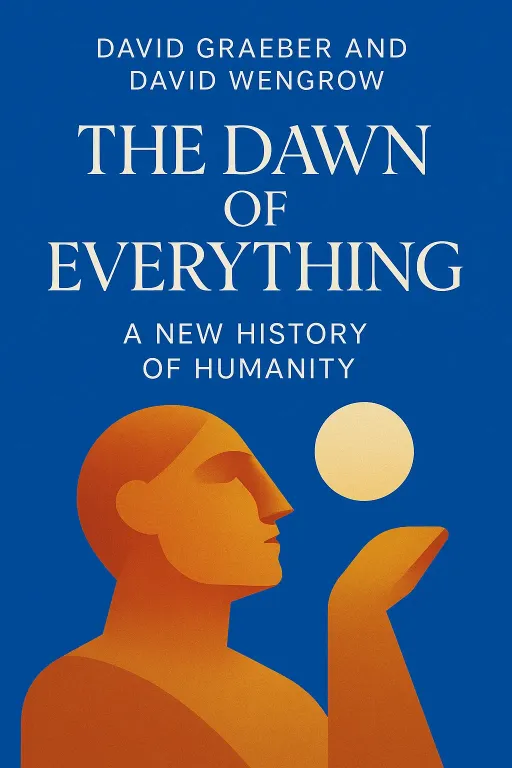
Rebooting Civilization: Why Our Past is a Blueprint for the Future
13 minGolden Hook & Introduction
SECTION
Prof. Eleanor Hart: We tend to think of human history as a one-way street. We started in small, simple bands, invented agriculture, built cities, and inevitably ended up with states, hierarchies, and inequality. It seems like a logical, unchangeable progression. But what if that entire story is a myth? What if our ancestors were not naive primitives, but sophisticated political actors who experimented with countless forms of social organization, many of them radically free and egalitarian?
Prof. Eleanor Hart: That's the explosive premise of 'The Dawn of Everything,' and it's what we're exploring today with our guest, thrandy. Welcome.
thrandy: Thanks for having me, Eleanor. It's a fascinating topic.
Prof. Eleanor Hart: I thought it would be perfect for you. As a consultant who analyzes and redesigns complex systems, this book feels like the ultimate consulting report on human society. It argues we've been working from a flawed project brief for centuries.
thrandy: That's exactly how it struck me. It’s about questioning the foundational assumptions before you even start to solve the problem. If the initial diagnosis is wrong, any solution you build on top of it will be flawed. I'm excited to dig in.
Prof. Eleanor Hart: Excellent. Today we'll dive deep into this from two perspectives. First, we'll deconstruct the myths that have trapped our thinking about society and uncover the powerful 'indigenous critique' that started it all. Then, we'll explore mind-bending examples of ancient societies that were masters of social experimentation, treating their political systems like flexible software.
Deep Dive into Core Topic 1: The Great Unlearning & The Indigenous Critique
SECTION
Prof. Eleanor Hart: So let's start with that flawed brief. The book argues we're stuck between two tired stories about our origins. Either we lived in an age of childlike innocence and fell from grace, that's the Rousseau story. Or we lived in a state of constant, brutal violence and were saved by the state, which is the Hobbesian view. Graeber and Wengrow say both are wrong, and they distract us from a much more interesting conversation that was happening in the 17th and 18th centuries. A conversation sparked by what they call the 'indigenous critique.'
thrandy: And this critique wasn't just a passing comment, right? It was a sustained intellectual argument.
Prof. Eleanor Hart: Precisely. And the book gives us a stunning protagonist for this story: a real historical figure named Kandiaronk. Picture this: it's the late 1600s in French-controlled North America. Kandiaronk is a statesman and orator from the Wendat people, renowned for his brilliant mind. He engages in a series of debates with a French aristocrat, Baron de Lahontan, who was so impressed he published them in a book that became a bestseller across Europe.
thrandy: So this isn't some romanticized fantasy. This is documented history.
Prof. Eleanor Hart: It is. And Kandiaronk's arguments were devastating. He looked at French society and was appalled. He saw a people obsessed with money, riddled with inequality, constantly competing, and fundamentally unfree. He couldn't understand why some people had everything while others begged in the streets. To the Wendat, who valued mutual aid, this was a sign of profound moral failure.
thrandy: A failure of the system's basic programming.
Prof. Eleanor Hart: Exactly. And he pinpointed the cause. He said, and this is a near-direct quote from the dialogues, "I affirm that what you call money is the devil of devils; the tyrant of the French, the source of all evils... Fathers sell their children, husbands their wives... brothers kill each other, friends are false, and all because of money." He argued that the very concepts of 'mine' and 'thine'—private property—were the root of this inhumanity.
thrandy: Wow. So it's not just a moral critique; it's a systems analysis. Kandiaronk is essentially saying the European 'operating system' is built on a logic of private property and money, which inevitably produces anti-social outcomes like competition, inequality, and a lack of freedom. He's identifying the root cause, not just the symptoms.
Prof. Eleanor Hart: He is. He concludes that a man motivated by self-interest, by money, simply cannot be a man of reason or wisdom. For the Wendat, the core tenets of humanity were wisdom, reason, and equity. And he saw that the European system made those virtues impossible. This critique, the book argues, was a profound shock to European intellectuals and directly fueled the Enlightenment's debates on freedom and equality.
thrandy: And that connects directly to how we design systems today, even in technology and AI. We create algorithms and platforms that are optimized for metrics like 'user engagement' or 'quarterly profit.' These are just modern proxies for 'money' and 'interest.' Kandiaronk's critique forces us to ask a really uncomfortable question: what if we optimized for 'reason,' or 'equity,' or 'mutual aid' instead? What would that AI, or that social platform, or even that logistics network look like? It's a fundamental design question.
Prof. Eleanor Hart: It changes the entire goal of the project. It's a call for empathy in design, to understand the human consequences of the code you're writing, whether that code is legal or digital.
thrandy: Right. It's about defining 'success' differently. Kandiaronk was telling the French, 'Your system is succeeding at the wrong things.' That's a critique we could certainly apply to many of our own systems today.
Deep Dive into Core Topic 2: Humanity as Social Designers
SECTION
Prof. Eleanor Hart: And that's the perfect bridge to our second point. Kandiaronk's society, with its emphasis on freedom and debate, wasn't just a lucky accident. The book argues it was the product of conscious social design. This idea that our ancestors were political innovators is perhaps the book's most hopeful and radical message. They weren't stuck.
thrandy: They were actively experimenting. They were social engineers.
Prof. Eleanor Hart: Yes! And the book is filled with incredible examples. One of my favorites is what they call 'seasonal dualism,' which was common among certain Plains Indian tribes like the Cheyenne and Lakota in the 19th century.
thrandy: Seasonal dualism? What does that mean?
Prof. Eleanor Hart: It means they switched their entire political system depending on the time of year. For most of the year, they lived in small, dispersed, highly egalitarian bands. There were no real leaders with coercive power. But in the summer, they all came together for the great bison hunt. This was a massive logistical operation that required coordination.
thrandy: Like managing a supply chain during peak season.
Prof. Eleanor Hart: Exactly. And to manage it, they transformed their society. They appointed a council, they designated warrior societies to act as a police force with the authority to punish or even kill anyone who broke the rules of the hunt. For that short period, they organized themselves almost like a state.
thrandy: So they temporarily adopted a hierarchical model for a specific, high-stakes task.
Prof. Eleanor Hart: Correct. But—and this is the crucial part—the moment the last hunt was over, they consciously and deliberately dismantled the entire structure. The police force dissolved. The leaders lost their coercive power. Everything went back to the default egalitarian mode. They even rotated which groups got to be in charge each year, to ensure no one held onto power for too long.
thrandy: That is incredible. It's a system with a built-in reset button. In logistics, we design networks for peak season, but we don't usually design the to dissolve afterwards. They built a system that was both highly efficient for a specific task and resilient against the long-term corruption of power. The flexibility is the key feature. It's a feature, not a bug.
Prof. Eleanor Hart: The book calls it 'political self-consciousness.' They could see the pros and cons of different systems because they literally lived them. They understood that hierarchy could be a useful tool, but a dangerous master. They weren't trapped in one way of being.
thrandy: It makes you wonder about our own rigid structures. We have one model—the year-round, hierarchical corporation, or the permanent state. We assume it has to be that way. The idea of consciously adopting different organizational structures for different 'seasons' or tasks is radical. It's a form of institutional creativity we seem to have lost. We've forgotten how to play with the rules.
Prof. Eleanor Hart: And the book shows this wasn't just a one-off. They point to early cities like Teotihuacan in Mexico, which around 300 AD seems to have undergone a revolution. It went from building giant pyramids and performing human sacrifices—the hallmarks of a budding monarchy—to suddenly stopping all of that and redirecting its resources to build high-quality apartment housing for nearly its entire population. It consciously re-architected its social contract.
thrandy: They chose social welfare over monumental power. They changed their own system, mid-stream. That’s a powerful precedent.
Synthesis & Takeaways
SECTION
Prof. Eleanor Hart: It really is. So we have these two powerful ideas from the book. First, that the most trenchant critique of our society's flaws came from the outside, from indigenous thinkers who valued freedom and reason above all. And second, that for most of our history, humans have been incredibly creative social designers, not just passive subjects of an evolutionary storyline.
thrandy: For me, the biggest lesson is about not getting 'stuck.' Whether you're a consultant designing a supply chain, a developer coding an algorithm, or just a citizen thinking about society, the book forces you to ask: Are the current rules the only possible rules? We've inherited one particular model of social organization, but history shows us there's a whole library of alternatives. The real work is to reclaim that political creativity.
Prof. Eleanor Hart: A beautiful summary. It’s not about trying to copy the past, but about realizing that the future is more open than we think.
thrandy: Exactly. It's about expanding our sense of what's possible.
Prof. Eleanor Hart: A powerful thought. So the question we leave our listeners with is this: In your own world, your workplace, your community... where are you stuck in a system you assume is unchangeable, and what would it look like to start experimenting again?
thrandy: A question worth asking.
Prof. Eleanor Hart: thrandy, thank you so much for this insightful conversation.
thrandy: Thank you, Eleanor. It was a pleasure.