Beyond the Surface: Decoding the Archeological Clues to Human Nature
10 minGolden Hook & Introduction
SECTION
Nova: What if I told you that much of what you think you know about human history, about how societies naturally 'progressed' from simple to complex, is not just incomplete, but fundamentally flawed?
Atlas: Whoa, Nova, that's a bold claim right out of the gate. Are we talking about a conspiracy theory or something a bit more... academic? Because frankly, the idea of linear progress feels pretty ingrained. You know, from hunter-gatherers to city-states, to... well, us.
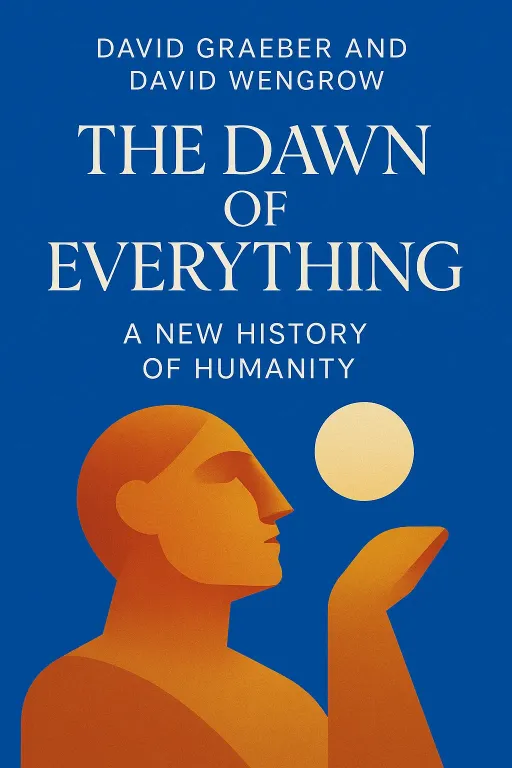
Nova: Absolutely not a conspiracy, Atlas, but definitely academic, and utterly paradigm-shifting. Today, we're diving into the brilliant, often provocative work of the late anthropologist David Graeber, particularly his monumental collaboration with archaeologist David Wengrow,. It's a book that's been widely acclaimed for its intellectual ambition and its rigorous challenge to conventional narratives, though it definitely stirred the pot among more traditional historians.
Atlas: Graeber... I recognize that name. Wasn't he also behind that incredible book on debt?
Nova: Exactly! He was a prolific thinker, an anarchist anthropologist who had this incredible knack for connecting the dots between ancient history, economic systems, and fundamental human freedoms. His background gave him this unique lens, allowing him to see patterns and challenge assumptions that others often missed, making his work a critical read for anyone looking to build robust, ethical ecosystems.
Atlas: I'm all about challenging assumptions. As someone who's always looking for patterns and a holistic approach to building, this sounds like it's right up my alley. So, what's the big 'blind spot' we've been missing?
The Myth of Linear Progress in Human Societies
SECTION
Nova: The blind spot, Atlas, is our deeply entrenched assumption that human societies followed a single, almost inevitable path. We tend to think of early humans as either 'noble savages' living in idyllic egalitarianism or 'brutal tyrants' locked in constant struggle, both destined to evolve into complex, hierarchical states. But Graeber and Wengrow, through a dazzling array of archaeological evidence, show that this simply isn't true.
Atlas: Wait, are you saying early human societies weren't just simple tribes waiting to become empires? Because that's pretty much what I learned in every history class. How can you have complex societies without hierarchy?
Nova: That's precisely what they challenge. They reveal a much richer, more varied history of human organization. For millennia, our ancestors were experimenting with diverse forms of social structures, shifting between them, sometimes even seasonally. Imagine communities that were egalitarian during one part of the year, perhaps for hunting, then adopted more hierarchical structures for building monumental architecture, only to dissolve those hierarchies again.
Atlas: So it's like a seasonal organizational chart? That's fascinating. Can you give me an example? Because for someone trying to build an adaptable, innovative team today, the idea of intentionally shifting structures sounds revolutionary, but also incredibly complex to manage.
Nova: Absolutely. Consider the example of the Kwakiutl people of the Pacific Northwest. During the winter ceremonial season, they were highly hierarchical, with chiefs, slaves, and elaborate rituals, almost like a theatrical production of power. But come summer, when they dispersed for foraging, those hierarchies would largely dissolve. People would joke about the 'chief' who was suddenly just another fisherman. They weren't stuck; they chose the social structure that best suited their current needs.
Atlas: That makes me wonder, how did they? Was there a formal vote? Did they just... agree? Because in our modern context, trying to get people to even agree on a meeting time can be a challenge, let alone fundamentally shifting power dynamics twice a year.
Nova: That's a great question. It wasn't always a formal vote as we understand it. Often, it was a cultural understanding, a shared narrative, or even a deliberate rejection of certain forms of power. They observed what worked and what didn't. They also had what Graeber calls 'founding acts of disobedience'—deliberate choices by groups to organize themselves differently, often in opposition to more authoritarian neighbors. This wasn't a passive evolution; it was active social engineering.
Atlas: That's actually really inspiring for anyone looking to foster growth and build an adaptable team. It suggests that our current organizational structures aren't inevitable. We have agency. But it also makes me think about the 'natural' way societies be organized. It sounds like there isn't one.
Nova: Exactly. The book profoundly challenges our fixed ideas about progress, suggesting that many of the freedoms we think we've gained in modern society, like democratic participation, were actually being experimented with, and sometimes practiced more widely, in societies thousands of years ago. It broadens your understanding of human potential and the many ways societies can be structured, moving beyond simple, progress-driven narratives.
Debt as the Bedrock of Social and Moral Structures
SECTION
Nova: Speaking of fundamental structures that shape human potential, let's pivot to another one of Graeber's groundbreaking insights, from his earlier, equally influential book,. We often view debt purely as a financial transaction—you borrow money, you pay it back with interest. But Graeber argues that debt is, and always has been, far more than that.
Atlas: Okay, so you’re saying debt isn't just about my credit card bill? Because that's a pretty universal understanding. How can debt be a 'moral' structure? Aren't we just talking about loans and interest rates, maybe a bit of economic history?
Nova: Oh, it goes so much deeper than that, Atlas. Graeber traces the history of debt and its profound impact on human societies, revealing how economic systems are deeply intertwined with moral and social structures. He argues that before money even existed, human societies operated on a complex web of obligations and reciprocal exchanges, which were essentially forms of social debt. These weren't just about goods; they were about favors, help, even lives.
Atlas: So basically you’re saying that the very idea of 'owing' someone something, whether it's a favor or a life, predates currency? That's a huge reframing. How did this 'moral debt' actually function in ancient societies?
Nova: He gives incredible examples. In many early societies, if someone was injured or killed, the 'debt' wasn't necessarily paid with money, but through complex systems of compensation, sometimes involving gifts, forced servitude, or even a marriage. It was about restoring social balance, not just economic value. And critically, these systems often included mechanisms for widespread debt forgiveness—jubilees—to prevent the accumulation of power and inequality that unchecked debt could create.
Atlas: That gives me chills. A 'jubilee' for debt forgiveness... that sounds like a radical concept in our current economic climate. It makes me think about recruiting strategies and building a loyal culture. If debt is so fundamental to social structures, how might understanding these deeper 'obligations' inform how we build sustainable success or even 'viral loops' today?
Nova: It's powerful, isn't it? If you're building an ecosystem, whether it's a team or a customer base, understanding the unspoken 'debts'—the expectations of reciprocity, the sense of loyalty, the moral obligations people feel towards an organization or a community—becomes paramount. A 'viral loop' isn't just about a clever mechanism; it's often about leveraging these deeper social currencies. When people feel a sense of contribution, belonging, or even a 'debt' of gratitude for something valuable, they're more likely to engage and spread the word.
Atlas: That's a great way to put it. It’s not just transactional; it’s relational. It’s about building trust and mutual obligation, not just chasing metrics. It challenges us to look beyond the surface of economic interactions and see the human narrative behind them.
Nova: Precisely. Graeber illuminates how seemingly abstract economic concepts are deeply human, shaped by our moral intuitions, our desire for fairness, and our constant negotiation of freedom and obligation.
Synthesis & Takeaways
SECTION
Nova: So, what both and ultimately show us is that human history, and human nature, is far messier, more experimental, and frankly, more hopeful than our simplistic narratives often suggest. We're not locked into a single path of 'progress,' nor are our economic systems purely logical, dispassionate machines.
Atlas: Yeah, I can definitely relate to that. For anyone who's a strategic builder or culture architect, grappling with these insights is huge. It really makes you question what assumptions you hold about the 'natural' way societies should be organized, or even how teams should be structured. It challenges us to trust our inner wisdom and embrace the journey of questioning the status quo.
Nova: Absolutely. Archaeology and anthropology aren't just dusty relics of the past. They're powerful lenses through which to understand our present and imagine more diverse, equitable futures. Graeber's work, in particular, is a call to recognize the incredible diversity of human social possibility, and to actively choose the kind of world we want to build.
Atlas: And that's the ultimate growth recommendation, isn't it? To constantly challenge our frameworks, celebrate those small wins of understanding, and acknowledge the progress we make in expanding our minds. It's about building ecosystems, not just products.
Nova: Couldn't agree more. So, for our listeners, we encourage you to reflect on your own 'natural' assumptions. How might archaeological discoveries, like those Graeber highlights, challenge your beliefs about organization, leadership, or even the very concept of progress? Share your thoughts with us!
Atlas: That’s a powerful challenge. Thank you, Nova, for shedding light on these profound ideas. This is Aibrary. Congratulations on your growth!