The Data of Human Nature: Deciphering Power, Purpose, and Rationality
Golden Hook & Introduction
SECTION
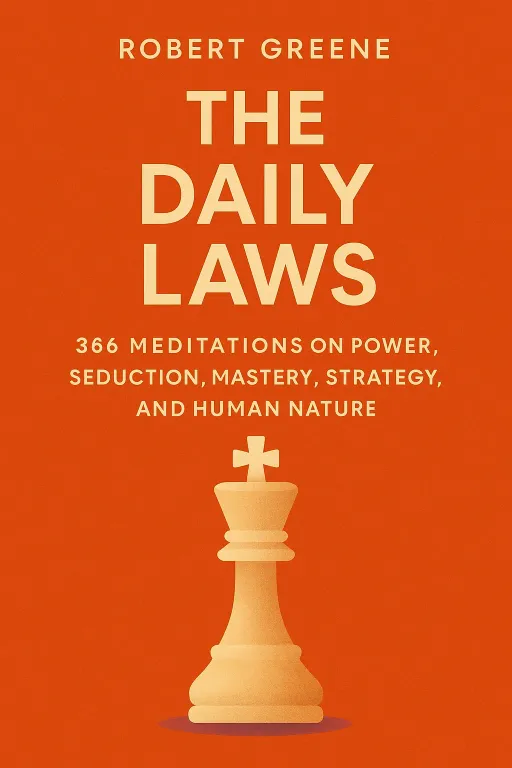
Dr. Warren Reed: Most people are running on a treadmill they didn't build, chasing goals they don't actually want. They wake up at thirty-five or forty, look at their careers, and realize they've spent a decade optimizing for the wrong metrics. Status. Money. External validation. Today, we are breaking that cycle. Welcome to the show. I'm Dr. Warren Reed, and with me is Jackson, a PhD and data analyst in the education sector. Today, we're dissecting Robert Greene's masterpiece,. Jackson, glad to have you here.
Jackson: Thanks, Warren. It's great to be here. As someone who works with data every day, I find Greene's work fascinating. He essentially treats human history and behavior as a massive dataset, looking for the underlying patterns of success, power, and failure.
Dr. Warren Reed: Exactly. No fluff. Just raw human nature. Today, we're tackling this from two distinct angles. First, how to identify and protect your unique Life's Task, using the strategic focus of icons like Steve Jobs. Second, how to cultivate the rational self, treating emotional impulses as noise so you can focus on the actual signal. Let's dive straight into the first pillar: Your Life's Task.
Deep Dive into Core Topic 1
SECTION
Dr. Warren Reed: January in is all about one thing: Your Life's Task. Most people fail here because they look outward instead of inward. They choose careers based on market demands or parental expectations. That is a tactical error. Greene's thesis is simple: you are born with a unique genetic makeup and primal inclinations. If you ignore them, you doom yourself to mediocrity. Jackson, as an analyst, how does this concept of primal inclinations resonate with you?
Jackson: It resonates deeply, Warren. In data science, we talk about 'overfitting' a model—when you train a model so perfectly to a specific, limited set of past data that it fails to adapt to new, real-world scenarios. When we conform too rigidly to societal expectations or choose a path solely for money, we are overfitting our lives. We ignore our natural variance, our unique 'weirdness' as Greene calls it. For me, looking back at my childhood, I was always obsessed with organizing information, finding the hidden stories in chaos. That eventually led me to my PhD and data analysis. But if I had forced myself into a standard corporate mold just for the title, I would have lost that intrinsic drive.
Dr. Warren Reed: Spot on. You have to look at your childhood obsessions. They are the cleanest data points you have. Before the world told you who to be, what were you drawn to? Let's look at Steve Jobs. A perfect case study. Jobs wasn't driven by money. In the early days of Apple, his singular, almost pathological focus was on design. He was obsessed with the aesthetics of the machine, the simplicity of the user interface, the elegance of the typography.
Jackson: Right, and that obsession goes back to his early life. He dropped out of college but stayed around to drop in on creative classes, like calligraphy. At the time, that seemed completely impractical. There was no obvious career path or financial return for studying calligraphy. But he followed that primal curiosity. Years later, that exact knowledge became the foundation for the beautiful typography on the Macintosh computer. He connected those seemingly disparate dots.
Dr. Warren Reed: Exactly. Here is the strategic breakdown of Jobs' approach: Second, master a niche that aligns with your natural obsessions. * Third, let the financial success be a lagging indicator of your focus. If Jobs had focused on market research and profit margins first, Apple would have built generic, forgettable boxes. Instead, he focused on his unique vision of design, and the money followed.
Jackson: It's a powerful shift in mindset. In education, we often see students struggling because they are trying to force themselves into boxes that don't fit. They are ignoring their internal compass. But Greene warns that finding your Life's Task isn't a straight line. It's a winding road. He shares his own story of wandering through Europe, working as a construction worker, an English teacher, a hotel receptionist, even a detective agency worker, before finally writing in his late thirties.
Dr. Warren Reed: Greene's journey is a masterclass in trial and error. He accumulated diverse skills. He didn't view those odd jobs as wasted time. He viewed them as data collection. Every job taught him something about human nature, power dynamics, and writing. When he met Joost Elffers in Italy and pitched the book, all those raw, uncoordinated experiences fused into a singular, powerful vision. The lesson here is clear: Treat every setback as a skill-acquisition opportunity. * Synthesize your unique experiences into a singular offering.
Jackson: That synthesis is key. It's what makes you irreplaceable. If you only have one skill, you're a commodity. But if you combine data analysis with psychology, or education with strategic design, you create a unique category where you have no competition. That's how you protect yourself from being replaced by automation or outsourcing.
Dr. Warren Reed: Yes. You become a category of one. But to get there, you have to actively rebel against false paths. Greene says, 'If you're on the false path, get off. Find energy in rebellion.' If you are working a job only for the paycheck or the status, you are leaking energy. You are playing defense. You need to play offense.
Jackson: It takes a lot of courage to do that, especially when you've invested years in a specific direction. As an INFJ, I tend to look for deep meaning in my work. If there's a misalignment between my values and my daily tasks, it creates a massive cognitive dissonance. I think many people feel that friction but are too afraid to pivot because of the 'sunk cost fallacy.' They think, 'I've spent five years in this industry, I can't leave now.' But from a data perspective, continuing to invest in a failing asset just because you've already lost money on it is irrational. You have to cut your losses and reallocate your resources to where they can actually grow.
Dr. Warren Reed: Absolutely. Sunk costs are irrelevant to future strategy. Cut the cord. Reallocate your energy. Now, let's transition to the second pillar of Greene's philosophy, which is essential for protecting your Life's Task: Cultivating the Rational Self.
Deep Dive into Core Topic 2
SECTION
Dr. Warren Reed: You can have the perfect vision for your life, but if you are a slave to your emotions, you will fail. October and November in focus on the Emotional Self and the Rational Human. Greene's core premise: humans are naturally irrational. We believe we are realistic, but we constantly project our desires, fears, and biases onto reality. To survive, you must become a radical realist. Jackson, how do you define rationality in this context?
Jackson: This is where Greene's definition is so refreshing. Most people think rationality means being a cold, unfeeling robot—suppressing all emotions. But neuroscience actually shows that people with damage to their emotional centers can't make simple decisions because they can't assign value to options. Greene argues that rationality is a beautiful harmony between the thinking process and our emotional nature. It's about using the energy of your emotions but guiding them with the cool hand of reason. He uses the classic metaphor of the rider and the horse. The horse is the emotion—it provides the raw power, the speed, the drive. The rider is the intellect—providing direction, steering the horse away from cliffs. If you have only the rider, you go nowhere. If you have only the horse, you crash.
Dr. Warren Reed: Excellent metaphor. Let's look at the historical data. Pericles of Athens. A master of emotional control. In ancient Greece, political assemblies were highly volatile, driven by passion, fear, and demagoguery. When the Peloponnesian War was looming, the Athenian citizens were panicking, wanting to rush into disastrous battles. Pericles did something counterintuitive. He refused to react in the moment. He would physically remove himself from the heated debates. He would go home, sit in silence, and analyze his own feelings. He asked himself: 'Is my anger justified? Am I acting out of pride or strategic necessity?' Only when his mind was completely calm would he return to lead.
Jackson: That's incredible. He was essentially increasing his reaction time to filter out the noise. In data analysis, we talk about 'smoothing' a noisy dataset to find the actual trend. If you react to every daily fluctuation, you'll make terrible predictions. Pericles was smoothing his emotional data. By waiting, he allowed the temporary spikes of fear and anger to subside, leaving him with the underlying strategic reality.
Dr. Warren Reed: Exactly. Here is the actionable protocol based on Pericles' strategy: Second, actively question your own motives. Ask yourself what emotional bias is coloring your view. * Third, treat other people's emotional outbursts as natural phenomena, like a storm, rather than personal attacks.
Jackson: That third point is so important for leadership. When someone lashes out at you, the natural human reaction is to lash back. But if you can step back and view their aggression as a data point—a reflection of their own insecurities, their own past traumas, or their fear—it completely changes the dynamic. You don't get defensive. You remain objective. You can analyze their behavior and make the optimal strategic move.
Dr. Warren Reed: Yes. Look at life as a chessboard, not a personal battlefield. When your opponent moves a piece, you don't get offended. You analyze the strategic implication of the move. You ask: 'Cui bono?' Who benefits? What is their actual objective?
Jackson: It's about shifting from a reactive mindset to an observational one. Greene talks about how success itself can be a major threat to our rationality. When we succeed, we tend to get grandiose. We think we have the Midas touch. We forget the role of luck, timing, and the contributions of others. We overfit our success model, assuming that what worked once will work forever in every context.
Dr. Warren Reed: Grandiosity is a psychological disease. It distorts your perception of scale. You start taking unnecessary risks because you believe you are invincible. To combat this, you must analyze your successes as rigorously as your failures. Break down the components of your victory: What percentage was due to market timing? * What percentage was due to luck or external factors? Keep your feet on the ground.
Jackson: It's like running a post-mortem on a project even when it goes well. In my work, if a model performs exceptionally well, we don't just celebrate; we investigate. We want to make sure there isn't a data leak or a bias in the training set that's giving us a false positive. We need to apply that same scientific skepticism to our personal achievements.
Dr. Warren Reed: Absolutely. And that brings us to the concept of the 'supposed nonplayers' of power. Greene warns us to be highly skeptical of people who claim to have no interest in power, who affect an air of extreme naiveté or moral superiority. Often, this is the ultimate power play. They use their apparent weakness or saintliness as a smokescreen to manipulate others without facing criticism.
Jackson: That's a fascinating observation. It's a form of passive-aggressive manipulation. They establish control by making you feel guilty or crude for asserting yourself. In education and academic environments, you see this quite a bit. People who wrap themselves in noble causes or moral purity, but if you look at their actual behavior—how they treat subordinates, how they handle disagreement—the results tell a very different story. Greene's rule is simple: ignore the words, focus entirely on the behavioral data.
Dr. Warren Reed: Yes. Character is destiny. Words are cheap. Anyone can write a beautiful mission statement or project a saintly persona. But patterns of behavior do not lie. If someone has a history of leaving a trail of drama and broken relationships behind them, they will do the same to you. Do not make excuses for them. Do not assume you can change them. Run the other way.
Synthesis & Takeaways
SECTION
Dr. Warren Reed: We've covered a massive amount of strategic ground today. Let's synthesize the core takeaways for Jackson and our listeners. First, your Life's Task is not a luxury; it is a survival strategy. Reconnect with your childhood obsessions, embrace your unique weirdness, and focus on creating exceptional value rather than chasing short-term status. Second, cultivate your inner Pericles. Increase your reaction time. Treat emotional impulses as raw data to be analyzed, not commands to be followed. Jackson, what are your final thoughts on how someone can start applying these daily laws immediately?
Jackson: I think it starts with small, daily habits of self-observation. Keep a journal. Track your emotional triggers. When you feel a sudden surge of anger, anxiety, or grandiosity, write it down. Treat yourself as a subject of study. Over time, you'll start to see the patterns in your own behavior. You'll see where you are prone to making irrational decisions. Once you have that data, you can build the guardrails to protect yourself from your own worst impulses.
Dr. Warren Reed: Excellent. Treat yourself as a scientific experiment. No judgment, just objective analysis. Thank you, Jackson, for bringing your analytical depth to this conversation. And to our listeners: stop drifting. Take control of your career, master your mind, and become a radical realist. We'll see you next time.
Jackson: Thanks, Warren. It was a pleasure.