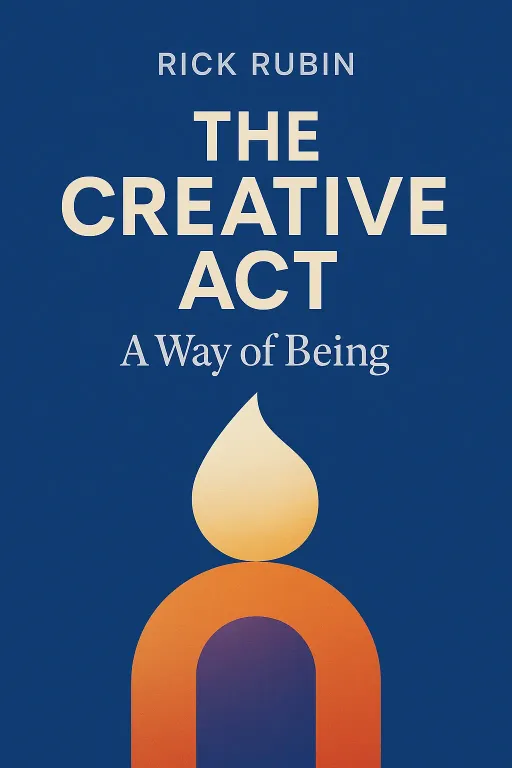
The Universal Algorithm: Engineering Creativity with Rick Rubin's Code
Golden Hook & Introduction
SECTION
Orion: What does a physicist trying to glimpse the nature of reality have in common with a film director trying to capture a moment of human truth? Or an aeronautical engineer searching for the perfect, most efficient shape for a wing?
Orion: They might seem like worlds apart—one driven by hard data, the others by feeling and aesthetics. But according to legendary music producer Rick Rubin in his book, "The Creative Act," they are all engaged in the exact same process. They are all acting as antennas, trying to tune into a signal that’s already being broadcast by the universe, and then translating that signal into a form we can understand.
Orion: Today, we're going to decode this philosophy. We'll dive deep into this from two perspectives. First, we'll explore the radical idea of creativity as an act of pure perception—tuning into the universe's broadcast. Then, we'll discuss the practical, two-phase engine for turning those faint signals into tangible reality, whether that's a mathematical proof or a movie.
Orion: And to help us do that, we have the perfect guest. Maanas Jakhar is a student of physics, aeronautics engineering, 3D modeling, mathematics, movie directing. Maanas, welcome. You live at this exact intersection of art and science. Does this idea that a physicist and a filmmaker are fundamentally doing the same thing resonate with you at all?
Maanas Jakhar: It absolutely does, Orion. Thanks for having me. I think people get hung up on the tools—a whiteboard of equations versus a camera—but the feeling of a breakthrough, that moment of insight when a complex problem suddenly simplifies or a story beat just clicks into place... that feeling is identical across all those fields. It feels less like you invented something and more like you finally something that was there all along.
Orion: That is the perfect place to start. It's like you've already read the first chapter. So let's dig into that first idea, which is the core of the whole book.
Deep Dive into Core Topic 1: Creativity as Perception
SECTION
Orion: Rubin argues that we don't anything. The ideas, the melodies, the stories, the solutions—they are already out there, in what he calls 'The Source.' It's this infinite, universal library of potential. Our job, as 'creatives,' is simply to become a better antenna. He calls it 'tuning in.'
Maanas Jakhar: So it's not about forcing an idea out of your own head. It's about being receptive to what's in the environment around you.
Orion: Exactly. And he doesn't just mean that as a nice metaphor. He describes it as a literal state of being. It means paying attention to the flutter of a leaf, the specific quality of light in a room, the sound of the wind, the unspoken feeling between two people. He believes the artist's primary skill is just radical awareness. The best work comes you, not you, which is a huge relief because it removes the ego and the crushing pressure to be 'brilliant.'
Maanas Jakhar: Right, the ego is the static that blocks the signal.
Orion: That's a great way to put it. As someone who studies physics, this must sound... familiar. The laws of thermodynamics or gravity weren't by Newton or Carnot. They were. They were always there, governing the universe. Is that a fair parallel to what Rubin is describing?
Maanas Jakhar: It's the perfect parallel. No physicist would ever claim to have 'created' E=mc². That would be absurd. Einstein perceived a fundamental relationship in the universe that already existed. The 'creative act' for him was designing the thought experiments—these incredible, imaginative scenarios in his mind—that served as the mental 'antennas' to allow him to see that relationship. It's all about finding the right frequency to listen on.
Orion: I love that phrase, 'mental antennas.' So how does this apply to your more explicitly artistic pursuits, like movie directing? How do you 'tune in' on a film set, which is often a chaotic, high-pressure environment?
Maanas Jakhar: It's a challenge, but it's essential. You can go in with a perfectly storyboarded shot list, a script with every line memorized. But then you watch the actors rehearse. And you listen. You listen to the space, the rhythm of their dialogue. Sometimes the most powerful, truthful moment in a scene isn't in the script at all. It's an unplanned glance, a slight hesitation, a crack in someone's voice.
Orion: And if you're too focused on your plan...
Maanas Jakhar: You'll miss it. You'll steamroll right over it. The director's job is to be aware enough, to be 'tuned in' enough, to see that faint signal and have the courage to say, 'Wait. That's it. That's the truth of the scene.' You're not forcing the truth; you're recognizing and capturing it when it appears.
Orion: So it's a passive state, almost? A state of pure receptivity?
Maanas Jakhar: I'd call it 'actively passive.' It's a paradox. You have to do the work to build the antenna—that means doing your research, knowing your equipment, understanding the physics of light. But then, in the moment of creation, you have to get quiet enough to let the signal come in. It's the same for 3D modeling. You can fight with the software for hours, trying to force a shape. Or you can relax, look at your reference images, and just 'see' the form that wants to emerge from the digital clay. You guide it more than you command it.
Orion: You guide it more than you command it. That's a fantastic line. And it's a perfect transition, because being 'quiet enough to let the signal come in' is one thing. But then you have to actually the thing. You have to turn that faint signal into something real.
Deep Dive into Core Topic 2: The Two-Phase Engine (Seed vs. Craft)
SECTION
Orion: And this is where Rubin makes a brilliant, and I think incredibly practical, distinction. He separates the creative process into two completely different modes of operation. He calls them 'The Seed' and 'The Craft.'
Maanas Jakhar: Okay, I'm interested. This sounds like a system.
Orion: It is. Phase One is 'The Seed.' This is the initial spark. The fragile, new idea. It might be a melody fragment, a single line of dialogue, a rough sketch. Rubin's number one rule is that you must protect this seed at all costs. It's delicate and imperfect. You cannot expose it to criticism, to analysis, or even to your own internal judgment. The only goal in this phase is to notice the seed and capture it, no matter how strange or silly it seems.
Maanas Jakhar: So, no immediate reality checks. No asking, 'But is this feasible?' or 'Is this any good?'
Orion: None. That comes later, in Phase Two: 'The Craft.' This is where logic, discipline, and rigor come in. Once the seed has had time to sprout and become a little stronger, you can bring in the craftsman's toolkit. You apply all your skill, your critical thinking, your knowledge of the rules, to shape it, refine it, and build it into a finished work. He says these two phases require completely different mindsets, and trying to apply 'Craft' logic to a 'Seed' idea is the fastest way to kill it. Maanas, from an engineering standpoint, this sounds like a workflow protocol.
Maanas Jakhar: It's exactly that. It's like separating pure research and development from manufacturing and production. In aeronautics, the 'seed' phase is the blue-sky concept sketch. A radical new wing design that looks more like a bird's wing than a traditional airfoil. You don't immediately run a full, multi-million dollar computational fluid dynamics, or CFD, analysis on a napkin drawing.
Orion: Why not? That seems like the logical, data-driven thing to do.
Maanas Jakhar: Because it would be absurd. The numbers would be terrible. The simulation would fail spectacularly. And based on that 'Craft' phase logic, you'd discard a potentially revolutionary idea before it ever had a chance to develop. The data would tell you it's a bad idea, because the idea isn't ready for data yet.
Orion: So what do you do instead, in the 'Seed' phase?
Maanas Jakhar: You protect it. You play with it. You ask 'what if?' You build a low-fidelity, quick-and-dirty 3D model just to see the form in three dimensions. You let the 'seed' grow in a safe, conceptual environment. The 'craft'—the rigorous CFD, the wind tunnel testing, the material stress analysis—that comes much, much later, once the core concept is robust enough to withstand that level of intense scrutiny. You have to let the idea get its legs before you ask it to run a marathon.
Orion: That's such a clear example. And I imagine it's the same in filmmaking? You can't judge the first take of a scene by the standards of a finished film.
Maanas Jakhar: Not at all. The first assembly cut of a movie is a perfect example of a 'seed' that needs protection. It's often way too long, the pacing is a mess, the sound is terrible, the emotional beats might not land. It's raw. You would never, ever show it to a test audience. But the director and the editor have to live with that raw, messy 'seed' for weeks, watching it over and over, to find the film's heartbeat within it.
Orion: And the 'craft' is everything that comes after.
Maanas Jakhar: Exactly. The 'craft' is the months of trimming frames, re-ordering scenes, meticulous sound design, color grading, adding music... all the technical, logical work that polishes the raw material. If you judged that initial raw footage with the harsh, critical eye of a paying audience member, you'd be paralyzed. You'd conclude the movie is a failure. You have to nurture the seed before you can harvest the fruit.
Synthesis & Takeaways
SECTION
Orion: So, when you put it all together, what we're really getting from Rick Rubin isn't just a philosophy, it's a universal operating system for creativity. Step one: Be a sensitive, open-minded antenna to perceive ideas that are already floating around you. And Step two: Create a deliberate, two-stage workflow to protect that fragile idea in a 'nursery' before you move it to the 'workshop' for disciplined crafting.
Maanas Jakhar: Exactly. It demystifies creativity. It takes it out of the realm of some magical lightning strike that only happens to 'artistic' people, and it turns it into a process. A system. And that system works whether you're dealing with abstract mathematical equations, the physics of aerodynamics, or the nuances of human emotion in a story. It's about perception first, execution second.
Orion: So for everyone listening, especially those in technical or scientific fields who might not think of themselves as 'creative,' what's the one thing they can try tomorrow?
Maanas Jakhar: I think the big takeaway is to consciously try this separation. The next time you have a new idea—for a project, a solution to a problem, anything at all—give yourself permission to put it in a 'nursery.' Don't analyze it. Don't ask if it's practical or efficient. Don't criticize it. Just write it down, sketch it, describe it to a trusted friend. Protect the seed. Schedule your 'craft' time, your analysis and critique time, for a day or two later. Just see what happens when you give your ideas a chance to breathe before you put them to the test. You might be surprised by what survives.
Orion: Give your ideas a chance to breathe. A perfect place to end. Maanas Jakhar, thank you so much for translating these ideas so brilliantly.
Maanas Jakhar: It was my pleasure, Orion. A fascinating conversation.