The Artist's Way of Being: Decoding Rick Rubin's Creative Philosophy
Golden Hook & Introduction
SECTION
Nova: What do you do when you face the blank page? That blinking cursor, that empty canvas... there's a panic that can set in, right? We think we have to an idea into existence, to wrestle something out of nothing.
Mihriban Barak: Oh, that feeling is all too real. It’s like a creative vacuum, and the pressure to fill it is immense.
Nova: Exactly! But what if the legendary music producer Rick Rubin is right? What if the goal isn't to the page at all, but to simply get quiet enough to hear what the universe is trying to tell you?
Mihriban Barak: That’s a beautiful and, honestly, a very relieving thought.
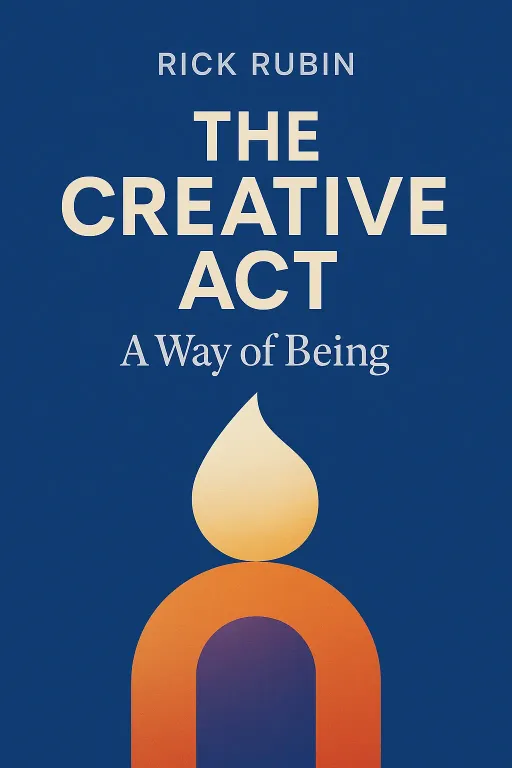
Nova: It's the core idea of his incredible book, "The Creative Act: A Way of Being," and it's what we're exploring today. And I'm so thrilled to have you here, Mihriban, because as a designer and artist, you live and breathe these challenges every day.
Mihriban Barak: Thanks for having me, Nova. I’m excited to dive in. This book really shifted my perspective.
Nova: I’m so glad. For everyone listening, we're going to tackle this from two perspectives. First, we'll explore Rubin's radical idea of creativity as an act of 'reception'—how to tune in to the ideas that are all around us. Then, we'll discuss how to protect that fragile idea during the creation process by detaching from the outcome and focusing on the work itself.
Deep Dive into Core Topic 1: Tuning the Antenna
SECTION
Nova: So let's start there. Mihriban, as a designer, that feeling of the blank Adobe Illustrator artboard must be so familiar. Have you ever felt that pressure to just... invent something out of thin air for a project?
Mihriban Barak: Constantly. It’s the default mode, I think. You get a brief, you open the software, and you think, "Okay, brain, go! Make something new. Now!" And of course, that’s usually when your brain decides to go on vacation. It's a recipe for frustration.
Nova: It really is! And this is where Rick Rubin completely flips the script. He suggests that we have it all backward. He says ideas aren't things we. They already exist. They're out there, in the world, in what he calls "The Source." Our job isn't to be a brilliant inventor, but to be a sensitive antenna.
Mihriban Barak: I love that metaphor. An antenna. It takes all the pressure off of being a "genius" and puts the focus on just being... aware.
Nova: Precisely! He talks about how we're all surrounded by these signals, these whispers of ideas, all the time. But our modern lives are so noisy. We're distracted, we're busy, we're stressed. Our antenna is caked in mud. The first act of creativity, for Rubin, is simply cleaning the antenna.
Mihriban Barak: That resonates so deeply with me. My best ideas, the concepts that feel truly special, have almost never come when I’m staring at my screen, trying to force them.
Nova: Where do they come from?
Mihriban Barak: They come on a walk, or when I’m looking at the way light hits a building, or sometimes in the shower. You know, the classic cliché. But it’s true! It feels less like I’m thinking hard and more like I’m finally quiet enough to notice a connection that was waiting for me. It feels less like invention and more like discovery.
Nova: Yes! That’s the exact word. Discovery. Rubin argues that the artist's primary practice is to pay attention. To look at a tree and not just see "tree," but to see the texture of the bark, the way the leaves filter the sunlight, the ecosystem living on its branches. It's about cultivating a state of wonder.
Mihriban Barak: It reminds me of the concept of 'beginner's mind' in Zen philosophy. Approaching everything as if you're seeing it for the first time. When you do that, the world becomes infinitely more interesting, and those "signals" you mentioned get a lot clearer. You start seeing patterns and relationships everywhere.
Nova: You're making connections, which is the heart of creativity. Rubin says it's not about looking for something useful. You're not on a hunt for your next project. You're just tuning your instrument. You're making yourself a better receiver for whatever might come through. Isn't that a beautiful, gentle way to approach a creative life?
Mihriban Barak: It’s a game-changer. It transforms creativity from this stressful, performance-based activity into a daily practice of mindfulness and connection with the world. It makes it sustainable. You can't force a brilliant idea every day, but you practice being aware every day.
Nova: Exactly. You're building the infrastructure for inspiration to strike. You're not waiting for lightning; you're putting up a lightning rod.
Deep Dive into Core Topic 2: The Great Work
SECTION
Nova: I love that. So we've tuned in, we've cleaned our antenna. And let's say an idea arrives. A signal comes through. It's beautiful, it's exciting, but it's also so fragile. And this is where the real danger comes in, right?
Mihriban Barak: Absolutely. The moment you try to bring it into reality, the doubt creeps in. "Is this good enough? What will people think? Is this what the client wanted?" The inner critic shows up to the party immediately.
Nova: And he is the worst guest! This brings us to Rubin's second revolutionary idea, which is all about protecting that idea from... well, from ourselves and from the world. He calls it creating without attachment.
Mihriban Barak: This part of the book was both liberating and, I have to admit, a little scary to read as a professional designer.
Nova: I can imagine! Let's break it down. Rubin proposes a hierarchy of service. When you're creating, your first duty is not to the audience. It's not to the client, not to your Instagram followers, not even to your own ego. Your first duty is to the. You are its custodian. Your job is to bring it into the world in its most pure, authentic form.
Mihriban Barak: So the audience comes last.
Nova: The audience comes last. He says if you're thinking about how people will react while you're in the middle of creating, you're compromising. You'll sand down the interesting edges. You'll make it more familiar, more palatable. You'll kill the very thing that made the idea special in the first place. The goal isn't applause; the goal is to do justice to the initial spark. He calls this engaging in "The Great Work."
Mihriban Barak: That sounds like the dream, truly. To create in this pure, protective bubble. But it also feels... risky. In the design world, the client's feedback is often the most important factor. A project is only "successful" if the client is happy. How do you reconcile this philosophy with a deadline and a paying client?
Nova: That is the perfect question, and it's where the nuance comes in. I don't think Rubin is saying to be a hermit who never listens to feedback. He's a producer; collaboration is his entire job. The key is you let the feedback in. He's talking about the initial phase of creation—the seedling phase.
Mihriban Barak: Ah, so it's about building a strong foundation first.
Nova: Exactly. You have to let the idea grow strong enough to stand on its own before you expose it to the harsh weather of other people's opinions. You need to understand what the work and what it on its own terms first. Once you have that unshakeable core, then you can listen to feedback. You'll be able to tell the difference between a suggestion that helps the work become more itself, and a suggestion that tries to turn it into something else entirely.
Mihriban Barak: That makes so much more sense. It's not about ignoring the client; it's about having a strong point of view to bring the conversation with the client. It’s about protecting the work from premature judgment, especially your own. My own perfectionism is often the loudest and most destructive critic.
Nova: We are always our own worst critics, aren't we? This mindset is the antidote. If your goal is simply to express the idea as authentically as possible, then "perfect" doesn't even enter the equation. The work is what it is. You just followed the energy. It removes the ego and the fear of failure. The only way to fail is to be inauthentic to the idea.
Mihriban Barak: That reframes everything. It means that even a project that a client rejects or that doesn't get a lot of "likes" isn't a failure if you were true to the work. It's just part of the process, part of your practice. That is incredibly freeing for someone just starting their career, who might feel like every single piece has to be a home run for their portfolio.
Nova: Right? It allows for experimentation, for play, for "failure." It allows you to build a body of work that is truly yours, because you weren't trying to please an imaginary audience the whole time. You were just tending to your garden.
Synthesis & Takeaways
SECTION
Nova: So, when we put it all together, it's this beautiful two-step dance, isn't it?
Mihriban Barak: It really is. Step one is to be open, to be a sensitive receiver for the world around you. Tune the antenna. Step two is to be a fierce, loving protector of what you receive, creating without attachment to the outcome, just focusing on the authentic expression of the idea.
Nova: From doing to being. From forcing to allowing. It's a profound shift. And for everyone listening who feels inspired by this but is wondering, "Okay, what can I actually tomorrow?" Rubin is all about small, consistent practices.
Mihriban Barak: Which is great, because big, sweeping changes can be intimidating.
Nova: Totally. So here's a simple, concrete action inspired by the book. We'll call it the "Awareness Walk." Sometime this week, go for a ten-minute walk. No phone, no music, no destination. Your only goal is to notice things.
Mihriban Barak: I love this.
Nova: Just notice. Notice the sound of your footsteps. Notice the different shades of green in the leaves. Notice the way the wind feels. There's no pressure to find anything "interesting" or "useful" for a project. The entire point of the exercise is just to practice paying attention. It's a workout for your creative antenna.
Mihriban Barak: And I'd add a layer for fellow designers or visual artists. Don't just look at nature. Look at man-made things with that same curiosity. Notice the typography on a forgotten street sign, the color palette of a weathered wall, the texture of cracked pavement. It's all data. It's all information for your antenna. You're just collecting it without judgment.
Nova: That's a perfect addition. It's about stocking the well, so that when you do need an idea, you have this rich, subconscious library to draw from. You've been feeding your creative spirit all along.
Mihriban Barak: It all comes back to that first idea. You're not inventing from nothing. You're making a new connection between things you've already let into your awareness.
Nova: Mihriban, this has been such an insightful conversation. Thank you for bringing your artist's perspective to these beautiful ideas.
Mihriban Barak: Thank you, Nova. It was a pleasure to explore it with you. It’s a reminder that the creative act is really just an act of living more fully.