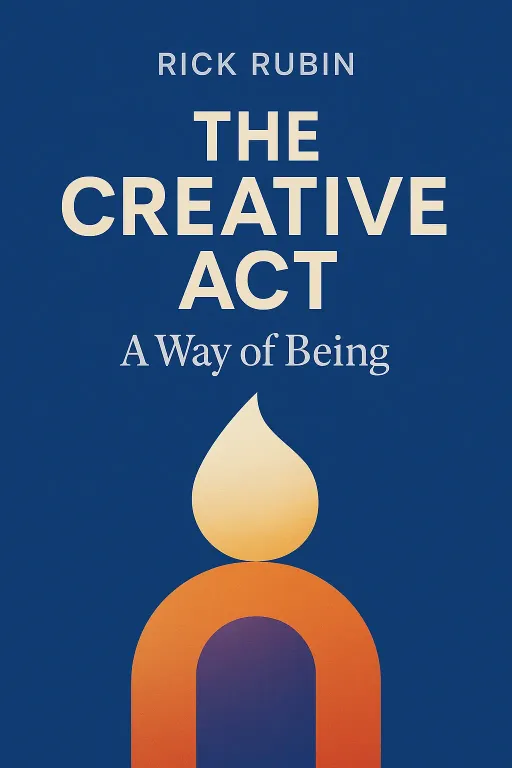
The Art of Being: Decoding Rick Rubin’s Creative Philosophy
Golden Hook & Introduction
SECTION
Nova: What if the greatest barrier to your next breakthrough isn't a lack of talent, but a lack of attention? We often treat creativity like a lightning bolt that strikes only a lucky few, but legendary music producer Rick Rubin says it's actually an active state of being—a way of moving through the world with your antenna fully extended. Welcome to the podcast. I'm Nova, and today we are diving into Rubin's beautiful, philosophical book,. Joining me to unpack these ideas is Nour Ghribi, an analytical thinker who loves to look under the hood of complex concepts. Nour, it is so wonderful to have you here with us today.
Nour Ghribi: Thanks, Nova. It is great to be here. You know, when I first picked up Rick Rubin's book, I was a bit skeptical. I think many of us who lean toward analytical thinking tend to view creativity as this mysterious, almost mystical process that you can't really measure or define. But as I read through his chapters, I realized he is actually describing a highly sophisticated cognitive framework. It is about how we process information, how we filter our environment, and how we make novel connections. I am really excited to break this down today.
Nova: Oh, I love that perspective. We are definitely going to look at the mechanics behind the magic. Today, we are going to tackle this book from two different angles. First, we will explore how to transform our daily lives into a rich stream of sensory data through heightened awareness. And then, we will dive into the practice of deep listening and why embracing uncertainty is the ultimate catalyst for breakthrough ideas. Let's start with this idea of the antenna. Rubin writes that we are all receiving signals from the universe all the time, but we have to tune ourselves to actually catch them. Nour, how does that resonate with your analytical mind?
Deep Dive into Core Topic 1
SECTION
Nour Ghribi: It makes perfect sense if you think about it in terms of data acquisition. Our brains are constantly bombarded with millions of bits of sensory information every single second. To keep us from going completely overwhelmed, our brains use cognitive filters to screen out what they deem irrelevant. We only consciously perceive a tiny fraction of what is actually happening around us. What Rubin is calling the antenna is essentially our conscious control over those filters. He is urging us to widen our bandwidth.
Nova: That is such a neat way to frame it. Widening our bandwidth. We tend to walk around on autopilot, right? We take the same route to work, we look at our phones, we think about our to-do lists. We are basically running on pre-programmed scripts. Rubin tells this wonderful story about how he works with artists in the studio. He doesn't start by telling them how to write a song. Instead, he might ask them to just sit quietly and describe every single sound they hear in the room, from the hum of the air conditioner to the distant traffic outside. He is forcing them to turn off the autopilot and actively gather data.
Nour Ghribi: Exactly. And from a cognitive standpoint, that shift is massive. When you force yourself to notice the micro-details of your environment, you are actively stimulating your prefrontal cortex. You are moving from passive consumption to active observation. For instance, think about a scientist looking at a slide under a microscope. If they only look for what they expect to see, they might miss a completely new phenomenon sitting right in the corner of the lens. Rubin's approach is about training ourselves to notice the things in the corner of the lens.
Nova: Yes, the beautiful anomalies. We often find the best ideas in those unexpected corners. Rubin emphasizes that the material for our creative work isn't something we have to manufacture out of thin air. It is already out there, waiting to be noticed. He says, quote, "The artist is on a scavenger hunt for these clues." I love that image of a scavenger hunt. It makes the whole process feel so playful and low-pressure. We don't have to be geniuses; we just have to be curious collectors.
Nour Ghribi: It really reframes the pressure of creation, doesn't it? If you view yourself as a collector of data points rather than a creator of raw matter, the anxiety of the blank page or the empty screen completely vanishes. Your job is simply to observe, record, and catalog. If you look at some of the greatest innovators in history, they weren't necessarily inventing entirely new concepts. They were just incredibly good at collecting disparate observations and connecting them. Think of Spencer Silver, the chemist who accidentally created a low-tack adhesive. He didn't set out to invent the Post-it Note. He just observed a curious property of a failed experiment, kept that data point in mind, and years later, his colleague Art Fry connected it to the problem of marking pages in his hymnal. That is the scavenger hunt in action.
Nova: That is a perfect example, Nour. It is all about holding onto those curious little data points without immediately needing to know what they are for. But to do that, we have to overcome our natural urge to categorize and judge everything instantly, don't we? We are so quick to say, "Oh, that's a bad idea," or "That's irrelevant." Rubin talks a lot about how judgment kills the creative spark before it even has a chance to catch fire.
Nour Ghribi: That is a huge hurdle for analytical thinkers. We love to analyze, categorize, and evaluate. It is our default mode. But Rubin suggests that during the initial phases of observation and collection, we have to suspend that critical faculty. If we judge too early, we prune away the very anomalies that could lead to breakthroughs. We need to allow ourselves to sit with the raw, unorganized data for a while before we start building models or drawing conclusions.
Nova: It is like letting the puzzle pieces sit on the table before you try to fit them together. We have to give them space to breathe. And that brings us beautifully to our second core topic: the practice of deep listening and learning to embrace the unknown.
Deep Dive into Core Topic 2
SECTION
Nova: Rubin has this beautiful chapter on deep listening. He says that most of the time, we aren't actually listening; we are just waiting for our turn to speak, or we are filtering what the other person is saying through our own assumptions. Deep listening, according to Rubin, is about listening with your whole body, without any agenda. It is about being completely present to the sound, the silence, and the space between the words.
Nour Ghribi: That concept of listening without an agenda is incredibly powerful. In communication theory, we often talk about active listening, but Rubin takes it a step further. He is talking about a state of receptive silence. When we listen with an agenda, we are essentially running a search query in our minds, looking for data that confirms our existing beliefs or helps us formulate our next argument. That is confirmation bias in real-time. But when you listen without an agenda, you allow yourself to be surprised. You open the door for information that might completely challenge your current mental model.
Nova: Yes, and that can be really uncomfortable, can't it? It requires us to step into the unknown and admit that we don't have all the answers. Rubin writes that the best work often comes from a place of not knowing. He encourages artists to embrace confusion and uncertainty, rather than rushing to find a comfortable, familiar solution. He says that when we are lost, we are forced to look at the world with fresh eyes.
Nour Ghribi: It is a beautiful paradox. The discomfort of not knowing is actually where the growth happens. In psychology, there is a concept called cognitive tolerance for ambiguity. People with high ambiguity tolerance are comfortable with complexity, contradictions, and lack of structure. They don't rush to premature closure. Rubin is essentially teaching us how to increase our tolerance for ambiguity. He wants us to sit in that uncomfortable, messy middle space where nothing is decided yet. Because if you rush to a solution just to relieve your anxiety, you will almost always choose the most obvious, conventional path.
Nova: That is so true. We choose the path of least resistance because it feels safe. I am reminded of how Rubin worked with the band System of a Down when they were recording their breakthrough album,. They had all these wild, disparate musical ideas—heavy metal riffs mixed with traditional Armenian folk melodies and bizarre, poetic lyrics. A conventional producer might have tried to smooth out those rough edges to make the music more radio-friendly. But Rubin did the opposite. He encouraged them to lean into the chaos, to listen deeply to the friction between those different styles, and to let the songs find their own strange, unpredictable shapes. He didn't try to force them into a pre-existing mold. He allowed the unknown to guide the process.
Nour Ghribi: And the result was a masterpiece that completely redefined the genre. That is the power of resisting premature optimization. If you optimize too early, you lock yourself into a local maximum—a good solution, but perhaps not the global maximum, which is the truly revolutionary breakthrough. By staying in the unknown longer, you allow the system to explore a much wider space of possibilities. It is a highly strategic way to approach problem-solving, even if it feels chaotic in the moment.
Nova: I love that term, premature optimization. It applies to so many areas of life, not just music or art. Whether you are designing a software program, writing a business strategy, or just trying to figure out your next career move, rushing to the finish line can rob you of the best possibilities. We have to learn to trust the process, even when we can't see the destination.
Nour Ghribi: Absolutely. And that trust isn't passive. It is an active, disciplined practice. It requires you to show up every day, pay attention, listen deeply, and keep collecting those little clues, even when you have no idea how they will eventually connect. It is about having faith that the patterns will emerge if you keep your antenna tuned.
Synthesis & Takeaways
SECTION
Nova: This has been such an eye-opening conversation, Nour. We have journeyed from seeing creativity as a mysterious gift to understanding it as a structured, intentional way of being. We talked about widening our bandwidth through heightened awareness, treating our daily lives as a scavenger hunt for data points, and resisting the urge to judge too early. And then we explored the power of deep listening and why increasing our tolerance for ambiguity is essential for reaching those truly breakthrough ideas.
Nour Ghribi: It really comes down to shifting our relationship with the world around us. Instead of trying to force our will upon our environment, Rubin invites us to become receptive vessels. For anyone listening who wants to start practicing this today, I have a simple recommendation. Try to cultivate what I call micro-observations. Once a day, take five minutes to step away from your screens. Go outside, or just look around the room you are in, and find three things you have never noticed before. It could be the texture of the wall, the way the light hits a surface, or a subtle sound in the background. Write them down without judging them or trying to make sense of them. Just collect them.
Nova: Oh, I love that. A daily five-minute scavenger hunt for the mind. It is a simple, beautiful way to start tuning our antennas. Nour, thank you so much for sharing your brilliant insights with us today. You have given us a whole new framework for understanding Rick Rubin's philosophy.
Nour Ghribi: Thank you, Nova. It was an absolute pleasure. I hope everyone enjoys their scavenger hunt today.
Nova: And to all our listeners, thank you for tuning in. We leave you with this question to ponder: What subtle signal is the universe sending you today that you might be missing simply because you aren't listening? Keep your antennas up, stay curious, and we will see you next time.