Personalized Podcast
Golden Hook & Introduction
SECTION
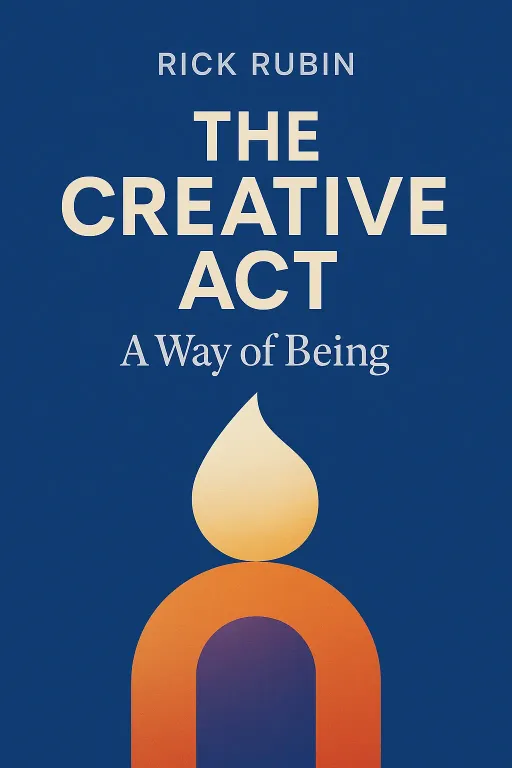
Dr. Warren Reed: What if the greatest barrier to your next breakthrough isn't a lack of talent, but your refusal to move? We often treat creativity like an intellectual puzzle to be solved entirely in our heads. But legendary music producer Rick Rubin says otherwise. Creativity isn't a job. It's a relationship with the world. And it requires physical momentum. Today, we're going to tackle his philosophy from two distinct angles. First, we'll explore how to tune our internal receivers to capture the subtle signals of our cultural environment. Second, we'll discuss how to break through analytical paralysis by embracing the power of physical action and leaving our comfort zones. I'm Dr. Warren Reed, and joining me is sociologist and researcher, Asude Yıldırım. Asude, welcome.
Asude Yıldırım: Thanks, Warren. It's wonderful to be here. You know, when I first read Rubin's work, I was struck by how much his view of the artist aligns with the work of a sociologist. He talks about the artist not as a creator of something out of nothing, but as a translator of the world around them. As researchers, we do the exact same thing. We observe, we listen, and we try to find the patterns in the noise.
Dr. Warren Reed: Exactly. It's about data collection. But not the spreadsheet kind. The sensory kind. Rubin's core premise is simple: we are all vessels. The universe is constantly broadcasting signals. Information. Emotion. Inspiration. The artist's only job is to be open enough to receive them. If your antenna is down, you miss the broadcast. Simple as that.
Asude Yıldırım: It really is. And as an INFJ, I tend to look at this through the lens of deep empathy and intuition. We live in a world that constantly demands output, productivity, and immediate results. But Rubin is asking us to slow down and focus on input. He's talking about cultivating a state of pure, non-judgmental awareness. In sociology, we call this breaking free from our social conditioning—learning to see the everyday world with fresh eyes, as if we are outsiders looking in for the very first time.
Deep Dive into Core Topic 1
SECTION
Dr. Warren Reed: Let's look at how Rubin actually put this into practice. Think about his work in the studio. He doesn't go in with a rigid blueprint. He doesn't tell a band, "Here is the hit song we are going to write today." Instead, he creates an environment of extreme receptivity. He watches. He listens to the room. He notices the subtle shifts in energy. There's a famous story of him working with the Red Hot Chili Peppers. They were stuck. Stagnant. Instead of forcing them to write, he moved them into a supposedly haunted mansion. Why? To disrupt their sensory inputs. To force their internal receivers to tune into a completely different frequency. The result? One of the most iconic albums of the nineties. It wasn't about trying harder. It was about changing the reception.
Asude Yıldırım: That is a perfect example, Warren. It shows that our environment deeply shapes our internal state. From a sociological perspective, we are constantly absorbing the norms, anxieties, and expectations of our social circles. If we stay in the same physical and social spaces, our thoughts become repetitive. We start playing the same mental loops. Rubin's approach of moving the band to a new environment is essentially a disruption of their habitus—the deeply ingrained habits and dispositions we carry. By changing the physical space, he forced them to drop their defensive, routine ways of thinking.
Dr. Warren Reed: Yes. Routine is the enemy of awareness. It makes us numb. We stop seeing the street we walk down every day. We stop hearing the ambient sounds. Rubin suggests a simple exercise to combat this: walk a different way to work. Eat with your non-dominant hand. Look at the sky for five minutes without your phone. These aren't just quirky habits. They are deliberate acts of sensory deconditioning. They force your brain out of autopilot.
Asude Yıldırım: It's about cultivating what Zen Buddhism calls 'beginner's mind,' which Rubin references heavily. For a researcher, this is crucial. If I go into a project assuming I already know the social dynamics of a group, I will only find what I'm looking for. I'll suffer from confirmation bias. But if I can approach the subject with that raw, unfiltered receptivity, I can see the underlying truths that others miss. But, Warren, let's be honest. Being that open can be incredibly overwhelming. When you turn your sensitivity all the way up, you absorb the negative signals along with the positive ones. How does Rubin suggest we handle that overwhelm?
Dr. Warren Reed: Boundaries. And structure. You can't keep the floodgates open twenty-four-seven. You'll drown. Rubin is a big proponent of ritual. You set aside specific times to be a receiver, and specific times to shut it down. You control the input. No news first thing in the morning. No social media before creative work. You protect your vessel. If you don't protect the vessel, the data gets corrupted by noise.
Asude Yıldırım: That makes complete sense. It's about creating a sacred space for observation. In research, we have clear boundaries between fieldwork and analysis. When you are in the field, you are purely receiving. You don't judge; you don't analyze. You just absorb. The analysis comes later, in a structured environment. It's a beautiful balance of openness and discipline.
Deep Dive into Core Topic 2
SECTION
Dr. Warren Reed: Let's pivot to the second major theme, which is the core of our discussion today: the power of action and movement. Leaving the comfort zone. This is where many analytical thinkers get stuck. They receive the signals. They analyze the data. They create beautiful, complex theories in their heads. And then? Nothing. They freeze. They suffer from analysis paralysis. Rubin has a direct antidote for this: movement. Action over thought.
Asude Yıldırım: This is something I struggle with deeply, Warren. As an INFJ and a researcher, my natural instinct is to understand everything completely before I take a single step. I want to read one more paper, analyze one more data set, refine the theory just a little bit more. It feels safe inside the mind. But Rubin argues that the mind can be a prison of our own making. The comfort zone is comfortable because it's predictable. But predictability is the death of creativity.
Dr. Warren Reed: Exactly. Thought is a simulation. Action is reality. You cannot think your way into a new way of acting; you have to act your way into a new way of thinking. Rubin uses a brilliant concept in the book: the idea of 'low-stakes experimentation.' When an artist is stuck on a lyric or a guitar solo, Rubin doesn't tell them to go home and think about it. He tells them to play it ten different ways, as fast as possible, without thinking. Play it like a punk song. Play it like a lullaby. Play it backwards. The goal isn't to find the perfect version immediately. The goal is to get the hands moving. To bypass the critical mind.
Asude Yıldırım: That is incredibly liberating. When you frame action as an experiment rather than a final product, the fear of failure completely evaporates. In sociology, we talk about the concept of 'play' as a fundamental way humans learn and construct meaning. When children play, they aren't worried about making mistakes; they are just exploring boundaries. As adults, we lose that. We think every action has to be a statement of our identity or a perfect representation of our competence. Rubin is inviting us to play again. To step out of our comfort zones not with fear, but with curiosity.
Dr. Warren Reed: Yes. Lower the stakes. If the stakes are high, you freeze. If the stakes are low, you flow. Let's look at another practical tool Rubin uses: arbitrary constraints. If you have infinite choices, you have infinite opportunities for hesitation. So, limit your options. Write a song using only three chords. Write an essay in under five hundred words. Complete a project in twenty-four hours. These constraints force you to move. They eliminate the luxury of over-thinking.
Asude Yıldırım: It's fascinating how constraints actually breed freedom. When you have fewer choices, your brain stops worrying about the 'perfect' choice and just focuses on making choice. It reminds me of the sociological concept of 'choice overload' or the tyranny of freedom. When we have limitless options, we experience anxiety and regret before we even make a decision. By imposing arbitrary constraints, we bypass that anxiety. We are forced to step out of our comfort zone because the old, comfortable pathways are blocked by the constraints we've set.
Dr. Warren Reed: Precisely. And let's talk about the physical aspect of this. Movement isn't just a metaphor. It's literal. Rubin talks about changing your physical posture, walking during meetings, or working in a different room. If you are stuck at your desk, stand up. If you are stuck indoors, go outside. The physical body and the mind are not separate systems. They are a single feedback loop. If you freeze your body, you freeze your thoughts.
Asude Yıldırım: That is a profound point, Warren. In modern academic and professional life, we highly intellectualize everything. We treat the body as merely a vehicle to carry our heads from one meeting to another. But somatic experiencing—the physical sensations in our bodies—is deeply tied to our cognitive flexibility. When we step out of our comfort zone physically, whether that's through a cold shower, a run, or simply sitting on the floor instead of a chair, we send a signal to our nervous system that we are entering a state of exploration. It wakes us up. It breaks the physical stagnation that mirrors our mental stagnation.
Synthesis & Takeaways
SECTION
Dr. Warren Reed: Let's bring this all together. We've covered two massive concepts today. First, the importance of being a highly receptive vessel—tuning into your environment, deconditioning your senses, and protecting your inputs. Second, the absolute necessity of movement—breaking analytical freeze through low-stakes experimentation, arbitrary constraints, and physical action. Asude, how do you see these two ideas connecting in a practical, everyday way?
Asude Yıldırım: I think they are two sides of the same coin, Warren. Receptivity without action leads to overwhelm and stagnation. You become a heavy vessel filled with water that eventually goes stale. On the other hand, action without receptivity leads to shallow, repetitive output. You are just making noise without listening to the music of the world. The magic happens in the cycle: you open yourself up to receive, you let the world move you, and then you immediately translate that movement into action. You don't wait for perfect clarity. You let the action itself refine your understanding.
Dr. Warren Reed: Beautifully said. It's a loop. Receive. Act. Adjust. Repeat. No room for stagnation. No room for comfort zones.
Asude Yıldırım: Exactly. And for our listeners, especially those who tend to live in their heads—the researchers, the thinkers, the planners—my challenge to you is this: find one area where you are currently waiting for 'perfect clarity' before taking action. It could be a project, a conversation, or a lifestyle change. Today, set an arbitrary constraint. Give yourself thirty minutes, or limit your resources, and take one imperfect, physical action. Step out of the comfort of your thoughts and into the reality of movement.
Dr. Warren Reed: No excuses. Just movement. Asude, thank you for bringing your unique sociological and analytical perspective to this. It's been an incredibly rich conversation.
Asude Yıldırım: Thank you, Warren. It was an absolute pleasure.
Dr. Warren Reed: And to our listeners, thank you for tuning in. Now, stop listening, get up, and go move. We'll see you next time.