

The Courage to Teach: Redefining Success by Daring to Be Disliked
Golden Hook & Introduction
SECTION
Nova: Vivian, as an educator and an advocate, you're constantly trying to help people grow, especially young girls. But what if the most common ways we try to 'help'—you know, with praise, with criticism, even by taking control—are actually holding them back? What if the real key to empowerment is having the courage to be disliked?
Vivian Ackon: Wow, Nova. That question hits home. There's a constant pressure in education to be the 'liked' teacher, the one the students connect with. But I've often wondered if that constant search for approval truly serves their long-term growth, or if it just serves my own need to feel effective. The idea of needing the courage to be disliked… it’s unsettling, but it feels important.
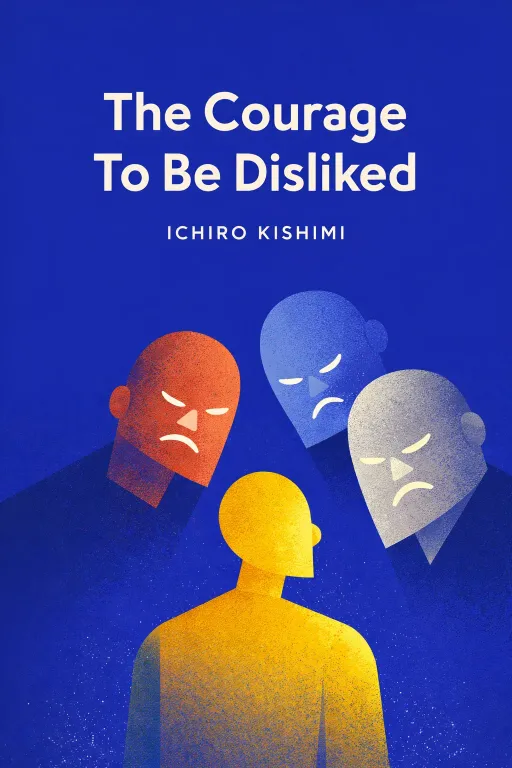
Nova: It is! And that's the provocative heart of the book we're diving into today, "The Courage to Be Disliked" by Ichiro Kishimi and Fumitake Koga. It’s based on Adlerian psychology, and it turns so much of what we think about happiness and relationships on its head. So today, we're going to unpack it from two powerful angles.
Vivian Ackon: I’m ready. My analytical brain is already buzzing.
Nova: I bet! First, we're going to challenge the very idea that our past controls our present, this whole concept of trauma. And then, we'll get intensely practical with a tool the book calls the 'separation of tasks,' which I think could change how you approach every relationship, from the classroom to your own life.
Vivian Ackon: Okay, challenging trauma and a practical tool for relationships. Let's do it. This sounds like exactly the kind of paradigm shift we need in education.
Deep Dive into Core Topic 1: The Power of Goals Over Causes
SECTION
Nova: Exactly. And the book's first big challenge to that 'people-pleasing' instinct is to rethink the past entirely. Most of us, thanks to Freud, think in terms of 'etiology'—the idea that your present unhappiness is by something in your past. A past event is the cause, your current feeling is the effect.
Vivian Ackon: Right. Cause and effect. That’s how we’re taught to analyze everything. If a student is struggling, we look for the cause—did they have a bad experience in a previous grade? Is something going on at home?
Nova: Precisely. But Adlerian psychology flips this. It champions 'teleology'—the idea that we aren't driven by past causes, but by present. Our behavior isn't a reaction; it's a choice we make to achieve something, even if we're not conscious of it. The book gives this incredible story to illustrate it. It’s about a young man telling a philosopher about his friend.
Vivian Ackon: Okay, I’m listening.
Nova: So, this friend has been a shut-in for years. He desperately to go out, to get a job, to live a normal life. But the moment he tries to step outside his room, he's hit with crippling anxiety, his heart pounds, his hands shake. The young man says, "See? It's because of some past trauma—maybe bullying, or his parents did something wrong. He can't go out." That’s the etiology argument.
Vivian Ackon: That makes perfect sense. The anxiety is the symptom of a past wound.
Nova: But the philosopher offers a different view. A teleological view. He says, "No. Your friend has a goal first: the goal is 'to not go out.' He doesn't want to face the world, maybe he fears judgment or failure. So, to achieve that goal, he the anxiety and the physical symptoms. They are the tools he uses to justify staying inside."
Vivian Ackon: Oh, that is… a radical reframe. So the anxiety isn't the cause of him staying inside. The desire to stay inside is the cause of the anxiety. The goal comes first.
Nova: You got it. The goal is to get his parents' attention and to avoid the challenges of the real world. The anxiety is his self-made excuse. He’s not a victim of his past; he's an active participant in his present.
Vivian Ackon: That’s… wow. I'm thinking of so many students right now. The student who says, 'I'm just not a math person.' We often treat that as a fixed state, a result of past struggles. But from this perspective, 'I'm not a math person' is a goal. The goal is to avoid the discomfort of trying, to avoid the potential judgment of getting a problem wrong. The identity they've created serves the purpose of not having to engage.
Nova: Yes! It's a shield! And it feels so real to them. The book even says anger is a tool. It tells a quick story about a man in a coffee shop. A waiter spills coffee on his brand-new jacket, and he flies into a rage, shouting at the waiter. He says, "I couldn't control it! The anger just happened."
Vivian Ackon: Which is what we all say.
Nova: But the philosopher asks, "Did you shout because you were angry? Or did you get angry you could shout?" The goal was to intimidate the waiter, to make him submit quickly. Anger was just the most efficient tool for the job. He could have just said, "This is a new jacket, I'm upset, what can we do about this?" But he chose anger.
Vivian Ackon: He fabricated it. This is huge because it shifts everything from powerlessness to power. If we are creating these emotions and states to serve a goal, it means we can choose different goals. We can choose to create confidence instead of anxiety. For a young girl who has been told she can't do something, this is the ultimate message of empowerment. It’s not about what happened to you; it’s about what you choose to do now.
Deep Dive into Core Topic 2: Freedom Through Boundaries
SECTION
Nova: And that is the perfect bridge to the second, even more practical idea. So if we're not prisoners of our past, and we're choosing our emotions and behaviors... what stops us from being free? The book argues it's because we're constantly meddling in other people's business. This brings us to the 'separation of tasks.'
Vivian Ackon: Separation of tasks. It sounds so simple, but I have a feeling it’s not.
Nova: It’s profound. The core question is simple: "Whose task is this?" The book says all interpersonal relationship problems are caused by either intruding on someone else's task or having your task intruded upon. The classic example is a child who won't study.
Vivian Ackon: The daily reality for many parents and teachers.
Nova: Right. The parent sees the child not studying. They worry. They get angry. They might yell, "Go to your room and study!" or hire tutors, or ground them. They are intervening, trying to force the child to complete the task. But the book asks, "Whose task is it to study?"
Vivian Ackon: It’s the child's task.
Nova: Exactly. The natural consequence of not studying is that the child's grades will fall, and they will realize they need to do something about it. That's their experience to have. The parent's task is not to force them to study. The parent's task is to build a relationship of trust, to let the child know they are there to help. To say, "If you want to study and need help, I'm here for you."
Vivian Ackon: But that is so hard to do in practice! As an educator, my performance is often judged by my students' grades. So I feel this immense pressure to make sure they succeed. When I do that, I'm taking on their task. I'm making their learning about success.
Nova: And what does the book say happens when you intrude?
Vivian Ackon: The child rebels. Or they become dependent, unable to function without someone telling them what to do. They never develop self-motivation. I see it all the time. We're so focused on the outcome that we rob them of the process, which is where the real learning happens. This 'separation of tasks' is about respecting the student as an independent individual.
Nova: And this is where it all connects back to our opening. When you truly separate tasks, you stop needing other people's approval. You do your task—which, for you, is to teach passionately, provide resources, and be a supportive presence. That's it. Whether the student chooses to learn, how they feel about your teaching style, whether they 'like' you... that is task.
Vivian Ackon: That’s their task. So the courage to be disliked is really the courage to respect boundaries. The courage to do my job to the best of my ability and trust my students to do theirs. It’s not about being cold or uncaring. It's the opposite. It's the deepest form of respect.
Nova: It's trusting them with their own lives. You can lead a horse to water, but you can't make it drink. Your job is to make sure the water is clean and accessible. Drinking is the horse's task. If you try to force its head into the trough, you'll just have a fight and a very wet, angry horse.
Vivian Ackon: And a very frustrated you. This is a game-changer, Nova. It frees you from the emotional weight of trying to control uncontrollable outcomes.
Synthesis & Takeaways
SECTION
Nova: It really is. So, to bring it all together, we have these two incredible, connected ideas from "The Courage to Be Disliked." First, we are not defined by our past causes, but by our present goals. We have the power to choose.
Vivian Ackon: We are the writers of our own story, not just readers of a script written by our past.
Nova: Beautifully put. And second, we find our freedom and improve all our relationships by practicing the 'separation of tasks'—by focusing only on what is ours to control and respecting others enough to let them handle what is theirs.
Vivian Ackon: Which ultimately gives us the courage to be disliked, because we're no longer living for others' approval. We're living by our own principles.
Nova: So, Vivian, as we close, what is the one thought or action you'd want to leave our listeners with, especially the educators, parents, and leaders out there?
Vivian Ackon: I think it’s a simple practice. The next time you find yourself in a moment of conflict or frustration with someone—a student, your own child, a colleague—just pause for a second. Before you react, before you try to fix it, ask yourself that one question: "Whose task is this?"
Nova: Mmm.
Vivian Ackon: Answering that honestly changes everything. It doesn't mean you stop caring. It means you start caring in a more powerful, respectful way. You care enough to let them own their journey. And that, I think, is the most profound way to empower someone. It’s the true courage of a teacher.









