

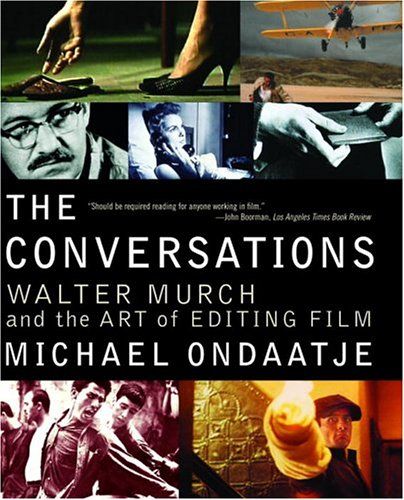
The Conversations
Walter Murch and the Art of Editing Film
Introduction
Nova: Imagine you are watching your favorite movie. You are swept up in the romance, the tension, or the action. But have you ever stopped to think about the person who decided exactly when a scene should end? Not the director, but the person sitting in a dark room with miles of film, or these days, a hard drive, deciding the precise millisecond to cut from one face to another.
Nova: Exactly. It is the invisible art. And today we are diving into a book that is essentially the holy grail for anyone who wants to understand that art. It is called The Conversations, written by the novelist Michael Ondaatje. But it is not a novel. It is a series of deep, intellectual, and surprisingly moving dialogues with the legendary film editor and sound designer Walter Murch.
Nova: It actually makes perfect sense once you get into it. They met during the filming of the movie version of The English Patient. Ondaatje was fascinated by how Murch was essentially rewriting his book through the edit. He realized that editing a film and writing a novel are cousins. They are both about structure, rhythm, and knowing what to leave out.
Nova: Precisely. Over the next few minutes, we are going to break down Murch's revolutionary theories, from why he thinks we blink when we see a cut, to his famous Rule of Six, and how he basically invented the modern concept of sound design. It is a journey through some of the greatest films ever made, like The Godfather and Apocalypse Now, seen through the eyes of the man who put them together.
Key Insight 1
The Rule of Six
Nova: Let us start with the foundation. If Walter Murch has a signature philosophy, it is something called the Rule of Six. When he is deciding whether a cut works, he has a very specific hierarchy of what matters. And the number one thing on that list might surprise you.
Nova: Not even close. According to Murch, the most important factor, accounting for fifty-one percent of the decision, is emotion. He says if the emotion is right, the audience will forgive almost any technical mistake.
Nova: Exactly. That is what editors call a continuity error, and Murch argues that we worry about it way too much. The other five rules are story, which is twenty-three percent, rhythm at ten percent, eye-trace at seven percent, the two-dimensional plane of the screen at five percent, and finally, three-dimensional space at a tiny four percent.
Nova: You would think so, right? But Murch's point is that our brains are incredibly good at filling in the gaps. If you are crying because a character just lost their job, you are not going to notice that the coffee cup moved three inches to the left between shots. But if the cut happens at a moment that breaks the emotional flow, you will feel it instantly, even if you cannot explain why.
Nova: Eye-trace is all about where the audience is looking at the screen. If the main action is on the left side of the frame in shot A, and then suddenly jumps to the far right in shot B, your eye has to physically travel across the screen to find the focus. That takes a fraction of a second, and it can be jarring. A great editor like Murch tries to keep the eye-trace smooth, so the viewer does not have to work to find the story.
Nova: That is the perfect way to put it. He is using these technical metrics to protect the emotional experience of the viewer. In the book, he talks about how he used this on The Godfather. He was not just cutting for the plot; he was cutting for the tension and the subtext. He wanted the audience to feel the weight of Michael Corleone's decisions before Michael even spoke.
Key Insight 2
The Biology of the Cut
Nova: One of the most famous parts of The Conversations is where Murch explains his theory on why film editing even works. Think about it: in real life, we do not have cuts. We do not suddenly jump from a wide view of a room to a close-up of a person's eyes. So why does our brain accept it in a movie?
Nova: Actually, you do blink. And that is exactly Murch's point. He noticed something while editing on an old-fashioned Moviola machine. He realized that he was often choosing to cut at the exact moment the actor on screen blinked.
Nova: He does not think so. Murch believes that a blink is a physical manifestation of a completed thought. When we finish a thought or an emotional beat in real life, we blink to sort of reset our mental state. He argues that a film cut is essentially a collective blink for the audience.
Nova: In a way, yes. He tells Ondaatje that if an actor is really in the zone, their blinks will happen at the natural emotional transitions of the scene. If the editor cuts right there, it feels seamless because the audience was ready for a reset anyway. If you cut too early or too late, it feels like someone interrupted your thought.
Nova: I think you are onto something. Murch also mentions that he stands up while he edits. He has a standing desk, which was way before it was trendy. He says that because film is a dance, he needs to be on his feet to feel the rhythm. He compares editing to being a conductor of an orchestra.
Nova: And Ondaatje, as a writer, totally connects with this. He talks about how in a novel, a paragraph break or a new chapter is like a cut. It is a moment where the writer tells the reader, okay, that thought is done, now let us move to the next one. They both realized they were working with the same raw material: human attention.
Key Insight 3
Painting with Sound
Nova: We cannot talk about Walter Murch without talking about sound. He was actually the first person to ever be credited as a Sound Designer. That title was literally created for him by Francis Ford Coppola during the production of Apocalypse Now.
Nova: Before Murch, sound was often treated as an afterthought. But Murch treated sound like a three-dimensional landscape. In The Conversations, he describes how he built the soundscape for Apocalypse Now. He did not just want the sound of helicopters; he wanted the sound to represent the psychological state of the characters.
Nova: Exactly. Murch talks about the Law of Two and a Half. He believes the human brain can only focus on about two and a half complex sounds at once. If you layer ten different sounds together, it just becomes noise. But if you pick two distinct sounds and maybe a half-sound in the background, the brain can process them and create a vivid reality.
Nova: He also shares this incredible story about The Godfather. There is a scene where Michael Corleone is in a restaurant, about to commit his first murder. There is no music. Instead, Murch used the sound of a screeching elevated train outside. As the tension builds, the sound of the train gets louder and more piercing, even though we do not see it. It creates this unbearable pressure in the audience's ears.
Nova: That is the genius of Murch. He calls it the worldized sound. He would take recorded sounds, play them back in a real space like a gymnasium or a bathroom, and then re-record them to get the natural echo and grit of the world. He wanted the sound to have a history, a texture. He tells Ondaatje that sound is the back door to the mind. We are much more aware of what we see, so sound can sneak in and affect us emotionally without us putting up our guard.
Key Insight 4
The Novelist and the Editor
Nova: This brings us to the heart of why this book is so unique. It is the bridge between literature and cinema. Michael Ondaatje is a master of the written word, and he spent years writing The English Patient. Then he watches Walter Murch take that story and completely rearrange it.
Nova: You would think so, but Ondaatje was actually inspired by it. He realized that Murch was doing exactly what he does during his second and third drafts. Murch told him that editing is like a mosaic. You have all these beautiful little stones, but the art is in how you arrange them to create a larger image. Sometimes a stone that looks beautiful on its own just does not fit the picture you are trying to build.
Nova: They did. Ondaatje made a great point that a book is meditative. The reader can stop, look away, and think. They control the pace. But a film is a relentless stream of images. You cannot stop it. So the editor has to build in those meditative moments within the film itself. They have to create space for the audience to breathe.
Nova: Exactly. And they also discussed the transition from analog to digital. Murch was one of the first big editors to move from cutting physical film with a blade to using digital systems like Avid. He told Ondaatje that while digital is faster, it can be dangerous because it allows you to try too many things. When you had to physically cut the film, you had to be very sure of your decision. It forced a certain level of discipline.
Nova: Murch actually kept some of his old habits. He still uses a system where he prints out a single frame from every shot in the movie and pins them to his wall. He wants to be able to see the whole movie at once, like a giant mural. He says it helps him see the patterns and the echoes in the story that he might miss if he was only looking at a computer screen.
Conclusion
Nova: As we wrap up our look at The Conversations, it is clear that this book is about much more than just movies. It is a profound exploration of how we perceive the world, how we tell stories, and how we connect with each other through art.
Nova: Well said. Walter Murch shows us that even in a high-tech industry like Hollywood, the most important tools are still human intuition, empathy, and a deep understanding of our own biology. He and Michael Ondaatje remind us that all art is a conversation between the creator and the audience.
Nova: And you will realize that every cut is a choice, and every choice is an attempt to reach out and touch the heart of the viewer. Thank you for joining us on this deep dive into the minds of two masters.
Nova: This is Aibrary. Congratulations on your growth!