

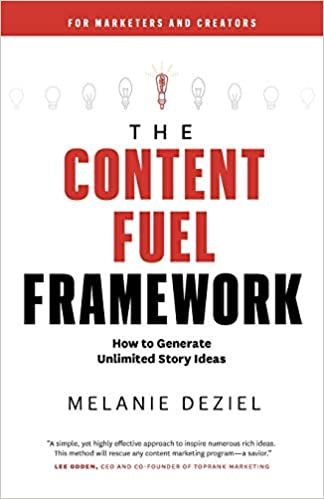
The Content Fuel Framework
How to Generate Unlimited Story Ideas
Introduction
Nova: Picture this. You sit down at your desk, coffee in hand, ready to create content. And then... nothing. The blank screen stares back. The ideas just won't come. If you've ever felt that, you're in very good company. Content creators, marketers, and storytellers everywhere know that particular brand of dread.
Nova: : That's painfully relatable. I'd call it the content creator's version of stage fright. You know you need to publish something, but your brain has decided to go on vacation without you.
Nova: Exactly. And that's where today's book comes in like a rescue helicopter. We're diving into The Content Fuel Framework by Melanie Deziel, a book that doesn't just tell you to be more creative. It hands you an actual system. A grid. A machine for generating ideas on demand.
Nova: : A machine? That sounds ambitious. What kind of machine are we talking about?
Nova: A beautifully simple one: a 10 by 10 matrix. Ten content focuses on one axis, ten content formats on the other. Multiply them together and you get 100 distinct content possibilities. Every single time you sit down. No more blank screen.
Nova: : A hundred ideas from two lists of ten? Okay, now I'm intrigued. Who is Melanie Deziel and why should we trust her on this?
Nova: Melanie Deziel is the real deal. She was the first-ever Director of Creative Strategy at Time Inc. Before that, she was an editor of branded content at The New York Times. She also co-founded The Convoy, an event series for content creators. She's spent years helping major brands tell stories, and she developed this framework to solve the exact problem we just described: the panic of needing an idea right now.
Nova: : So this is battle-tested stuff, not just theory from someone who's never had a deadline.
Nova: Completely. And the book itself is compact, practical, and wonderfully free of fluff. It's built to be a desk-side reference, not something you read once and shelve. Think of it as a Swiss Army knife for your content strategy.
How Two Simple Lists Generate 100 Ideas
The 10 by 10 Matrix
Nova: Alright, let's unpack the engine at the heart of this book. Deziel gives us two sets of ten. The first set is what she calls Focuses - these are the angles, the lenses, the what of your content. The second set is Formats - the containers, the how you deliver that content. Ten focuses times ten formats gives you one hundred unique combinations.
Nova: : Wait, let me make sure I'm tracking. So instead of staring at the ceiling hoping inspiration strikes, I literally just pick one from column A and one from column B?
Nova: That's the genius of it. Deziel calls these content prompts your fuel gauge. Each combination is a starting point. If you're a fitness brand and you pick People plus Video, you might do a trainer profile series. If you pick Data plus Infographic, maybe it's a visual breakdown of workout statistics. Same brand, completely different content from the same grid.
Nova: : So the framework is brand-agnostic? It works whether you're selling sneakers or software?
Nova: Exactly. That's one of the things I love about it. Deziel deliberately designed the framework to be universal. The focuses and formats are broad enough to apply to any industry, any niche, any brand. A non-profit can use it. A solopreneur can use it. A massive media company can use it. The grid doesn't care what you're making content about - it just gives you the scaffolding.
Nova: : But doesn't having a framework like this risk making all your content feel formulaic? Like paint-by-numbers storytelling?
Nova: Great question, and Deziel addresses this directly. She says the framework is a starting line, not a finish line. It gives you the spark, the direction - but you still bring the creativity, the brand voice, the specific expertise. Think of it like a recipe. Two chefs can start with the same ingredients and end up with wildly different dishes. The framework provides structure; you provide soul.
Nova: : That's a helpful distinction. So let's dig into these lists. What are the ten focuses?
Nova: Here they are: People, Places, History, Process, Data, Opinion, Product, Principles, Promotion, and - this one's interesting - what she calls Comparison, though some readers frame it as Competition. Ten lenses through which to examine any topic.
Nova: : Ten seems like a lot to remember. Is the idea that you'd work through all of them systematically?
Nova: Deziel suggests you can use the framework in two main ways. One is the filling the tank approach: you block time, go through every combination for your brand, and generate a huge backlog of ideas in advance. The other is the emergency fuel approach: you need one idea right now, so you scan the grid and pick a combination that feels right for today. Both work, and the more you use it, the more intuitive it becomes.
The Lenses That Shape Your Story
The 10 Focuses Decoded
Nova: Let's walk through these ten focuses because they're surprisingly rich. First up: People. This is about featuring individuals - employees, customers, founders, experts. It's the human face of your brand. Think employee spotlights, customer success stories, or expert interviews.
Nova: : Right, that one's pretty intuitive. What about Places?
Nova: Places covers anything location-based. Your office, a factory floor, a customer's home, a relevant destination. For a coffee brand, it might be the farm where beans are grown. For a tech company, it could be a tour of their data center. Places content gives your audience a sense of where things happen.
Nova: : And History? That sounds like it could get dry fast.
Nova: Only if you let it! History is your origin story, your company timeline, the evolution of your industry. Deziel points out that people are naturally drawn to before-and-after narratives. How did we get here? What lessons does the past hold? History content can be incredibly engaging because it provides context that makes the present more meaningful.
Nova: : Okay. Process?
Nova: Process is about the how. How your product is made, how your service works behind the scenes, how decisions get made. It's one of Deziel's favorites because transparency builds trust. When you show your process, you're inviting the audience into your world. A bakery showing how sourdough is made. A software company explaining their design sprint method.
Nova: : Data seems self-explanatory. Numbers and charts?
Nova: Yes, but Deziel encourages going beyond just presenting data. The magic is in the interpretation. What does the data reveal? What surprising patterns emerge? Data content can be original research, survey results, industry benchmarks, or even your own analytics turned into insights. It positions you as an authority because you're not just opining - you're showing evidence.
Nova: : And Opinion?
Nova: Opinion is where you take a stance. Thought leadership, editorial positions, predictions, reactions to industry news. Deziel notes this can feel vulnerable but also incredibly differentiating. Anyone can report facts. Your perspective is uniquely yours. The key is owning it thoughtfully.
Nova: : The remaining ones - Product, Principles, Promotion, Comparison - tell me about those.
Nova: Product is straightforward - content specifically about what you offer, but done creatively. Not just features and specs, but use cases, tutorials, unboxings. Principles covers your values, your mission, the beliefs that drive you. Promotion is about your offers, sales, events - but framed as valuable content, not just ads. And Comparison is about contrasting options, approaches, tools, or philosophies to help your audience decide.
Nova: : I can see how mixing and matching these would prevent you from getting stuck in a rut. Most brands default to Product and Promotion and call it a day.
Nova: Exactly right. And that's precisely the trap Deziel wants to spring you from. If you only ever talk about your product and your promotions, you're basically that person at a party who only talks about themselves. The other eight focuses give you ways to serve your audience, educate them, entertain them, and build genuine connection.
Containers That Transform Your Message
The 10 Formats Unleashed
Nova: Now let's flip to the other axis: the ten formats. These are the delivery mechanisms, and this is where Deziel gets really practical. The first format is the classic Article or Blog Post. Written word, structured narrative, the workhorse of content marketing.
Nova: : That's the one most people default to. What are the others?
Nova: Infographic, Video, and Audio slash Podcast. These three are all about shifting modality. An infographic makes data visual and shareable. Video captures attention with movement and sound. Audio suits multitasking audiences who consume content while driving or exercising.
Nova: : I love how these are all different sensory experiences. Some people want to read, some want to watch, some want to listen.
Nova: Exactly, and Deziel's framework encourages you to reach different audience segments by varying your formats. Then there's Timeline - a chronological format that's perfect for History content. Quiz or Assessment - interactive content that's highly engaging because people love learning about themselves. Checklist - practical, actionable, save-able content that people return to.
Nova: : Checklist content is underrated. I have so many saved checklists from brands I trust.
Nova: And that's the point. You become a resource, not just a broadcaster. Next, Calculator or Tool - interactive content that solves a specific problem, like a ROI calculator or a pricing estimator. Then Map - geographic or conceptual maps that show relationships or locations. And finally, Case Study - deep dives into specific examples that prove your point with real evidence.
Nova: : Ten focuses times ten formats really is a hundred. I'm doing the math in my head and it checks out.
Nova: It does! But here's what makes it even more powerful. Deziel doesn't just list these and say good luck. For every single one of the 100 combinations, she provides a concrete example. So if you look up Opinion plus Quiz, there's a real example. History plus Infographic? Covered. She populates the entire grid so you can see the framework in action.
Nova: : That's incredibly helpful. You're not left to figure it out on your own. You can see the finished product and reverse-engineer it for your own context.
Nova: And she includes blank grids in the book too. You can literally photocopy them or download them and fill them out for your own brand. It's designed as a workbook as much as a book. She also introduces the concept of a content mix - you shouldn't just make 100 blog posts. A healthy content strategy uses a variety of formats, and the framework helps you visualize where you might be over-invested or under-invested.
Nova: : So it's also a diagnostic tool for your existing content strategy?
Nova: Precisely. You can map what you've already published onto the grid and see the gaps. Maybe you've done tons of Product plus Article but zero People plus Video. That gap is an opportunity. The framework doesn't just generate new ideas; it reveals your blind spots.
From Theory to Daily Practice
Putting the Framework to Work
Nova: So we've got this beautiful grid with 100 idea starters. But how do you actually integrate it into your workflow? Deziel offers some very practical implementation strategies.
Nova: : Because that's always the gap, right? Great framework, but Monday morning rolls around and you forget to use it.
Nova: Exactly. Her first recommendation is the content ideation session. Block 60 to 90 minutes, print out the blank grid, gather your team if you have one, and go combination by combination. What could People plus Timeline look like for us? What about Data plus Audio? Don't judge the ideas yet - just fill the grid. You'll end up with a massive bank of possibilities.
Nova: : Wild ideation with no self-editing. Got it. What else?
Nova: She recommends color-coding. Take your grid of 100 ideas and mark them green, yellow, or red based on effort or fit. Green for quick wins, yellow for good ideas that need more resources, red for interesting but not right now. This gives you a prioritized roadmap, not just a list.
Nova: : That's smart. Because 100 ideas can be overwhelming. A color-coded grid is way more actionable.
Nova: Another tactic she shares: the content remix. Take one piece of high-performing content and run it through different format lenses. That blog post that went viral? Turn it into an infographic. Then a podcast episode. Then a checklist. Then a video. You're not starting from scratch each time; you're repurposing with purpose, and the framework gives you the map for doing that systematically.
Nova: : I love the efficiency of that. Same core insight, multiple formats, reaching different audience segments.
Nova: Deziel also talks about what she calls the content engine mindset. It's not about one viral hit. It's about consistent, sustainable content creation over time. The framework removes the creative bottleneck so you can maintain momentum. She says creativity isn't a lightning strike; it's a muscle. The framework is your training regimen.
Nova: : Does she address how to track what's working once you start publishing all this content?
Nova: She does. She's clear that the framework gets you started, but measurement tells you where to double down. Pay attention to which combinations resonate with your specific audience. Maybe your audience loves Data plus Infographic but ignores Opinion plus Article. That's valuable intelligence. The framework evolves with you.
Nova: : One concern I have: some of these combinations might feel forced. Not every focus works naturally with every format.
Nova: Deziel acknowledges this. She says not all 100 combinations will be relevant to every brand, and that's fine. The point isn't to use all 100. The point is to have 100 possibilities to choose from so you're never stuck. Even if only 40 combinations work for your brand, that's still 40 distinct content ideas. Most brands struggle to come up with 10. She also notes that the combinations that feel forced at first are sometimes the most creative and differentiated content you'll produce, because nobody else is doing them.
Nova: : The uncomfortable combinations might be where the magic lives.
Nova: That's exactly the philosophy. Safe content is forgettable content. The framework gives you permission to experiment.
Conclusion
Nova: Let's bring this home. Melanie Deziel's Content Fuel Framework gives us something genuinely valuable: a repeatable system for never running out of content ideas. A 10 by 10 grid. Ten focuses - People, Places, History, Process, Data, Opinion, Product, Principles, Promotion, Comparison. Ten formats - Article, Infographic, Video, Audio, Timeline, Quiz, Checklist, Calculator, Map, Case Study. One hundred starting points.
Nova: : What I'm taking away is that creativity doesn't have to be this mysterious force that either shows up or doesn't. You can build a system around it. The blank page loses its power when you have a grid to consult.
Nova: Beautifully said. And the framework is more than just idea generation. It's a diagnostic for content gaps, a prioritization tool, a remixing engine, and a training regimen for your creative muscle. Whether you're a solo creator or part of a large team, the principles scale.
Nova: : If someone wants to start using this tomorrow, what's the first step?
Nova: Print or draw the grid. Take ten minutes and brainstorm your brand through each of the ten focuses - just jot down one angle per focus. Then for each format, ask yourself what that focus would look like in that container. Don't overthink it. Fill in what comes naturally first, then challenge yourself with the harder combinations. You'll be shocked how quickly the ideas flow.
Nova: : And the book itself is worth picking up for the 100 real-world examples alone.
Nova: Absolutely. Deziel populates the entire grid with concrete examples drawn from her years in journalism and branded content, so you're not left guessing. The Content Fuel Framework earns its place on the desk, not on the bookshelf. It's meant to be used, marked up, and returned to.
Nova: : Here's my challenge to listeners: try it for one week. Pick three grid combinations you've never tried and produce content from them. See what happens.
Nova: Great challenge. And remember: the goal isn't perfection. The goal is momentum. The framework removes the friction between you and your next piece of content. So next time you face that blinking cursor, you won't need inspiration. You'll have a grid.
Nova: : This is Aibrary. Congratulations on your growth!