

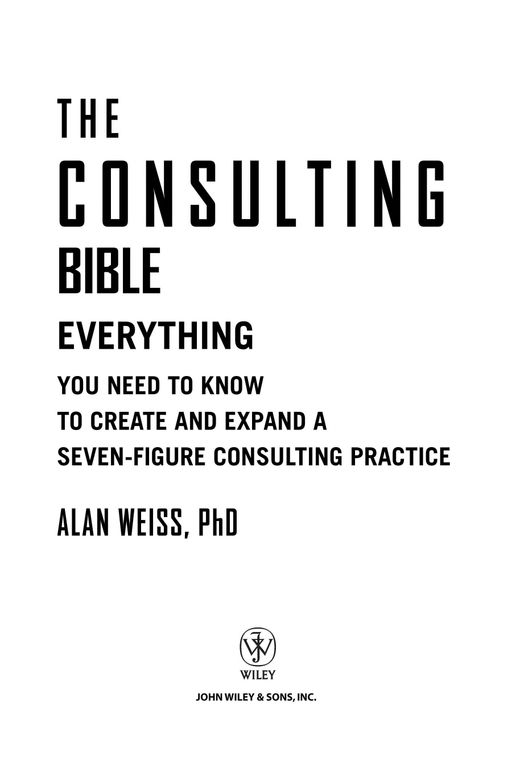
The consulting Bible
Introduction: The Consultant's Crisis of Identity
Introduction: The Consultant's Crisis of Identity
Nova: Welcome to The Strategy Session, the podcast where we dissect the foundational texts that shape modern business. Today, we are cracking open a massive tome, a veritable blueprint for independent success: Alan Weiss’s "The Consulting Bible."
Nova: : That's a bold title, Nova. "The Bible." It suggests definitive, perhaps even dogmatic, truth. What makes this book, and Weiss himself, so essential that it earns such a lofty label in a field as crowded as consulting?
Nova: That's the perfect entry point. Weiss argues that most people calling themselves consultants are actually just highly-paid order-takers, glorified temps who charge by the hour. He says they are vendors, not partners. The book isn't just about to consult; it’s about a consultant fundamentally is. He challenges the entire identity of the profession.
Nova: : So, this isn't just a collection of templates. It’s a philosophical manifesto for escaping the commodity trap. I’ve heard the term 'rock star of consulting' thrown around in relation to him. What’s the core philosophy that separates the 'rock star' from the average freelancer?
Nova: It boils down to positioning and value. Weiss insists you must stop being a vendor who sells time and start being a trusted advisor who sells guaranteed outcomes. He’s famous for his contrarian stance on pricing, which we’ll dive into, but first, we have to understand the mindset shift required to even for those prices. This book is the roadmap to that transformation, aiming squarely at the seven-figure practice.
Nova: : Seven figures. That’s the promise. For our listeners who are grinding out 60-hour weeks just to hit six figures, this sounds like the secret sauce. Let’s start there: the necessary mindset change required to even open this book and take it seriously.
Key Insight 1: Positioning for Indispensability
The Identity Crisis: Vendor vs. Trusted Advisor
Nova: Chapter one in the Weiss playbook is about defining who you are. He draws a sharp line between the vendor and the trusted advisor. A vendor executes tasks; an advisor changes the client's condition. The vendor is replaceable; the advisor is indispensable.
Nova: : That sounds great in theory, but how does a solo consultant, maybe someone just starting out, bridge that gap? If I’m hired to build a spreadsheet model, I’m selling a spreadsheet model, right? I’m a vendor of Excel skills.
Nova: Weiss would say you’re selling the of that spreadsheet model. Are you selling rows and columns, or are you selling the ability for the CEO to make a $5 million capital investment decision with 95% confidence? He forces you to articulate the latter. He stresses that you must learn and appreciate the origins and evolution of the profession itself to understand your inherent value.
Nova: : So, it’s about framing the conversation away from the 'how' and toward the 'why' and the 'what if.' I remember reading about his philosophy on coaching—that you shouldn't just provide answers, but ask better questions. Is that part of this positioning?
Nova: Absolutely. That’s a crucial piece of his philosophy. He advises coaches to stop providing suggested wording or methodologies, because if you do that, you’re just doing their subordinate work. Instead, you ask them what would do, and then you help them refine it. This elevates you from a task-doer to a strategic sounding board. It’s about intellectual partnership.
Nova: : That requires immense confidence, though. If I’m asking the client what they would do, I’m exposing myself to the risk that their idea is terrible. How does Weiss suggest we maintain authority while adopting this collaborative stance?
Nova: He ties it directly back to positioning. If you have established yourself as a 'Visible Expert'—a concept we’ll explore in a moment—your questions carry weight. You’re not asking from a position of weakness; you’re asking from a position of deep, proven experience. The book details the nine components of a successful consulting practice, and the first few are all about establishing this authority before you even pitch a project.
Nova: : It sounds like the work you do you get the client is more important than the work you do the client. Is that fair to say?
Nova: Precisely. He’s very clear: you are not in the consulting business; you are in the marketing business. Every professional service firm is fundamentally a marketing operation. If you can’t market the benefits of your services, you’re just an expensive hobbyist. This leads us perfectly into the next major theme: how do you market yourself when you’re trying to sell something intangible like 'improved condition'?
Nova: : And I assume the answer involves avoiding the classic mistake of just listing services on a website?
Nova: That’s amateur hour, according to Weiss. The Bible is packed with strategies to avoid that trap, focusing instead on creating a compelling value proposition that speaks directly to the client's pain points, not your service catalog. It’s about creating meaning in your own practice, which he calls 'Alanism'—life is about the creation of meaning, not the search for it.
Nova: : So, we shift from being reactive order-takers to proactive meaning-creators. That’s a significant pivot. Let’s talk about the mechanism that allows you to charge for that meaning, because that’s where the rubber meets the road: pricing.
Key Insight 2: Value-Based Fees
The Pricing Revolution: Killing the Billable Hour
Nova: If there is one concept Alan Weiss is most famous for championing, it’s the death of the hourly rate. He views charging by the hour as fundamentally unethical for a true consultant.
Nova: : Unethical? That’s a strong word. For many listeners, the hourly rate is the only way they know how to calculate revenue. Why is it unethical?
Nova: Because it rewards inefficiency and punishes expertise. If you solve a $10 million problem in one hour because you are brilliant, why should you be paid less than someone who takes 100 hours because they are slow? Weiss argues that fees should be dependent only on two things: the value provided and the client's perception of that value. This is Value-Based Pricing.
Nova: : I see the logic, but the practical application is terrifying for a new consultant. How do I quantify the value of my advice? If I tell a client, 'This strategy will save you $2 million,' and they pay me $200,000, what happens if they only realize $500,000 in savings? Do I owe them a refund?
Nova: That’s the common fear, and Weiss addresses it head-on. The key is in the. You don't just present a price; you present a proposal where the client explicitly agrees to the expected outcome and the fee structure the work begins. You are pricing the positive change, not the activity. The book details how to structure these agreements to mitigate risk for both parties.
Nova: : So, the negotiation isn't about the rate, it's about the scope of the transformation. If I can demonstrate that my intervention, even if it takes a short time, unlocks massive financial upside—say, streamlining a supply chain that saves millions annually—then a fee of $150,000 is a bargain for them.
Nova: Exactly. A bargain! He points out that clients are often far more willing to pay for a guaranteed result that impacts their bottom line than they are to pay for someone’s time spent analyzing data. He even notes how the legal profession, despite charging $1,000 an hour, recognizes the power of value-based structures in certain contexts.
Nova: : What about the consultant who immediately quantify the value? For instance, an HR consultant improving morale. Morale is hard to put a dollar figure on, even though it clearly impacts retention and productivity.
Nova: That’s where the 'trusted advisor' status comes in again. For softer outcomes, you focus on proxy metrics that the C-suite cares about: reduction in employee turnover costs, decrease in time-to-hire, or improved engagement scores that correlate with profitability. The Bible emphasizes that if you cannot articulate the value, you haven't done your homework on the client's business. You must be able to speak their language, which is the language of money, risk, and opportunity.
Nova: : It sounds like the entire framework forces the consultant to become an expert in the client’s business model, not just their own niche skill set. It’s a much higher bar.
Nova: It is a higher bar, but it’s the only bar that leads to a seven-figure practice without burning out. Hourly billing caps your income based on the hours in a day. Value-based fees cap your income based on the value you create, which is theoretically limitless. It’s the ultimate leverage tool, provided you have the marketing muscle to back up the price tag.
Key Insight 3: Building a Global Brand
The Visible Expert: Marketing for Attraction, Not Chasing
Nova: We established that consultants are in the marketing business. Now, let’s talk about Weiss says we should market. He champions the concept of the 'Visible Expert.' This is the antithesis of the consultant who waits for referrals.
Nova: : So, what does 'Visible Expert' mean in practice? Is it just having a big social media following, or is there more substance to it?
Nova: It’s substance first. It means you have a proprietary approach, a unique methodology, and you communicate that consistently through high-value content. Weiss has published over 60 books and 500 articles—that’s visibility built on intellectual property. The Visible Expert doesn't chase clients; clients seek them out because their expertise is undeniable and easily accessible.
Nova: : That sounds like a long game. If I’m trying to pay my rent next month, how do I implement this visibility strategy immediately? Are there tactical takeaways in the Bible for rapid client acquisition?
Nova: Yes, the book covers both the long-term brand building and the short-term tactics. For immediate impact, Weiss details how to craft your Value Proposition—it must clearly state how clients are improved. Then, you define your Ideal Buyers—not just industry, but specific titles and company types that have the budget and the pain point you solve best. You then focus all your marketing efforts laser-like on reaching only those people.
Nova: : I’ve seen consultants try to be everything to everyone. They list 'Strategy, Operations, HR, and IT implementation' on their website. Weiss must despise that, given his focus on specialization.
Nova: He despises it. He insists that breadth equals weakness in the consulting world. The Bible guides you to narrow your focus until you become the logical choice for a specific, high-value problem for a specific type of client. He even discusses how to market remotely to reduce costs and increase fees, which is incredibly relevant today.
Nova: : That remote marketing aspect is interesting. Does he suggest that visibility can be achieved without constant travel and in-person schmoozing?
Nova: Absolutely. Visibility is about being seen where your ideal buyers are looking. For many, that means industry publications, high-level conferences where you are speaking, or, increasingly, digital platforms where you are publishing definitive content. The goal is to create a system where your marketing efforts attract diverse clients globally, rather than relying on local word-of-mouth.
Nova: : It sounds like the entire marketing section is designed to support the value-based pricing model. If you charge a premium, you must look and act like a premium, singular authority. You can’t charge like a specialist if you market like a generalist.
Nova: Precisely. The marketing builds the credibility, the positioning justifies the fee, and the execution delivers the promised outcome. It’s a closed loop of professional excellence. The book doesn't just give you the theory; it gives you the structure for the entire business model, from the initial client interview to the final invoice.
Key Insight 4: Structure and Scaling
The Architecture of a Seven-Figure Practice
Nova: We’ve covered the mindset, the pricing, and the marketing. The final major theme in "The Consulting Bible" is the actual architecture—how to structure an independent or boutique practice to reliably hit that seven-figure mark and beyond.
Nova: : When we talk about a 'boutique practice,' does Weiss mean hiring a team, or is this still geared toward the highly successful solo practitioner who wants leverage?
Nova: It covers both, but the foundation is always the solo genius. He details how to scale without sacrificing quality, often through strategic alliances or subcontracting specialized tasks while maintaining ownership of the client relationship and the strategic direction. The key is leverage, not just headcount.
Nova: : Leverage is the magic word. In a traditional firm, leverage often means junior staff doing the grunt work. How does Weiss achieve leverage while maintaining that 'Trusted Advisor' status with the client?
Nova: By ensuring that the client sees the grunt work. The client only interacts with the principal—you—who is managing the strategy and delivering the high-level insights. The Bible suggests creating proprietary intellectual property—checklists, frameworks, models—that can be deployed repeatedly. This IP becomes the scalable asset, not just your time.
Nova: : That makes sense. If I have a proprietary 12-step process for organizational change, I can deploy that process for Client A, Client B, and Client C, charging full value each time, because the is the product, refined by my experience.
Nova: Exactly. And he provides guidance on the necessary operational components: proposal writing that locks in value pricing, contract negotiation that protects your intellectual property, and financial management that supports high-margin work. He doesn't shy away from the boring stuff; he elevates it to strategic necessity.
Nova: : I’m curious about the longevity aspect. Weiss has been doing this for decades. Does the book address how to avoid burnout when you’re constantly operating at this high level of strategic input?
Nova: It does, indirectly, by emphasizing efficiency and high fees. When you charge appropriately for the value, you can afford to work less, or at least work on more meaningful projects. He advocates for setting strict boundaries. If you are a $500,000-a-year consultant, you don't need 50 clients; you might only need five or six high-impact engagements per year. That frees up time for thought leadership, which feeds back into the 'Visible Expert' marketing engine.
Nova: : So, the structure is designed to create a self-sustaining ecosystem: high fees fund high-quality marketing, which attracts clients willing to pay high fees for proven, proprietary solutions. It’s a virtuous cycle built on discipline.
Nova: It is a cycle built on discipline, yes, but also on courage. Courage to walk away from low-paying, time-sucking work. Courage to state a fee that makes the client pause. The book is essentially a massive dose of courage, packaged with the tactical instructions to back it up. It’s why it remains a foundational text, long after its initial publication.
Conclusion: The Legacy of the Bible
Conclusion: The Legacy of the Bible
Nova: We’ve covered a lot of ground today, moving from the philosophical definition of a consultant to the hard mechanics of a seven-figure practice, all thanks to Alan Weiss’s "The Consulting Bible."
Nova: : If I had to distill the entire message into one sentence for a listener who is overwhelmed by the detail, what is the single most important takeaway?
Nova: The single most important takeaway is this: Stop selling your time. Start selling the guaranteed improvement of your client’s condition, and price that improvement based on its economic value, not your effort. Everything else—marketing, positioning, structure—is simply the scaffolding required to support that premium price.
Nova: : That’s powerful. It forces us to stop thinking like employees who clock in and start thinking like business owners whose value is externalized. For those ready to make the leap, the book emphasizes that you must be a salesperson, that competence alone is insufficient.
Nova: Absolutely. Competence is the price of entry, but marketing and positioning are the keys to the kingdom. Weiss gives you the tools to become the Visible Expert, the one who attracts the right opportunities, allowing you to walk away from the noise and focus only on transformational work.
Nova: : It’s a challenging read because it forces radical self-assessment. You have to look at your current business model and admit if you’re operating as a vendor. But the payoff—the freedom and financial reward of being a true trusted advisor—seems worth the confrontation.
Nova: It is the confrontation that leads to growth. Weiss’s work is a necessary disruption for anyone serious about professional services. It’s not about being the cheapest or the fastest; it’s about being the most valuable and articulating that value clearly.
Nova: : So, listeners, if you’re ready to trade your timesheet for a value proposition, this book is your essential guide. It’s a dense read, but the insights on value-based fees and expert positioning are worth the investment ten times over.
Nova: We couldn't agree more. Thank you for joining us for this deep dive into the principles that build enduring consulting empires. This is Aibrary. Congratulations on your growth!