

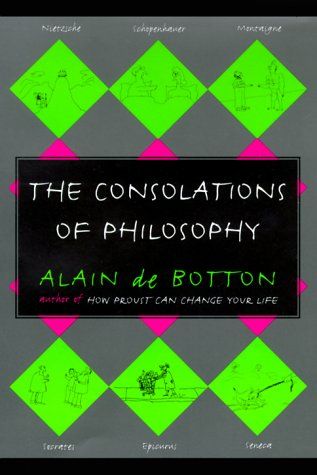
The consolations of philosophy
Introduction: Philosophy as a Survival Guide
Introduction: Philosophy as a Survival Guide
Nova: Welcome to 'The Aibrary,' the show where we excavate the past to build a better future. Today, we're diving into a book that promises something radical: that philosophy isn't just for dusty academics, but a genuine survival guide for the modern mess. We're talking about Alain de Botton’s bestseller, 'The Consolations of Philosophy.'
Nova: : That title alone is a promise, Nova. In a world that feels increasingly anxious, where do we even start looking for consolation? Is this just self-help dressed up in a toga?
Nova: That’s the perfect question, because De Botton actively fights that stereotype. He argues that modern life has stripped philosophy of its original purpose: to teach us how to live well. He says philosophy used to be a form of therapy, a practical tool. His book takes six major thinkers—Socrates, Epicurus, Seneca, Montaigne, Schopenhauer, and Nietzsche—and pairs each one with a specific, universal human affliction. It’s genius in its simplicity.
Nova: : So, instead of reading dense treatises, we get a philosopher assigned to our current crisis? That sounds incredibly targeted. Which affliction is the first on the docket? I’m guessing something about money, given how much we worry about it.
Nova: You’re close, but De Botton starts with something even more fundamental to our social existence: the fear of being unpopular. He kicks off with Socrates, the ultimate gadfly, and asks: How do we deal with being misunderstood or actively disliked? It’s a powerful opening because, in the age of social media, the fear of public shaming or just not fitting in is constant.
Nova: : That’s a fantastic hook. We’ve all felt the sting of a poorly received comment or a social slight. If Socrates, who literally drank hemlock because of his unpopularity, can offer comfort, I’m listening. Tell us how De Botton sets the stage for this ancient wisdom to feel relevant right now.
Nova: He frames it beautifully. He suggests that we often crave popularity not for its own sake, but because we believe popularity equals correctness. Socrates forces us to question that assumption. It’s about finding an internal compass strong enough to withstand external disapproval. It’s philosophy as intellectual armor. Let’s break down this first major theme: The Sting of Unpopularity, guided by the man who knew it best.
Nova: : Armor sounds good. I feel like I need a whole suit of it just to check my email some mornings. Let’s see what the ancient Athenians can teach us about surviving the Twitter mob, or whatever the modern equivalent is.
Nova: Exactly. Prepare to be consoled. This is 'The Aibrary,' and we’re starting our journey into the practical wisdom of the ages.
Key Insight 1: Finding Virtue in Being the Gadfly
Socrates: The Sting of Unpopularity
Nova: So, we start with Socrates. De Botton points out that Socrates was famously, aggressively unpopular. He was called the 'gadfly of Athens.' He annoyed people by constantly asking 'What do you actually mean by that?'
Nova: : The gadfly. I love that image. It’s so active. He wasn't just quietly disagreeing; he was actively buzzing around the established order until they had to swat him away. But how does that console us when we feel like we’re being swatted today?
Nova: De Botton uses Socrates to teach us that the desire for universal approval is fundamentally flawed. Socrates argued that the only approval worth having is the approval of the wise, and that the masses are rarely wise, especially when it comes to complex moral or intellectual issues. He suggests we should prioritize being right over being liked.
Nova: : That’s a tough pill to swallow, though. It’s easy to say when you’re a genius, but what if I’m just trying to suggest a new workflow at my office and everyone hates the idea? I still have to work with those people tomorrow.
Nova: That’s where De Botton’s modern application shines. He doesn't advocate for being a jerk. Socrates’ unpopularity stemmed from his commitment to truth and self-examination. De Botton suggests we should examine we are unpopular. Are we unpopular because we are challenging a lazy consensus with a necessary truth, like Socrates? Or are we unpopular because we are simply being arrogant or obtuse?
Nova: : Ah, the self-check. That’s the Socratic method applied internally. If I’m unpopular because I’m genuinely trying to improve things, even if it’s uncomfortable, then Socrates gives me permission to keep going, knowing the discomfort is temporary and perhaps even necessary for growth.
Nova: Precisely. De Botton quotes Socrates’ defense, where he essentially says, 'If you kill me, you will harm yourselves more than you harm me.' The point is that the truth-teller, even if silenced, has done a service to the community by forcing it to confront its own ignorance. The consolation is realizing that your integrity is more valuable than temporary social ease.
Nova: : So, the consolation isn't that people will suddenly love you, but that their opinion of you matters far less than your own commitment to what is good and true. That shifts the locus of control entirely inward. It’s a powerful antidote to the constant need for external validation.
Nova: It is. And De Botton highlights that Socrates wasn't just a martyr; he was a master of irony. He often pretended to know less than he did, which was another way of disarming his critics while still making his point. It shows that intellectual rigor doesn't have to be humorless.
Nova: : I’m picturing that now—the calm, slightly amused expression while everyone else is getting worked up. It’s about cultivating that inner calm. If we can accept that being misunderstood is part of the job description for anyone trying to think clearly, the sting lessens.
Nova: It transforms the insult from a personal attack into a signpost. 'Oh, they’re mad. That means I’m probably onto something important.' It reframes rejection as confirmation of your unique perspective. It’s a radical shift in perspective that sets us up perfectly for the next challenge: the anxiety of not having enough.
Nova: : From the public square to the private wallet. I’m ready for Epicurus to tell me how to stop obsessing over my bank balance.
Key Insight 2: The Art of Enough and Simple Pleasures
Epicurus: The Anxiety of Poverty
Nova: Next up, we have Epicurus, often wildly misunderstood. Most people hear 'Epicurean' and think of decadent feasts and endless luxury. De Botton uses Epicurus to address the modern anxiety over money and material lack.
Nova: : Right! I always thought Epicureanism was about indulgence. If he’s the philosopher for poverty, that means the book is going to completely flip that common understanding on its head, doesn't it?
Nova: Absolutely. De Botton explains that Epicurus wasn't advocating for hedonism; he was advocating for —a state of serene calmness, free from fear and pain. And he realized that the pursuit of endless luxury is the fastest way to that calm.
Nova: : Because the more you have, the more you have to lose, and the more you need to maintain that standard. It creates a treadmill of desire.
Nova: Exactly. Epicurus categorized desires into three types: natural and necessary, natural but unnecessary, and unnatural and unnecessary. The key consolation is realizing that the first category—the necessary ones—are incredibly easy to satisfy.
Nova: : So, if I have bread, water, and a roof, I’ve already met the Epicurean standard for a good life? That’s a massive relief in a consumerist society that tells us we need the latest gadget to be happy.
Nova: It is. De Botton emphasizes that Epicurus didn't preach total asceticism; he simply taught us to appreciate the simple things so deeply that the lack of extravagant things ceases to be painful. He famously said, 'Do not spoil what you have by desiring what you have not; remember that what you now have was once among the things you only hoped for.'
Nova: : That quote hits hard. I remember hoping for the apartment I have now, or the job I currently hold. We achieve the goal, and then immediately reset the goalpost further out. Epicurus seems to be telling us to pause and actually the achievement.
Nova: He is. And the greatest consolation he offers regarding money is that the things that truly bring happiness—friendship, intellectual conversation, security—are either free or very cheap. He valued his small garden community over the riches of kings. De Botton frames this as a necessary corrective to capitalism’s relentless focus on accumulation.
Nova: : It makes me think about how much time we spend money for things we don't actually need, time we could be spending cultivating those necessary things, like friendship. The trade-off is terrible when viewed through the Epicurean lens.
Nova: It is. And De Botton notes that Epicurus was particularly good at managing the fear of poverty. He taught that if you can be content with little, you are effectively rich, because no external force can truly impoverish you. You’ve already secured your baseline happiness.
Nova: : So, the consolation isn't about getting rich; it's about becoming immune to the of being poor. It’s a psychological shield against economic anxiety. That’s incredibly practical.
Nova: It is the ultimate psychological hedge. We move now from the fear of having too little to the frustration of not being able to enough, or not being able to control our circumstances. For that, we turn to the Stoic master, Seneca, and the problem of frustration.
Nova: : Seneca. I always associate him with enduring hardship. Let’s see how he helps us deal with the daily grind of things not going our way.
Key Insight 3: The Stoic Acceptance of External Events
Seneca: Dealing with Frustration and Lack of Control
Nova: Seneca, the Stoic, is De Botton’s guide for frustration—that feeling when you’ve done everything right, but the traffic is terrible, the project stalls, or the world simply refuses to bend to your will. The Stoic answer is radical acceptance.
Nova: : Acceptance sounds passive, Nova. If I accept that my project is delayed indefinitely, won't I just give up? I need a little productive anger to push through obstacles.
Nova: That’s the common modern misinterpretation of Stoicism. De Botton clarifies that Stoicism isn't about suppressing emotion; it’s about correctly assigning for that emotion. Seneca argues that we are rarely frustrated by events themselves, but by our about those events.
Nova: : So, the traffic isn't frustrating; my judgment that 'Traffic should never happen to me' is the source of the frustration. That makes sense, but it requires constant mental vigilance, doesn't it?
Nova: It requires practice. De Botton highlights Seneca’s focus on the dichotomy of control: what is up to us, and what is not up to us. Our opinions, our intentions, our responses—those are up to us. The outcome, the weather, other people’s actions—those are not. The consolation here is the immediate relief that comes from ceasing to fight unwinnable battles.
Nova: : It’s like realizing you’ve been trying to push a boulder uphill with your bare hands, and Seneca hands you a lever and says, 'Stop pushing the boulder; focus on moving the fulcrum.'
Nova: A perfect analogy. De Botton notes that Seneca often used the metaphor of an archer. The archer’s job is to aim perfectly, draw the bow correctly, and release cleanly. That is their control. Whether the arrow hits the target depends on the wind, the target moving, or a sudden gust—factors outside the archer’s domain. The archer can only be judged on the quality of the shot, not the result.
Nova: : That’s brilliant for professional life. We can be judged on the quality of our effort, our planning, and our execution, but we must release the outcome to the universe. It frees up so much mental energy that was previously wasted on worrying about the uncontrollable.
Nova: And Seneca was writing this while being an advisor to the notoriously volatile Emperor Nero! He was constantly under threat. His ability to remain composed wasn't because he was emotionless, but because he had mentally prepared for the worst possible outcome—exile or death—so that when minor frustrations occurred, they seemed trivial by comparison.
Nova: : So, the Stoic consolation is preemptive emotional inoculation. By contemplating disaster, we deflate the power of everyday annoyances. It’s a form of mental rehearsal for resilience.
Nova: Exactly. It’s about building an inner citadel. And this leads us beautifully into our next philosopher, who deals with a frustration that’s even more personal and pervasive: the feeling of not being good enough. We turn to the introspective master, Michel de Montaigne.
Nova: : Montaigne. The guy who invented the essay by just writing about his own life. I’m eager to see how his radical self-acceptance tackles modern inadequacy, especially when we’re constantly comparing our messy behind-the-scenes to everyone else’s curated highlight reel.
Key Insight 4: Embracing the Flawed and Inconsistent Self
Montaigne: The Burden of Inadequacy
Nova: Montaigne is De Botton’s antidote to inadequacy. In our hyper-competitive world, we feel pressure to be consistently brilliant, successful, and perfectly virtuous. Montaigne, however, celebrated inconsistency and imperfection.
Nova: : He was famously honest, wasn't he? I recall him writing about everything, even his kidney stones and his bowel movements, without shame. That level of transparency feels revolutionary even now.
Nova: It is. De Botton argues that Montaigne’s greatest gift is teaching us that we are not one single, consistent entity. We are a collection of contradictory impulses, shifting moods, and evolving opinions. Trying to force ourselves into a single, perfect mold is the source of our self-loathing.
Nova: : So, when I feel like a fraud because I was decisive yesterday but completely indecisive today, Montaigne would say, 'Welcome to the club. That’s just being human.'
Nova: Precisely. De Botton writes that Montaigne suggests we should stop trying to be a statue and accept that we are more like a flowing river—always changing, sometimes muddy, sometimes clear. The consolation is that self-acceptance doesn't require perfection; it requires honest observation.
Nova: : But how does this help when inadequacy manifests as professional failure? Say I bombed a presentation. The world sees the failure, not my internal river of contradictions.
Nova: Montaigne shifts the focus from the external to the internal of self-understanding. He suggests that the most important thing is to understand you failed, not just to beat yourself up over the failure itself. He valued the process of introspection over the final product. De Botton notes that Montaigne’s essays are essentially a record of his attempts to know himself, flaws and all.
Nova: : It’s a shift from 'I am a failure' to 'I experienced a failure, and now I will study that experience.' That’s a crucial distinction. It turns failure into data rather than a permanent identity marker.
Nova: And De Botton points out that Montaigne’s honesty was also a form of social critique. By being so open about his own weaknesses—his vanity, his occasional cowardice—he implicitly gave everyone else permission to be less than perfect too. He lowered the bar for acceptable human behavior from the divine to the merely human.
Nova: : That’s a huge service to the collective psyche. We’re exhausted trying to maintain an impossible façade. If the great essayist admits he’s a bit of a mess, then maybe my messiness is just my unique texture.
Nova: It is. And De Botton connects this to our modern obsession with branding. We curate our lives for public consumption. Montaigne’s consolation is that the most interesting, most authentic life is the one lived in full view of one’s own inconsistencies. It’s about being a good companion to yourself, even when you’re being difficult.
Nova: : So, we’ve gone from Socrates telling us to stand firm against the crowd, to Epicurus telling us to be content with little, to Seneca telling us to control our judgments, and now Montaigne telling us to be kind to our own messy nature. It’s a comprehensive toolkit. Who’s left to tackle the truly heavy stuff, like existential dread or deep sorrow?
Nova: That’s where we bring in the pessimist champion, Arthur Schopenhauer, to address the agony of heartbreak. Prepare yourself; this section is surprisingly comforting, precisely because of its darkness.
Nova: : Schopenhauer and heartbreak. That sounds like a recipe for wallowing, but I trust De Botton to find the silver lining in the abyss.
Key Insight 5: Finding Company in Universal Suffering
Schopenhauer: The Agony of Heartbreak
Nova: We arrive at Schopenhauer, the philosopher famous for his bleak view of the world as driven by a blind, insatiable Will. When dealing with heartbreak, De Botton suggests Schopenhauer is the perfect guide because he validates the depth of the pain.
Nova: : Most self-help books tell you to 'look on the bright side' after a breakup. Schopenhauer is probably telling you the bright side is a lie, which, honestly, feels more honest when you’re devastated.
Nova: Exactly. The consolation from Schopenhauer isn't that the pain will vanish quickly, but that the pain is and. He argues that romantic love is often just the Will of the species tricking us into procreation. Once that illusion fades, the suffering is exposed.
Nova: : Ouch. That’s harsh, but it’s also strangely liberating. If my intense, world-ending sorrow is just the universe playing out a biological script, maybe it’s less about being uniquely broken and more about me experiencing a fundamental human condition.
Nova: That’s the core comfort. De Botton explains that Schopenhauer’s pessimism allows us to feel our suffering fully without the added layer of guilt or self-blame that we should be 'over it by now.' He normalizes the agony. He says that the intensity of our suffering is proportional to the depth of our illusion about how wonderful life or that specific relationship was supposed to be.
Nova: : So, the consolation is solidarity in suffering. We are not alone in this specific flavor of despair; every great thinker who has ever loved has felt this exact, crushing weight.
Nova: Yes. And De Botton highlights a key point: Schopenhauer suggests that the intensity of heartbreak is actually a measure of our capacity for deep feeling. It’s a sign that we are capable of profound connection, even if the object of that connection is gone. The pain proves the capacity for joy existed.
Nova: : That reframes the entire experience. It’s not a sign of weakness; it’s evidence of emotional strength, even if that strength is currently being used to fuel misery. What about moving forward? Does Schopenhauer offer a path out?
Nova: He does, through art and contemplation. Once you accept the universal nature of suffering, you can step back slightly and observe it, much like an artist observing a tragic scene. You move from being the victim the drama to being the observer the drama. This detachment, achieved through intellectual recognition, lessens the immediate emotional grip.
Nova: : It’s about intellectualizing the emotion just enough to gain perspective, without denying the emotion itself. It’s a very fine line to walk.
Nova: It is, and De Botton makes it clear that Schopenhauer is not the final word, but the necessary validation. You need to feel the depth of the hole before you can appreciate the ladder. And the final philosopher, Nietzsche, is the one who hands you the tools to climb out, focusing on overcoming hardship.
Nova: : From the depths of despair to the heights of self-overcoming. That sounds like a powerful transition to wrap up our philosophical journey.
Conclusion: Philosophy as a Lifelong Practice
Conclusion: Philosophy as a Lifelong Practice
Nova: We’ve covered a lot of ground today, moving from the public square with Socrates to the private agony of heartbreak with Schopenhauer. If there is one overarching takeaway from De Botton’s 'The Consolations of Philosophy,' what is it?
Nova: : I think the biggest realization is that philosophy isn't an abstract subject; it’s a series of highly specific, personalized tools. We tend to think of philosophy as debating metaphysics, but De Botton shows us it’s about asking, 'How do I handle being unpopular today?' or 'How do I appreciate what I have right now?' It democratizes wisdom.
Nova: Absolutely. The key action item for our listeners is to stop seeing these thinkers as historical figures and start seeing them as consultants. When you feel inadequate, don't just scroll social media; ask, 'What would Montaigne say about this specific flaw I’m obsessing over?' When you’re frustrated, ask, 'Am I blaming external events for my internal judgment, like Seneca advised?'
Nova: : It forces us to categorize our suffering, which immediately reduces its overwhelming power. If I can label my problem—'Ah, this is an Epicurean problem of desiring the unnecessary'—it suddenly seems manageable, not existential.
Nova: And the final, profound consolation is that these thinkers, despite their flaws and their historical distance, were deeply human. Socrates faced execution, Epicurus lived simply to avoid fear, and Schopenhauer knew profound sorrow. They weren't perfect gurus; they were people who struggled and developed systems to cope with those struggles. Their wisdom is earned, not gifted.
Nova: : It makes the whole endeavor feel achievable. We aren't expected to become geniuses overnight, but we are encouraged to adopt a philosophical —one of inquiry, acceptance, and self-awareness.
Nova: That’s the perfect summary. De Botton’s work is a powerful reminder that the greatest luxury isn't wealth or fame, but a well-examined life equipped with the wisdom of the ages to navigate the inevitable bumps. It’s about making philosophy indispensable again.
Nova: : It certainly makes me want to reread those old texts with a new, practical lens. Thank you, Nova, for guiding us through this incredibly useful tour of ancient therapy.
Nova: My pleasure. Remember, the answers to life’s biggest challenges might just be waiting in the collected works of a few very thoughtful, very opinionated dead people. This is Aibrary. Congratulations on your growth!