

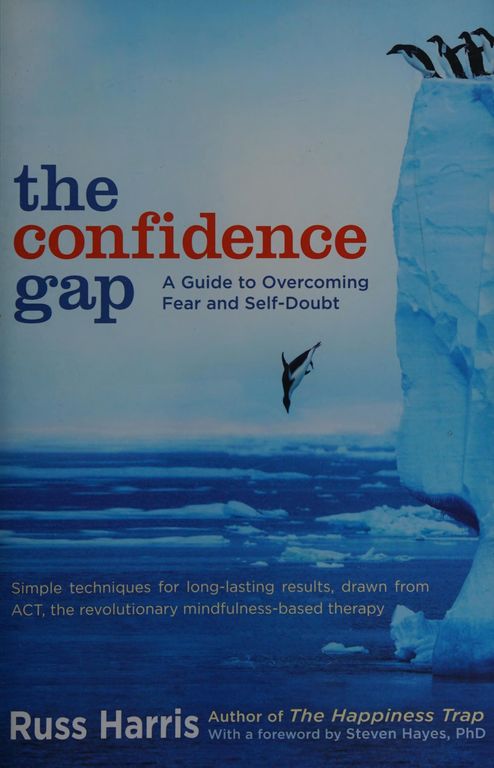
The confidence gap
Introduction: The Paradox of Feeling Ready
Introduction: The Paradox of Feeling Ready
Nova: Welcome back to The Deep Dive. Today, we are tackling a concept that trips up nearly everyone: confidence. We’re unpacking Russ Harris’s phenomenal book, The Confidence Gap: A Guide to Overcoming Fear and Self-Doubt. And I have to start with the most provocative idea from this book.
Nova: : Wait, provocative? I thought confidence was about feeling good about yourself before you act. What’s the provocation?
Nova: Exactly. Harris flips the script entirely. He argues that the vast majority of us are waiting for confidence to show up before we take the leap. We think, 'I’ll apply for that job when I feel confident enough,' or 'I’ll start that business when I feel sure of myself.' That, he says, is the trap. The Confidence Gap is the space between where we are and where we want to be, a gap widened by waiting for feelings that may never arrive.
Nova: : So, the book’s central thesis is that confidence isn't a prerequisite for action; it's the side effect of action? That sounds almost too simple, or maybe too hard, depending on how much fear I’m currently wrestling with.
Nova: It’s both. It’s simple in concept, but requires a total mindset shift in practice. Harris grounds this entire philosophy in Acceptance and Commitment Therapy, or ACT. He’s essentially saying: Stop trying to confident, and start what matters to you, even when you’re terrified. That’s what we’re diving into today: how to stop waiting for the feeling and start building real, resilient confidence.
Nova: : I’m already intrigued. Because I know I’ve put off huge opportunities waiting for that elusive 'feeling ready' moment. Let’s start by dissecting this 'Gap.' What exactly is the traditional, flawed view of confidence that Harris is fighting against?
Nova: Let’s jump right into Chapter One. We need to understand the enemy: the myth of prerequisite confidence.
Key Insight 1: Confidence Follows Action, Not the Reverse
The Myth of Prerequisite Confidence
Nova: Harris points out that we treat confidence like a magical shield we must possess before entering the arena. We see successful people and assume they never felt doubt. But Harris, drawing from decades of clinical work, tells us that’s a performance. Everyone feels doubt. The difference is what they do next.
Nova: : That makes sense when you look at elite athletes or performers. They don't stop practicing because they feel nervous before a game; they practice the nervousness present. But for the average person trying to speak up in a meeting, that nervousness feels like a stop sign.
Nova: Precisely. And this is where the traditional model fails us. It suggests that if we feel fear, anxiety, or self-doubt—the 'negative' internal experiences—we must eliminate them before proceeding. Harris calls this 'experiential avoidance.' We avoid the feeling, and by avoiding the feeling, we avoid the action that would build our competence and, subsequently, our confidence.
Nova: : Experiential avoidance. That’s a clinical term for procrastinating because you’re scared of looking foolish. If I avoid sending that difficult email, I avoid the anxiety of potential conflict, but I also avoid the confidence boost of having handled a tough situation well.
Nova: You nailed it. And Harris emphasizes that trying to force positive feelings or suppress negative ones is exhausting and ultimately counterproductive. Think about trying to hold a beach ball underwater. The harder you push it down, the more energy it takes, and the more violently it pops back up. Negative thoughts and feelings are like that beach ball. The moment you stop fighting them, they lose their power to dictate your behavior.
Nova: : So, if we stop fighting the feeling, what do we start fighting? If we aren't fighting for confidence, what is the new target? Is it just 'doing stuff'? That still feels vague.
Nova: It’s not just 'doing stuff.' It’s doing stuff that aligns with who you fundamentally want to be. This brings us to the first major pillar of the ACT approach: Values. This is the engine that drives action when feelings are unhelpful. We need to move from chasing feelings to pursuing purpose.
Nova: : That sounds like a massive pivot. We’re moving from an internal, emotional metric—'How do I feel?'—to an external, directional metric—'Where am I going?' I think we need a whole chapter on this concept of values, because that’s the anchor Harris provides when the sea of doubt gets rough.
Key Insight 2: Defining What Truly Matters
Values as Your Compass, Not Goals as Your Destination
Nova: Harris makes a crucial distinction between goals and values. Goals are destinations: 'I want to get promoted,' or 'I want to lose 20 pounds.' They are achievable and finite. Values, on the other hand, are directions. They are ongoing ways of living.
Nova: : Give me an example. If my goal is to 'write a novel,' what’s the corresponding value?
Nova: The value might be 'Creative Expression' or 'Sharing Insight.' You can live the value of Creative Expression today by writing one good sentence, even if the novel isn't finished for another five years. If your goal is 'Get a promotion,' the value might be 'Leadership' or 'Making a Positive Impact.' You can practice leadership today by mentoring a junior colleague, regardless of your title.
Nova: : That reframing is powerful. It means I can be successful at living my life, even if the big goal is far off. It decouples my daily self-worth from the achievement of a distant milestone.
Nova: Exactly. And Harris stresses that when you act based on your values, the fear and doubt become less important. They are just background noise. If your value is 'Being a supportive partner,' and you feel anxious about having a difficult conversation, you still have a clear reason to have that conversation. The anxiety is present, but the for acting is bigger than the anxiety.
Nova: : I’m picturing it like this: If I’m sailing, the goal is to reach a specific island. But the value is 'Exploration.' If a storm hits, I might have to change course temporarily to survive, but my value of Exploration keeps me pointed generally toward the sea, not back to the harbor out of fear. Is that a fair analogy for how ACT views values?
Nova: That is an excellent analogy. And Harris provides exercises to help clarify these values—he doesn't just tell you to have them. He asks you to imagine your 80th birthday and what you would want people to say about how you lived. He asks you to look at the areas of life: work, relationships, health, personal growth. Where are you living your values, and where are you stuck in the Gap?
Nova: : I remember reading about the concept of 'living small' when we avoid things out of fear. If I avoid public speaking because I fear judgment, I’m not just avoiding the speech; I’m avoiding the value of 'Sharing Knowledge' or 'Influencing Others.' That avoidance shrinks my world.
Nova: It shrinks your world dramatically. And the beautiful irony Harris points out is that by avoiding the discomfort associated with living big—the discomfort of potential failure or judgment—we end up living a life that is far more uncomfortable in the long run, because it’s inauthentic and unfulfilled. The fear of the moment is traded for the regret of a lifetime. So, once we have our compass—our values—how do we handle the inevitable internal resistance that pops up when we try to move in that direction?
Nova: : That’s where the real ACT magic comes in, right? Dealing with the internal critics. I think we need to talk about cognitive defusion. It sounds very technical, but I suspect it’s the most practical tool in the book for silencing the inner critic.
Key Insight 3: Changing Your Relationship with Your Thoughts
The ACT Toolkit: Defusion and Acceptance
Nova: Cognitive Defusion is Harris’s term for stepping back from your thoughts. It’s not about changing the content of the thought—you can’t just argue yourself out of 'I’m going to fail.' It’s about changing your with the thought. You stop treating thoughts as literal commands or objective truths.
Nova: : How do you practically do that? If I’m thinking, 'This presentation is going to be a disaster,' how do I defuse that?
Nova: Harris offers several brilliant, almost playful techniques. One is to add a preface. Instead of 'I am a failure,' you say, 'I am having the thought that I am a failure.' That tiny linguistic shift creates distance. You are no longer the thought; you are the observer of the thought.
Nova: : That’s subtle but huge. It moves the thought from being a statement of fact to being a piece of mental weather passing through. What’s another technique? Because sometimes just adding 'I am having the thought' isn't enough when the emotion is spiking.
Nova: Another powerful one is to treat the thought like a song lyric stuck on repeat. Harris suggests singing the thought to the tune of 'Happy Birthday' or repeating it very quickly until it loses all meaning. It turns the serious, threatening thought into something silly and abstract. It breaks the fusion.
Nova: : I love that. It weaponizes absurdity against anxiety. But what about the itself? Defusion handles the thoughts, but what about the physical sensation of anxiety—the tight chest, the racing heart? That’s where acceptance comes in, correct?
Nova: Absolutely. Acceptance, in the ACT sense, is not resignation. It’s not saying, 'I like feeling anxious.' It’s saying, 'I notice I am feeling anxious right now, and I choose to take this feeling with me as I move toward my value.' It’s making room for the discomfort.
Nova: : So, if I’m giving that presentation, I accept the tight chest. I don't try to relax it, I don't try to distract from it. I just acknowledge, 'Hello, tight chest. You are here. I’m still going to talk about Q3 projections now.'
Nova: Precisely. Harris often uses the analogy of a passenger on a bus. Fear and doubt are passengers. You can’t kick them off the bus—they bought a ticket, they are coming along for the ride. But you, the driver, decide the destination based on your values. You don't let the passengers steer. The goal isn't a bus ride without passengers; it's a bus ride to the right destination, regardless of who is sitting next to you.
Nova: : That passenger analogy is incredibly sticky. It reframes the entire internal struggle from a battle to a negotiation where you hold the ultimate authority. If we can master defusion and acceptance, we are ready for the final step: building the engine of confidence through committed action.
Key Insight 4: Building Competence Through Practice
Committed Action: The Confidence Engine
Nova: This is where the rubber meets the road. Committed Action is the process of taking concrete, value-driven steps, even when you feel the fear, doubt, and discomfort we just discussed. This is the only way to bridge the Confidence Gap.
Nova: : Harris outlines a practical cycle here, right? It’s not just one big action, but a series of manageable steps. I recall seeing something about four steps to follow in order to become more confident in any action.
Nova: Yes, he breaks down the process of skill acquisition and confidence building into a repeatable loop. Step one is: Practice the skills. This is preparation, but crucially, it’s practice the intention of applying it in a real-world, slightly uncomfortable setting.
Nova: : So, if I’m nervous about networking, I don't just read a book on networking. I practice my opening line on my dog, then on a trusted friend, then maybe I attend a low-stakes virtual event just to say hello to one person.
Nova: Exactly. Step two is: Apply them effectively. This is taking that practiced skill into the real world, armed with your defusion and acceptance tools. You are testing the waters, not trying to win the ocean.
Nova: : And this is where the confidence starts to build, because even if the application isn't perfect, you survived the experience. You proved to your brain that the catastrophic outcome you predicted didn't materialize.
Nova: That’s the core feedback loop. Step three is: Assess the results. But Harris insists you assess based on your, not on external validation. Did you act in alignment with your value of 'Connection' by initiating that conversation? Yes. Great. That’s a win, regardless of whether the other person was fascinating or boring.
Nova: : And the final step? Closing the loop?
Nova: Step four is: Adjust and repeat. You look at what worked and what didn't, not as a judgment on your worth, but as data for the next attempt. This turns every attempt into a learning opportunity, not a pass/fail test of your inherent capability. This iterative process is what builds genuine, robust confidence—the kind that sticks, because it’s built on evidence of your own behavior, not on fleeting positive self-talk.
Nova: : It’s fascinating how this model removes the pressure. If I fail, I haven't failed at being confident; I’ve simply gathered data on how to better apply my value-driven action next time. It’s a system designed for resilience.
Nova: It is. And Harris suggests that if you commit to this cycle—Values, Defusion, Acceptance, Committed Action—the feeling of confidence will naturally start to show up more often, not as the starting gun, but as the applause after you’ve already run the race. It’s a profound shift from seeking internal validation to demonstrating external commitment.
Conclusion: Living Beyond the Gap
Conclusion: Living Beyond the Gap
Nova: We’ve covered a lot of ground today, moving from the paralyzing myth of prerequisite confidence to the actionable framework provided by Russ Harris in The Confidence Gap. The key takeaway, I think, is that confidence isn't a trait you are born with or without; it’s a skill you build through intentional, value-driven action.
Nova: : Absolutely. The biggest shift for me is realizing that the internal noise—the fear, the doubt, the self-criticism—is just noise. It’s the passenger on the bus. Our job isn't to silence the passenger; it’s to keep our hands firmly on the wheel, steering toward what we define as a meaningful life through our values.
Nova: And remember the tools for handling that noise: Cognitive Defusion—treating thoughts as just thoughts, not commands—and Acceptance—making room for the discomfort so it doesn't block the path. You don't need to feel brave to be brave; you just need to act bravely, even if your knees are knocking.
Nova: : So, for our listeners who feel stuck in that gap right now, what’s the single most actionable thing they can do this week based on this book?
Nova: Don't try to overhaul your entire life. Pick one small area where you’ve been avoiding action because of fear. Then, clearly define the underlying value you are avoiding. Is it connection? Creativity? Honesty? Once you have the value, take one tiny, committed action toward it this week, fully expecting the doubt to show up. Don't wait for the feeling of confidence; just take the step. That small step is the first brick in closing the gap.
Nova: : It’s about choosing direction over feeling. It’s about building evidence of your own capability, one small, value-aligned action at a time. Russ Harris gives us permission to be imperfectly courageous.
Nova: Exactly. Stop waiting for the feeling of readiness. Start moving. The readiness will catch up. This is Aibrary. Congratulations on your growth!