

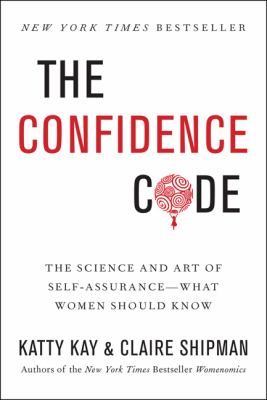
The Confidence Code
Introduction
Nova: What if I told you that competence and hard work aren't enough to get you promoted? What if you could be the most qualified person in the room and still watch someone less capable sail past you? That's the uncomfortable reality Katty Kay and Claire Shipman uncovered in their groundbreaking book, The Confidence Code. And it explains a lot about why, half a century after women stormed the boardrooms, they still hold barely a fraction of top leadership positions.
Nova: Co-host: So the central argument is that confidence, not just competence, is the real currency of career success?
Nova: Exactly. Kay and Shipman are both veteran journalists. Katty Kay is a BBC World News anchor, Claire Shipman a longtime ABC News correspondent. They spent decades interviewing some of the most powerful women in the world and kept noticing the same thing: behind closed doors, even the most accomplished women were drowning in self-doubt. These were women running countries, running companies, making history, yet they felt like frauds. And so Kay and Shipman set out to answer a single, urgent question: why is there such a massive confidence gap between men and women, and what can we actually do about it?
Nova: Co-host: That's a bold thesis. And I'm already thinking: is this really a thing, or are they cherry-picking anecdotes from their Rolodex?
Nova: Fair question. But here's the thing: the data is staggering. When Hewlett-Packard reviewed its personnel records, it discovered that women only applied for a promotion when they met 100 percent of the qualifications. One hundred percent. Men? They threw their hat in the ring when they met just 60 percent. There's also a famous 2011 survey from the UK's Institute of Leadership and Management showing that half of female managers reported self-doubt about their performance, versus fewer than a third of male managers. So it's not just anecdotes. It's a measurable, persistent pattern.
Nova: Co-host: So the confidence gap is real. And the book is essentially a detective story tracing where it comes from and how to close it.
Nova: That's the perfect way to put it. Today, we're cracking open The Confidence Code: the science, the stories, and the surprisingly hopeful news that confidence isn't something you either have or you don't. It's something you can build. Let's dig in.
Key Insight 1
What Confidence Actually Is and Why It Matters
Nova: Before we talk about the gap, we should define what Kay and Shipman actually mean by confidence. They don't mean swagger. They don't mean being the loudest person in the room. Their definition is both simple and powerful: confidence is the bridge between thoughts and actions.
Nova: Co-host: Okay, unpack that for me.
Nova: Imagine you have a great idea during a meeting. You know it's good. But instead of speaking up, you hesitate. You second-guess. You tell yourself someone else will say it. That hesitation, that gap between your thought and the action of actually raising your hand, is where confidence lives or dies. Confidence is the thing that turns your abilities into visible, tangible results.
Nova: Co-host: So it's the ignition switch. You can have a full tank of competence but if the engine doesn't turn over, you're not going anywhere.
Nova: Exactly. And this is where the book gets really provocative. Kay and Shipman argue that confidence actually matters as much as competence, maybe even slightly more in certain contexts, as long as the gap between the two isn't enormous. They cite a fascinating study by psychologist Cameron Anderson from 2009. He gave students a list of historical names and events, some real, some fake. The students who confidently checked off the most fakes, meaning they were the most overconfident, ended up being the most respected and influential members of their groups.
Nova: Co-host: Wait, so being confidently wrong beats being quietly right?
Nova: Disturbing, isn't it? The point isn't to be wrong. The point is that humans are wired to respond to confidence. We interpret it as a signal of competence. The person who believes they belong in the room often ends up owning the room, even if they aren't the smartest person in it. And Kay and Shipman argue that women, on average, are far less willing to project that kind of self-assurance unless they feel absolutely certain.
Nova: Co-host: Which brings us to the confidence gap itself.
Key Insight 2
The Confidence Gap by the Numbers
Nova: Let's put some numbers on this. At Manchester Business School, professor Marilyn Davidson asks her students every year what they expect to earn five years after graduation and what they think they deserve to earn. Every year for seven years, the men said they deserved around eighty thousand dollars. The women? Sixty-four thousand. That's a twenty percent gap in self-perceived worth before anyone's even hired them.
Nova: Co-host: That's a huge difference just in what you think your labor is worth.
Nova: And then there's the negotiation research from Linda Babcock at Carnegie Mellon. She found that men initiate salary negotiations four times as often as women. And when women do negotiate, they ask for thirty percent less. Multiply that over a forty-year career and you're talking about a massive cumulative disadvantage.
Nova: Co-host: But is this really about confidence, or is it about women being penalized for negotiating? There's research showing women get backlash for assertiveness in ways men don't.
Nova: Both things can be true, and Kay and Shipman acknowledge that. But they also point to a 2003 study by Cornell psychologist David Dunning and Washington State's Joyce Ehrlinger. They gave male and female students a scientific reasoning quiz. Before the quiz, women rated their scientific ability at 6.5 out of 10. Men rated themselves at 7.6. After the quiz, women guessed they got 5.8 out of 10 correct. Men guessed 7.1. Actual performance? Women scored 7.5, men 7.9. Nearly identical.
Nova: Co-host: So women underestimate, men overestimate, and the actual results are basically the same.
Nova: And here's the kicker. After the quiz, students were invited to participate in a science competition for prizes, not knowing their scores. Seventy-one percent of men signed up. Only forty-nine percent of women did. That's the confidence gap in action. Women didn't need to be better; they just needed to believe they were good enough to try. And that's the tragedy Kay and Shipman keep returning to: the talent isn't missing. The belief is.
Deep Dive
Biology, Brains, and Why Women Overthink
Nova: So where does this gap come from? Kay and Shipman went deep into neuroscience and genetics, and what they found is fascinating. Confidence is partly hardwired. They visited neuropsychologist Steve Suomi, who studies rhesus monkeys at his lab in Maryland. These monkeys share a serotonin transporter gene remarkably similar to humans.
Nova: Co-host: Serotonin being the neurotransmitter linked to mood and calm.
Nova: Right. The gene comes in three variants: one that processes serotonin efficiently, one moderately, and one poorly. Suomi found that the monkeys with the efficient variant were resilient, bold, and confident. Those with the poor variant were anxious and withdrawn. Behavioral geneticist Robert Plomin then replicated this in humans, studying fifteen thousand sets of twins in Britain. He found that confidence is at least twenty-five percent genetic. Possibly as high as fifty percent.
Nova: Co-host: So a quarter to half of your confidence is basically a genetic hand you're dealt.
Nova: Yes. And here's where the gender twist comes in. The favorable variants of these genes are equally distributed across men and women. But women produce about fifty-two percent less serotonin than men. And women with the unfavorable gene variants are much more prone to anxiety than men with the same variants. Then you add brain structure differences. Psychiatrist Daniel Amen found that female brains have about thirty percent more neurons firing at any given moment compared to male brains.
Nova: Co-host: More neural activity. So women's brains are literally busier.
Nova: Especially in the frontal cortex, the home of reasoning, and the limbic cortex, the home of emotion. And women have more white matter connecting the two hemispheres, meaning they integrate information across both sides of the brain more readily. The upside is that women tend to be excellent multitaskers, deeply empathetic, and intuitive. The downside is a higher susceptibility to overthinking, rumination, anxiety, and even insomnia.
Nova: Co-host: So the biological setup that makes women great at seeing the big picture also makes them more likely to spiral into self-doubt. That's a real double-edged sword.
Nova: And then there are hormones. Men have roughly ten times more testosterone than women, and testosterone is linked to risk-taking and ego. Estrogen, dominant in women, encourages bonding, connection, and conflict avoidance. Kay and Shipman argue that this biological cocktail means women are neurologically primed to pause, evaluate, and question, while men are chemically wired to charge ahead.
Nova: Co-host: But they're not saying women are doomed by biology, right?
Nova: Absolutely not. This is the hopeful part. Epigenetics shows that genes can switch on and off based on life experiences. The brain is plastic. You can rewire it. The book's message isn't that women are stuck; it's that understanding your hardware helps you decide where to apply the software updates.
Practical Strategies
Mastery, Failure, and the Action Cure
Nova: So if biology isn't destiny, what actually builds confidence? Kay and Shipman's answer is surprisingly straightforward: action. Confidence doesn't come before action. It comes through action. They call it the mastery loop.
Nova: Co-host: Explain that.
Nova: Think of Katty Kay learning to kiteboard. She describes being dragged through the water, falling constantly, getting frustrated and sore. It took years. But eventually, through repeated effort and failure, she figured it out. Now she rides with genuine confidence. The confidence didn't arrive first. The doing did.
Nova: Co-host: So confidence is a byproduct of struggle, not a prerequisite for it.
Nova: That might be the book's most counterintuitive and important message. Kay and Shipman emphasize that you have to be willing to fail fast. Perfectionism is the enemy of confidence because it keeps you from starting. Women in particular tend to believe they need to be perfectly prepared before they act. The authors call this the perfectionism trap. You wait until you're fully ready, but you're never fully ready, so you never start.
Nova: Co-host: Hence the HP statistic: women want one hundred percent of qualifications before applying. Men are fine with sixty percent.
Nova: Exactly. The book's advice is to aim for mastery, not perfection. Mastery is about the process, the learning, the gradual improvement. Perfection is about a pristine, untouchable end state that doesn't exist. Kay and Shipman also talk about something called externalizing attribution. Research shows that when men fail, they tend to blame external factors: the market was tough, the timing was off. When women fail, they tend to internalize: I wasn't good enough, I'm not smart enough.
Nova: Co-host: So men protect their self-image by pointing outward, and women erode theirs by pointing inward.
Nova: That's it. The book encourages training yourself to recognize this pattern and deliberately broaden your attribution. Did you fail? Okay. What external factors contributed? What did you actually do well? What can you learn? The goal is to treat failure as data, not as an indictment of your worth.
Nova: Co-host: What about the inner critic? The voice in your head that says you're going to mess up?
Nova: Kay and Shipman call those NATs: Negative Automatic Thoughts. And they argue that people with killer NATs consistently have low confidence. The antidote is reframing. When your brain says, I'm going to blow this presentation, you consciously reframe: I've prepared thoroughly, and even if it's not perfect, I have valuable things to say. It sounds simple, but it's a deliberate practice. You're essentially building a mental firewall against toxic self-talk.
Nova: Co-host: So the prescription is: act before you feel ready, let yourself fail, learn from it, blame less, reframe more, and repeat.
Conclusion
Nova: Here's what I love about The Confidence Code: it doesn't let anyone off the hook. Kay and Shipman tell women that waiting for confidence to magically appear before you take action is backwards. You have to act your way into confidence. But they also make clear that workplaces, institutions, and society at large need to recognize that confidence and competence are not the same thing, and that rewarding the loudest voice in the room often means missing the best idea.
Nova: Co-host: So the takeaway isn't just that women need to change. The system needs to change too. But the immediate, actionable part for any individual listening is that confidence is a skill, not a fixed trait.
Nova: Exactly. Let's distill the key strategies from the book. One: take action before you feel ready. Confidence follows action, not the other way around. Two: embrace imperfection. Done is better than perfect. Three: fail fast and learn faster. Treat setbacks as data, not as identity. Four: externalize your attributions. Not everything is your fault. Five: reframe your negative automatic thoughts. Your inner critic is not the voice of truth. Six: speak up and be visible. Competence that stays silent might as well not exist.
Nova: Co-host: And I'd add a seventh from the science: just because genetics accounts for twenty-five to fifty percent of your confidence baseline doesn't mean you're stuck. The brain is plastic. Every time you take a small risk and survive, you're physically rewiring your neural pathways toward greater confidence.
Nova: Beautifully put. Kay and Shipman leave readers with a paradox that's also a liberation: you don't need to feel confident to be confident. Confidence is what happens when you stop waiting for permission from your own brain and just start doing the thing anyway. The book is a reminder that the women who have broken through to the top didn't get there by eliminating self-doubt. They got there by acting in spite of it.
Nova: Co-host: This is Aibrary. Congratulations on your growth!