The Macro-Economic Landscape and Human Adaptation
Golden Hook & Introduction
SECTION
Nova: If you are waiting for a quiet, stable moment to finally figure out your career or your investments, you might be waiting on a world that literally does not exist anymore.
Atlas: Oh, that is a bit of a wake-up call to start the morning. But honestly, it resonates. It feels like every time we finally get a handle on a new tool or a market trend, the ground shifts again. It is exhausting trying to keep up.
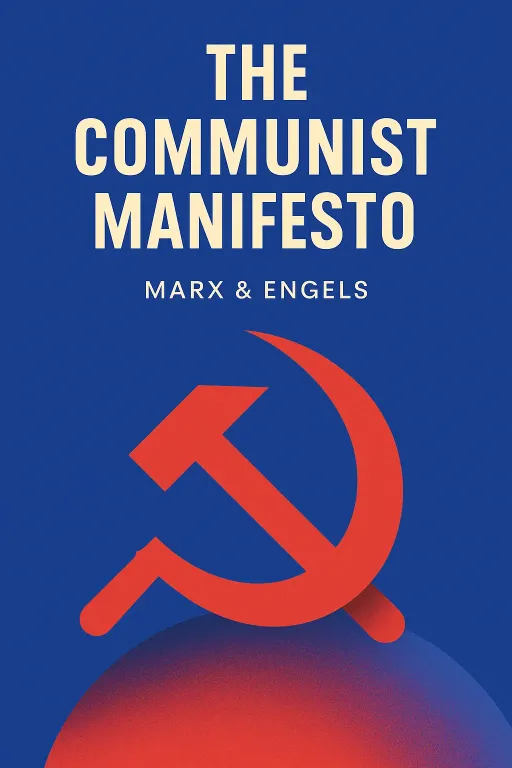
Nova: It is a massive source of anxiety for so many people right now. That feeling of running on a treadmill that keeps speeding up is exactly why we are diving into two incredibly powerful, yet seemingly opposite books today. We are looking at the classic, highly influential, and deeply polarizing text, The Communist Manifesto, written by Karl Marx and Friedrich Engels in 1848, alongside a modern, widely acclaimed masterwork of environmental reportage, Adventures in the Anthropocene, published in 2014 by the award-winning science journalist Gaia Vince.
Atlas: Wow, Marx and modern environmental science. That is a wild pairing. This is not your typical beach reading list. What connects a nineteenth-century political tract with a modern book about climate adaptation?
Nova: The connecting thread is how human beings adapt when their entire environment, whether economic or physical, undergoes a massive, systemic shift. Marx and Engels were looking at the early days of industrialization, documenting how the rise of steam power and factories completely tore down the old feudal way of life and redefined the value of human labor. Gaia Vince looks at the modern equivalent, which is how human activity has altered our planet so deeply that we have entered a new geological epoch, the Anthropocene, forcing communities to engineer wild, completely new ways to survive.
Atlas: I see where this is going. It is about understanding the giant, invisible forces reshaping our world, so we can stop feeling overwhelmed and start figuring out how to navigate them. Instead of just reacting to the daily news cycle, we are looking at the deep structural shifts.
Nova: Exactly. It is about moving from panic to perspective. By looking at these two massive shifts, the economic and the ecological, we can start to see the patterns of how human systems adapt, and more importantly, how we as individuals can find agency when the old rules stop working.
The Structural Reshaping of Labor and Value
SECTION
Nova: Let us start with Marx and Engels because their analysis of the Industrial Revolution provides a perfect framework for understanding how economic structures rewrite the rules of daily life. When they wrote the Manifesto, the world was transition from agriculture and localized crafts to massive, centralized factories. This was not just a change in technology; it was a total restructuring of society.
Atlas: Right, it was the birth of the modern nine-to-five, or back then, probably more like a fourteen-hour workday. Before that, a craftsman owned their tools and controlled their time. Suddenly, they had to sell their labor by the hour to someone else who owned the machines.
Nova: That is the core of their analysis. They observed that capital accumulation and industrialization structurally reshape what they called class dynamics, but what we can think of today as the value of our labor. When a new technology comes along, it often commoditizes skills that used to take a lifetime to master. A master weaver spent years learning their trade, but a steam-powered loom could be operated by someone with only a few hours of training. The skilled craft was replaced by a repetitive task, and as a result, the individual leverage of the worker plummeted.
Atlas: That sounds incredibly familiar. Swap out steam looms for generative artificial intelligence, and we are having the exact same conversation today. Writers, programmers, designers, people who spent decades honing their craft, are suddenly looking at software that can generate outputs in seconds. It feels like our labor is being commoditized all over again.
Nova: The parallel is striking. Marx and Engels described how the constant revolutionizing of production, uninterrupted disturbance of all social conditions, and everlasting uncertainty distinguish the modern epoch from all earlier ones. They wrote that all that is solid melts into air. That feeling of instability we experience today is not a bug in the modern economy; it is a fundamental feature of rapid technological transition.
Atlas: That is a comforting, yet slightly terrifying way to look at it. It means the overwhelm we feel is not a personal failure. It is a natural response to a massive structural shift. But if the system is constantly melting everything that is solid, how do we build any kind of security?
Nova: The key is to realize that during these shifts, the value moves away from the execution of routine tasks and toward the ownership of assets or the mastery of the system itself. In the industrial era, security did not come from trying to be the fastest manual weaver; it came to those who understood how to organize the new industrial systems, or those who acquired stakes in the new infrastructure. Today, as routine cognitive tasks become automated, the value of simple execution is dropping. The value is shifting toward unique human curation, complex problem-solving, and managing the technological tools.
Atlas: So, instead of fighting the machine, or trying to compete with it on its own terms, we have to look at where the new leverage points are being created. We have to ask ourselves what cannot be easily commoditized.
Nova: Yes, and that requires a shift in mindset. We cannot rely on a static skill set to carry us through a thirty-year career anymore. We have to view our career as an evolving portfolio of capabilities, constantly adapting to the macro-environment.
Human Adaptation in the Anthropocene
SECTION
Nova: This idea of constant adaptation brings us beautifully to Gaia Vince and her book, Adventures in the Anthropocene. While Marx looks at the economic landscape, Vince looks at the literal, physical landscape. She spent hundreds of days traveling the world to document how real people are adapting to the planetary changes we have set in motion.
Atlas: This is where we get into the boots-on-the-ground reality. What kind of changes is she looking at, and how are people actually dealing with them?
Nova: She looks at communities facing immediate, existential threats from climate change, resource depletion, and ecological shifts. But instead of focusing solely on the tragedy, she highlights the incredible, often bizarre ways humans are engineering solutions. For example, she travels to the Himalayas, where glaciers are melting rapidly due to rising temperatures. This melting threatens the water supply for millions of people who rely on seasonal runoff for agriculture.
Atlas: That sounds like an absolute catastrophe. How do you even begin to adapt to a disappearing glacier?
Nova: You build your own. Vince introduces us to a local engineer named Sonam Wangchuk, who realized that instead of letting the winter water run off and waste away, they could pipe it down to the valleys and spray it into the freezing air. The water freezes instantly, building giant, cone-shaped ice towers that resemble Buddhist shrines, which they call ice stupas. These artificial glaciers store the water during the freezing winter and melt slowly during the spring, precisely when the farmers need to irrigate their crops.
Atlas: That is brilliant. It is simple, localized engineering that completely bypasses the need for massive, slow-moving global treaties. They saw a critical vulnerability in their environment and built a direct, practical solution.
Nova: It is a perfect example of what Vince calls human ingenuity in the face of the Anthropocene. Another incredible story she shares is from the Caribbean, where coral reefs are dying. A scientist named Wolf Hilbertz and a biologist named Tom Goreau developed a technology called Biorock. They submerge steel structures in the ocean and run a safe, low-voltage electrical current through them. This current triggers a chemical reaction that causes natural minerals in the seawater to precipitate onto the steel, forming a thick layer of limestone. Coral larvae can attach to this limestone and grow up to six times faster than normal, and they are much more resilient to temperature spikes.
Atlas: So they are literally growing artificial reefs using electricity. That is mind-blowing. It shows that adaptation is not just about hunkering down and enduring the storm; it is about actively redesigning our relationship with our environment.
Nova: Exactly. Vince shows that when the macro-environment changes, the communities that survive are not the ones waiting for things to go back to normal. They are the ones who accept the new reality immediately and start experimenting with whatever resources they have on hand. They do not get paralyzed by the scale of the problem; they focus on local, actionable innovations.
Synthesis & Takeaways
SECTION
Atlas: This brings us back to our listeners who are trying to navigate their own rapidly changing professional and financial landscapes. The scale of AI, economic volatility, and industry disruption can feel just as overwhelming as a melting glacier.
Nova: The lesson from both the Himalayan ice stupas and the Biorock reefs is that adaptation is a creative, active process. If we apply this to our careers, we have to stop trying to preserve old roles that are no longer viable in the current economic climate. We need to look at the new landscape, identify where the critical vulnerabilities are, and build our own versions of ice stupas.
Atlas: How do we translate that into a concrete strategy? If someone is feeling overwhelmed by the sheer number of changes in their industry, what is the first step?
Nova: The first step is to conduct a personal structural audit. Ask yourself: what parts of my daily work are becoming commoditized or automated? Where is the value shifting in my industry? If you are a graphic designer, the value is shifting away from simple image generation and toward strategic brand storytelling and creative direction. If you are in finance, the value is moving from routine data analysis to complex risk management and human relationship building.
Atlas: That makes sense. It is about identifying the high-value, non-commoditizable skills. But how do we find the time to build those skills when we are already overwhelmed just trying to keep up with our daily workload?
Nova: This is where we have to protect our learning time like an invaluable asset. You do not need to spend hours a day. It is about consistent, focused progress. Schedule just forty-five minutes, three times a week, to learn a new tool, analyze a market trend, or build a new capability. Treat that time as an unbreakable appointment with your future self.
Atlas: I like that. It is a practical, sustainable way to build momentum. It is not about reading a whole textbook in one sitting; it is about making continuous, incremental progress.
Nova: Exactly. The perfect book or the perfect course is not the goal. Forward motion is the goal. By dedicating consistent, focused time to understanding the systemic shifts in your industry, you move from being a passive victim of change to an active engineer of your own adaptation.
Atlas: That is a powerful place to leave it. The world is going to keep changing, but we have the tools and the capacity to adapt, build, and thrive.
Nova: This is Aibrary. Congratulations on your growth!