Decoding the Shifts of Societal and Organizational Control
Golden Hook & Introduction
SECTION
Nova: Owning the company does not actually mean you run it. In fact, the people holding the stock certificates might be the most powerless people in the building.
Atlas: That sounds like a massive paradox, especially to anyone who has spent their entire career trying to buy their way to the top of the food chain.
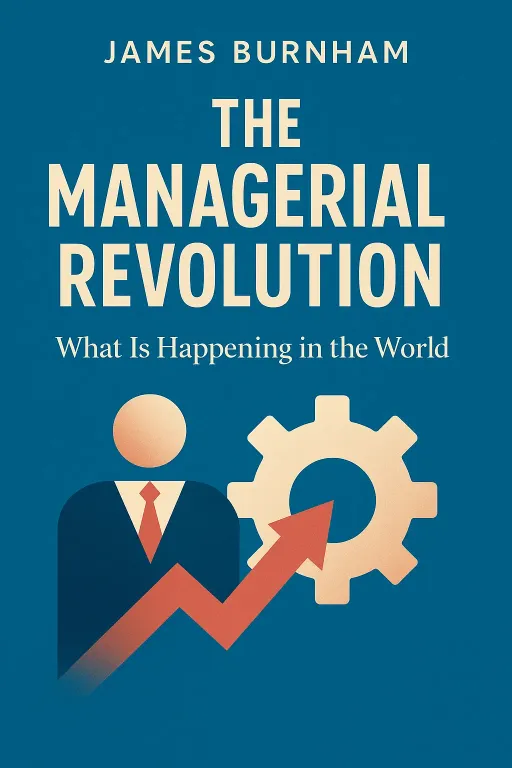
Nova: It is one of the most fascinating shifts in modern history, and today we are looking at how the very nature of power has changed. We are diving into Karl Marx and Friedrich Engels's classic 1848 text, The Communist Manifesto, alongside James Burnham's landmark 1941 book, The Managerial Revolution.
Atlas: Talk about an intellectual heavyweight matchup. You have the ultimate critique of nineteenth-century capitalism side-by-side with a mid-twentieth-century analysis of bureaucratic power.
Nova: Exactly. And what makes Burnham so interesting is his personal journey. He actually started as a prominent Trotskyist intellectual in the 1930s before completely breaking away from Marxism to write this book. He realized that the future was not heading toward a workers' paradise, nor was it staying with traditional capitalists. Instead, a completely different group was quietly taking over the world.
Atlas: That is a brilliant setup. For anyone listening who is navigating a complex corporate environment, trying to build a lasting legacy, or just trying to understand who actually holds the remote control in their organization, this conversation is going to hit very close to home.
Nova: We are moving past the simple idea of who has the biggest title. We are looking at the invisible machinery of control.
The Engine of Struggle - Marx, Engels, and the Power of Ownership
SECTION
Nova: Let us start with the foundation. Marx and Engels wrote the Manifesto during a time of massive physical disruption. The steam engine was rewriting the landscape of Europe, factories were rising like fortresses, and society was splitting into two highly visible camps.
Atlas: Right, the classic division. You had the bourgeoisie, who owned the factories and the land, and the proletariat, who had nothing to sell but their physical labor.
Nova: Yes, and that ownership of physical resources was the absolute source of power. If you owned the steam loom, you dictated how many hours a person worked, what they got paid, and whether they could feed their family. The power was direct, physical, and highly concentrated.
Atlas: I can see how that would create an incredibly intense friction. It is a zero-sum game. The owner wants to extract maximum work for minimum cost to stay competitive, while the worker wants to survive and reclaim some of their life.
Nova: It was an engine of constant struggle. Marx and Engels argued that all history is the history of this class struggle. The physical ownership of the means of production was the leverage point. If you owned the physical assets, you owned the political system, the laws, and the culture.
Atlas: But let us look at how that actually played out. In the nineteenth century, if you wanted to build a legacy, you built a steel mill or a railroad. You put your name on the building. The owner was a visible patriarch.
Nova: Exactly. Think of the Carnegies, the Rockefellers, the Vanderbilts. They were the personification of capital. They made the decisions because they owned the equity. But as the industrial machine grew larger, something fascinating happened. The systems became too massive for any single family, or even a group of wealthy partners, to manage.
Atlas: That makes complete sense. You cannot run a global railroad network or a multinational chemical company just because your grandfather built the first factory. The sheer complexity of operations requires specialized knowledge.
Nova: And that is where the seed of the next revolution was planted. The owners had to start delegating. They could not oversee the daily operations, the supply chains, the complex accounting, and the labor relations themselves. They needed help.
Atlas: So they started hiring professionals. They brought in coordinators, engineers, administrators.
Nova: They did. And in doing so, they unknowingly began to hand over the keys to the kingdom. Marx believed the workers would eventually overthrow the owners. But what actually happened was far more subtle. The owners slowly became obsolete, and a new class stepped into the vacuum.
The Managerial Takeover - Burnham and the Silent Shift of Control
SECTION
Nova: This brings us directly to James Burnham and his analysis in The Managerial Revolution. Writing in 1941, amidst the chaos of World War Two and the rise of massive state bureaucracies, Burnham made a bold prediction. He argued that capitalism was indeed dying, but it was not being replaced by socialism.
Atlas: Now that you mention it, that must have been a highly controversial take at the time. Everyone was focused on the clash between corporate capitalism and state-run systems.
Nova: It was incredibly polarizing. But Burnham looked past the ideological labels and saw a structural similarity. Whether you looked at the massive corporations in the United States, the state-run industries in Nazi Germany, or the bureaucratic ministries in Soviet Russia, the actual running of society was falling into the hands of the same type of person: the professional manager.
Atlas: Let us break that down. What exactly is a manager in Burnham's definition? Because today, we use that word for anyone who supervises a small team.
Nova: Burnham defined managers as those who direct, coordinate, and integrate the technical and administrative processes of production. These are the production managers, the operating executives, the systems engineers, the administrators. They are the people who know how the complex machinery of a modern organization actually functions.
Atlas: Oh, I see. It is the difference between owning a commercial airline and actually knowing how to fly the planes, schedule the routes, maintain the jet engines, and coordinate air traffic control. The shareholders might own the airline, but they have absolutely no idea how to run it.
Nova: Exactly. If all the shareholders of a major airline vanished tomorrow, the planes would still fly. The managers would keep the system running. But if all the managers, engineers, and coordinators vanished, the airline would grind to a halt instantly, no matter how much money the shareholders poured into it.
Atlas: That is a profound realization. The real leverage has shifted from ownership to operational control. The person who understands and controls the system is the one who actually wields the power.
Nova: Burnham called this the separation of ownership and control. In a modern public corporation, ownership is fragmented among millions of retail investors and pension funds. It is passive. The actual decisions, the strategic direction, the allocation of resources, are made by salaried professionals.
Atlas: That sounds like a silent coup. The capitalists thought they were hiring servants, but they ended up hiring their successors.
Nova: That is precisely what happened. And this manager class has its own interests, its own culture, and its own way of looking at the world. They do not think like traditional owners who are focused purely on short-term profit or personal wealth preservation. They are focused on system expansion, efficiency, stability, and the growth of the organization itself.
Atlas: I can definitely see how that plays out in modern corporate dynamics. You often see executive teams prioritizing market share, technological dominance, or organizational complexity over immediate payouts to shareholders. They want to build a bigger, more resilient empire because that empire is the source of their status and security.
Nova: Yes, and they do this because their power is tied to the system, not the equity. They do not need to own the company to control it. They just need to be indispensable to its operation.
Mastering Quiet Leverage - Modern Systems and Legacy
SECTION
Atlas: This brings us to a really critical point for our listeners. If the nature of power has shifted from raw ownership to systemic control, how do we apply this to our own careers and organizations?
Nova: It requires us to ask a deep question: are we relying on the traditional power of formal authority, or are we mastering the quiet leverage of structural and administrative systems to drive alignment?
Atlas: That is a massive shift in mindset. For a long time, the goal was simply to get the title, to get the corner office, to be the boss who can say, because I said so.
Nova: But that kind of raw, command-and-control authority is incredibly fragile today. It creates instant friction. It breeds quiet quitting, resistance, and talent drain. The modern strategic leader understands that the most effective power is invisible. It is built into the architecture of the organization.
Atlas: It is like designing a highway system. You do not need a police officer standing every ten feet to tell people where to drive if you have designed clear lanes, intuitive exit ramps, and logical signage. The physical structure of the road guides the behavior naturally.
Nova: Exactly. You design the environment so that the desired outcome is the path of least resistance. This is what we call quiet leverage. Instead of constantly pushing people to perform, you structure the information flow, the incentives, and the daily workflows so that high performance is the natural result.
Atlas: Let us look at a concrete example of this. How does a leader build this kind of systemic leverage?
Nova: Think about how information is shared in your organization. If you are the bottleneck, if every decision has to go through you, you do not actually have a powerful system. You have a personal dependency. You are working under the old model of personal authority. But if you design a decentralized decision-making framework, where clear parameters are established and teams have the autonomy to execute within those guardrails, you have built a self-aligning system.
Atlas: That makes so much sense. You are moving from being the operator to being the architect. You are building a machine that can run, scale, and evolve without your constant physical intervention.
Nova: And that is how you build a lasting legacy. A legacy built on personal authority disappears the moment you leave the room. A legacy built on systemic architecture continues to grow, adapt, and generate value long after you are gone.
Atlas: This is incredibly relevant as we look at the rise of artificial intelligence and algorithmic management. We are seeing a new layer of systems being introduced into the workplace.
Nova: We are. The algorithms, the data pipelines, the automated workflows, these are the new administrative tools of the managerial class. The leaders who will dominate the next decade are not just those who understand their industry, but those who understand how to integrate these digital systems with human talent.
Atlas: It is about becoming a systems architect. If you can design the data structures, the feedback loops, and the collaborative frameworks, you are positioning yourself at the absolute center of modern power.
Nova: You are. You are moving past the old friction of labor versus capital and entering the domain of structural alignment.
Synthesis & Takeaways
SECTION
Atlas: Looking at this from a high-level perspective, if we want to build a lasting legacy, we have to stop focusing purely on accumulating raw resources or chasing formal titles. We have to become masters of the system itself.
Nova: That is the ultimate synthesis of these two works. Marx showed us how resources create power, but Burnham showed us how systems control those resources. When you combine those insights, you realize that true organizational mastery is about designing systems that outlast us.
Atlas: It is a shift from playing the game to designing the board itself.
Nova: Beautifully put. When you design the board, you do not need to raise your voice or demand compliance. The board itself guides the players toward the objective.
Atlas: I love that. It is a powerful reframing of what leadership actually means in the modern era.
Nova: Let us close with a powerful thought from Burnham's work: sovereignty lies in the hands of those who control the access to the instruments of production. Today, those instruments are digital, organizational, and systemic. Master the system, and you master the future.
Atlas: This is Aibrary. Congratulations on your growth!