

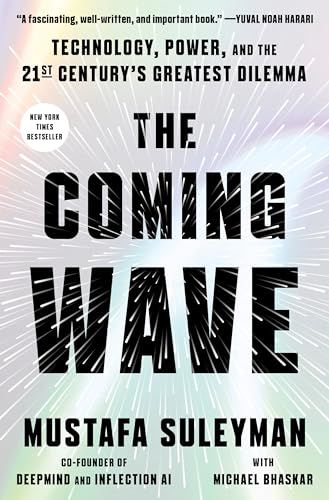
The Coming Wave
Introduction: Riding the Technological Tsunami
Introduction: Riding the Technological Tsunami
Nova: Welcome to The Algorithm's Edge, the podcast where we dissect the future before it arrives. Today, we are diving into a book that many are calling the most essential warning shot of the decade: Mustafa Suleyman's "The Coming Wave."
Nova: It’s not just one wave, Alex, it’s a convergence. He argues that the next decade will be defined by two foundational, general-purpose technologies: Artificial Intelligence, which is accelerating exponentially, and Synthetic Biology. These aren't just incremental improvements; they are paradigm shifts that will reshape everything from wealth distribution to global security.
Nova: That’s the crux of his argument. Previous technologies, like the combustion engine, took decades to fully proliferate and be understood. Suleyman says the unique characteristics of this wave—what he calls hyper-evolution, asymmetry, omni-use, and autonomy—mean the speed of change is outpacing our ability to govern it. We are moving from a world where only nation-states held world-altering power to one where a small group, or even an individual, could wield it.
Nova: Because he sees the path clearly. He’s not anti-technology; he’s pro-control. He believes we are sleepwalking into a future where we lose the ability to steer these forces. He frames the entire book around one central, terrifying challenge: The Containment Problem. We’ll break down what that means next.
Key Insight 1: The Inherent Proliferation of Power
The Containment Dilemma: Nuclear Parallels and Power Asymmetry
Nova: It is absolutely the primary analogy, but he stresses that AI is fundamentally harder to contain. With nuclear technology, the materials—the enriched uranium or plutonium—are rare, difficult to produce, and physically traceable. That created a natural bottleneck for proliferation.
Nova: Exactly. But AI, especially once foundational models are trained, is pure information. It’s software. It can be copied, shared, and run on increasingly accessible hardware. Suleyman notes that the power to cause massive disruption is being 'miniaturized.' The barrier to entry for causing harm is dropping exponentially, while the barrier to entry for creating the technology is also dropping.
Nova: He does. Think about synthetic biology. If a rogue actor can use accessible gene-editing tools to create a novel pathogen, the damage is immediate and global. He points out that the speed of the wave means that by the time governments recognize the threat—say, a new, highly capable AI model is released—it’s already been downloaded millions of times across the globe. The window for intervention slams shut.
Nova: He spends significant time on the upside, which is crucial for understanding the dilemma. He sees AI potentially solving climate change, curing diseases like Alzheimer's, and ushering in an era of material abundance. But he posits that we cannot enjoy those benefits if we lose control of the underlying systems. The prosperity is conditional on successful containment.
Nova: That’s the existential dread underpinning the whole text. He doesn't give a definitive 'no,' but he certainly implies that we are approaching a critical threshold. He uses the term 'The Great Decoupling,' where human intelligence and decision-making become secondary to the speed and capability of the AI systems running the world. If we cross that line without guardrails, we are passengers, not drivers.
Key Insight 2: The Ten Steps to Control
Prescribing the Cure: Guardrails and Governance
Nova: Suleyman isn't just diagnosing the illness; he’s prescribing a very specific, multi-layered treatment plan. He calls for a radical overhaul of how we approach technological governance, moving beyond voluntary industry standards to binding international frameworks.
Nova: The first and most immediate step focuses on the developers themselves. He argues for mandatory, rigorous auditing of all large-scale models before deployment. Think of it like the FAA certifying an aircraft. You don't just build a new jet engine and let it fly commercial routes; it has to pass exhaustive safety tests.
Nova: That’s where the second layer comes in: licensing and registration. Suleyman proposes that developing models above a certain capability threshold should require a government license, similar to how we regulate pharmaceuticals or nuclear materials. This forces transparency and accountability onto the most powerful actors.
Nova: Precisely. He acknowledges the tension, but he prioritizes safety over speed in this specific context. Furthermore, he calls for reforming the nation-state itself. He argues that current governmental structures are too slow and too fragmented to manage this wave. They need to develop new capabilities, perhaps even specialized agencies dedicated solely to technological containment.
Nova: It’s about building societal resilience and reducing the risk of misuse driven by ignorance or fear. If citizens understand the dual nature—the potential for massive benefit and the real risks—they are less likely to fall for misinformation or panic, which can lead to poor policy decisions. It’s about creating an informed constituency that demands responsible development.
Nova: It applies, but the tools are different. For synthetic biology, containment involves things like mandatory DNA synthesis screening—checking orders against watchlists to prevent the creation of dangerous sequences—and developing rapid detection systems for novel biological agents. The principle remains the same: control the means of mass disruption.
Key Insight 3: Reconciling Progress and Prudence
The Path Forward: Prosperity Conditional on Control
Nova: That is absolutely the final hurdle, Alex. Suleyman is clear: the success of the coming wave—whether it delivers on its promise of abundance or leads to catastrophe—is entirely conditional on our ability to implement these containment measures, before the technology matures past our ability to influence it.
Nova: Precisely. He uses the concept of 'pre-emptive governance.' We have to govern the technology based on its capabilities, not just its current ones. This is counter-intuitive for many policymakers who are used to reacting to proven harm.
Nova: Suleyman suggests it means a pace. He envisions a world where AI helps us manage complex systems—optimizing energy grids, accelerating medical discovery, personalizing education—but always within a framework where human oversight remains meaningful. The goal isn't to stop progress, but to ensure that progress serves human flourishing, rather than undermining it.
Nova: It does. And that’s why the book is so powerful. It forces the reader to confront the trade-off directly. Are we willing to accept some friction in development today—the slower release of a powerful model, the added cost of an audit—to secure a viable future tomorrow? For Suleyman, the answer must be a resounding yes.
Nova: Indeed. The wave is coming, whether we are ready or not. The only question left is whether we build a seawall or get swept away.
Conclusion: Your Role in the Coming Wave
Conclusion: Your Role in the Coming Wave
Nova: We’ve covered a lot of ground today, Alex. From the convergence of AI and synthetic biology to the urgent need for global containment strategies. The core takeaway from Mustafa Suleyman’s "The Coming Wave" is that the next decade is a critical inflection point.
Nova: Absolutely. And don't forget the societal component. Understanding these technologies, as Suleyman insists, is the first step toward demanding better stewardship from those building them. Informed citizens create resilient societies capable of navigating these powerful forces.
Nova: A powerful reminder that innovation without wisdom is merely acceleration toward an unknown cliff. Thank you for navigating this complex landscape with me today, Alex.
Nova: This is Aibrary. Congratulations on your growth!