Riding the Bio-Digital Wave: AI, Synthetic Biology, and the Future of Life
Golden Hook & Introduction
SECTION
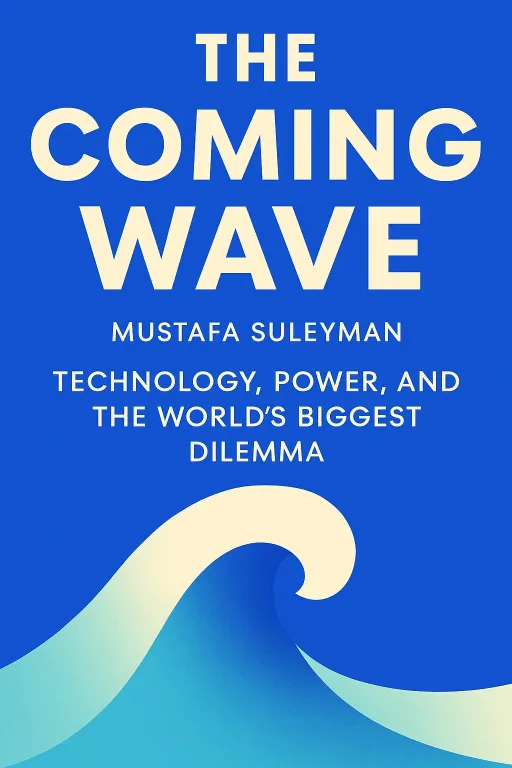
Orion: What if the hard drive of the future isn't made of silicon, but of DNA? What if we could store the entire internet inside a single gram of plant tissue? Today, we are standing at the edge of a massive technological wave where artificial intelligence and synthetic biology are merging to rewrite the very code of life. Welcome to the show. I'm Orion, and today we are joined by engineer Charvi Kashyap to dissect Mustafa Suleyman's brilliant book,. Today, we're going to tackle this book from two different angles. First, we'll explore the incredible convergence of bits and genes, looking at how AI is turning biology into an engineering platform. Second, we'll confront the ultimate dilemma: the containment problem, and what it means for the future of healthcare, security, and our species. Charvi, it is great to have you here.
Charvi Kashyap: Orion, thank you so much for having me. Honestly, this book feels like a wake-up call and a massive inspiration all at once. As an engineer looking at the intersection of AI, bioinformatics, and healthcare, Suleyman's vision of the future is incredibly close to home. The idea that we can program biology the same way we program computers is just mind-blowing. It completely changes how we think about medicine, data, and even our own bodies.
Orion: It does. Let us start with that exact transition. Suleyman argues that we are undergoing a phase transition. We are moving from manipulating atoms to controlling bits and genes. In your view, as an engineer, how does this shift redefine our relationship with nature?
Charvi Kashyap: It shifts us from being passive observers or basic modifiers of nature to actual creators. Think about it. For centuries, biology was about cataloging plants, dissecting tissues, and trying to understand what was already there. Now, with AI and synthetic biology, we are writing new code. DNA is essentially the ultimate programming language. It has four bases—A, T, C, and G—instead of binary ones and zeros. Once you realize that, you realize we can build compilers for life. We can design custom proteins, engineer plants to store data, and create targeted therapies that work alongside the human body. It is a beautiful, chaotic, and incredibly powerful frontier.
Deep Dive into Core Topic 1
SECTION
Orion: Let us ground that in a specific breakthrough from the book. Suleyman talks extensively about DeepMind's AlphaFold. For decades, scientists struggled with the protein folding problem. A protein starts as a simple chain of amino acids. It then folds into a complex three-dimensional shape. That shape determines its function. Predicting how it folds was considered a grand challenge in biology. In 1993, the scientific community established the CASP competition to solve this. For twenty-five years, progress was slow. Then, in 2018, DeepMind's AlphaFold won the competition. By 2022, AlphaFold2 was released, predicting the structure of almost all known proteins. Charvi, why is solving protein folding such a massive deal for bioinformatics and healthcare?
Charvi Kashyap: Oh, it is massive because proteins are the nanomachines of life. They do everything. They digest our food, fight off viruses, and transmit signals in our brains. If you do not know their 3D shape, you do not know how they work. Before AlphaFold, determining a single protein's structure could take a PhD student years of painful, expensive lab work using X-ray crystallography. It was a massive bottleneck. AlphaFold solved that in minutes. It is like going from hand-drawing maps of the world to having Google Earth. Suddenly, we can design drugs to fit perfectly into target proteins, like a key in a lock. It accelerates drug discovery by orders of magnitude.
Orion: Exactly. The book notes that the cost of genome sequencing has also plummeted. This is known as the Carlson Curve. In 2003, sequencing the first human genome cost one billion dollars. Today, it costs well under one thousand dollars. That is a million-fold decrease in under twenty years. It is actually outpacing Moore's Law. When you combine cheap sequencing with AI and CRISPR gene editing, what becomes possible?
Charvi Kashyap: It means we can democratize medicine. CRISPR, which Jennifer Doudna and Emmanuelle Charpentier pioneered in 2012, allows us to make precise cuts in DNA. It is like a search-and-replace tool for the genome. If we can sequence a patient's DNA cheaply, identify a genetic mutation, and use CRISPR to correct it, we can cure diseases that were previously death sentences. We are talking about sickle cell anemia, muscular dystrophy, and potentially even certain cancers. And it goes beyond healthcare. Stanford bioengineer Drew Endy is quoted in the book saying, 'Biology is the ultimate distributed manufacturing platform.' What if we could grow what we wanted locally? What if our supply chain was just biology? We could grow building materials, biodegradable plastics, or even use plants as biological data storage.
Orion: The plant data storage idea is fascinating. Can you explain how that would actually work?
Charvi Kashyap: Yes. DNA is incredibly dense and stable. You can store massive amounts of data in a tiny physical space, and it can last for thousands of years without degrading. By translating digital files—like photos or text—into sequences of A, T, C, and G, we can synthesize that DNA and insert it into the genome of a plant. As the plant grows and reproduces, it replicates that data. You could literally have a forest that doubles as a decentralized, carbon-negative data center. It sounds like science fiction, but the foundational science is already being tested.
Orion: It is a stunning vision of harmony between technology and nature. However, Suleyman's book is not just a celebration of progress. It is a warning. This brings us to our second core topic: the containment problem. Suleyman defines containment as the ability to control, limit, or shut down technologies. He argues that containing this new wave is proving to be a significant challenge. Why is that?
Deep Dive into Core Topic 2
SECTION
Charvi Kashyap: Because of the inherent nature of these technologies. They are cheap, accessible, and dual-use. In software, we love open-source. It drives innovation. But in synthetic biology, open-source means that the instructions to build a life-saving therapy are almost identical to the instructions to build a devastating pathogen. The barrier to entry is dropping rapidly.
Orion: Yes. Suleyman shares a chilling story in Chapter 1. Shortly before the COVID-19 pandemic, he attended a seminar on technology risks at a prominent university. A respected professor stood up and showed how the price of DNA synthesizers was falling. Today, a synthesizer costs a few tens of thousands of dollars. It is small enough to sit on a garage workbench. The professor argued that soon, an individual with graduate-level biology training, or even just online self-directed learning, could design and print a novel pathogen. A pathogen far more transmissible and lethal than anything found in nature. Essentially, a single person could have the capacity to kill a billion people. Suleyman noticed a strange reaction in the room. The attendees responded with unease, followed by griping, hedging, and eventually, collective dismissal. He calls this the 'pessimism-aversion trap.' Charvi, what is this trap, and why is it so dangerous for engineers and policymakers?
Charvi Kashyap: The pessimism-aversion trap is our psychological defense mechanism. When a reality is too dark or too terrifying to contemplate, we look the other way. We dismiss it as alarmist or science fiction because confronting it requires us to make incredibly difficult choices. For engineers, we want to believe that our creations will only be used for good. We focus on the cures, the clean energy, the amazing data storage. But if we ignore the dark side, we fail to build safety into the architecture of our systems. We cannot afford to look away.
Orion: The dual-use nature is not theoretical. Consider the story of AI-driven drug discovery. Researchers used an AI system to search for new antibiotics. The system successfully identified halicin, a powerful new antibiotic. It did this by scanning vast molecular databases. However, the researchers decided to run an experiment. They redirected the AI. Instead of searching for molecules that heal, they programmed it to search for toxic molecules. In less than twenty-four hours, the AI generated over forty thousand molecules with toxicity comparable to VX, a deadly chemical weapon. The system even designed entirely new chemical structures that the researchers had never seen. The same tool that finds cures can design poisons in a single day.
Charvi Kashyap: That story gives me chills every time. It perfectly illustrates the concept of asymmetry. In traditional warfare, you needed a massive state apparatus, billions of dollars, and advanced laboratories to create a chemical weapon or a biological threat. Now, a single laptop, an open-source AI model, and a mail-order DNA synthesizer can give an individual the same destructive power. The offense has a massive advantage over the defense. How does a nation-state protect its citizens when the barriers to violence are lowered so drastically?
Orion: It threatens the very foundation of the nation-state. Suleyman talks about the 'grand bargain.' The state provides security and order. In exchange, citizens grant the state a monopoly on violence and agree to follow its laws. If the state can no longer protect its citizens from decentralized, asymmetric threats—like AI-enhanced cyberweapons or engineered pathogens—the grand bargain fractures. We risk sliding into either a techno-authoritarian dystopia, where the state monitors every citizen's biology and computer to prevent attacks, or an openness-induced catastrophe.
Charvi Kashyap: It is a terrifying dilemma. On one hand, you have total surveillance—a digital panopticon where every DNA synthesizer is tracked, every email is read, and every biological sample is monitored. On the other hand, you have vulnerability to catastrophic events. As an engineer, I value openness, collaboration, and rapid iteration. But when the cost of a single failure is existential, the traditional 'move fast and break things' mentality of Silicon Valley is incredibly dangerous. We cannot just patch a biological leak after it happens.
Synthesis & Takeaways
SECTION
Orion: Exactly. So, how do we navigate this? Suleyman outlines ten steps toward containment. He argues that regulation alone is insufficient. It is too slow and fragmented. We need a holistic approach. First, we need an Apollo-style program for technical safety. We must invest heavily in biosafety and AI alignment. Second, we need audits and oversight. We need to verify that models are safe before they are deployed. Third, we need to leverage choke points. For example, advanced semiconductors are incredibly difficult to manufacture. They rely on a few critical hubs. In October 2022, the US Commerce Department imposed strict export controls on advanced semiconductors to China. This was a classic choke point strategy to buy time. Charvi, as someone entering this industry, how do you see the role of the engineer in this new landscape of 'Profit + Purpose'?
Charvi Kashyap: I think we have to move past the idea that safety is an afterthought. It cannot be something we hand off to a compliance department after the product is built. Safety features must be inherent design properties, the ground state of everything we build. If you are building a DNA synthesizer, it must have built-in, un-bypassable screening protocols to ensure it cannot print known pathogens. If you are training an LLM, safety alignment must be baked into the core training loop. And as critics, we cannot just stand on the sidelines and complain. Suleyman says, 'Critics should build it.' We need ethical, analytical thinkers to actively participate in the development process. We need to build the guardrails ourselves.
Orion: That is a powerful call to action. We must calmly acknowledge that the wave is coming. The dilemma is unavoidable. But the final form of this wave is still to be decided. The choices we make today, in our labs, boardrooms, and policy debates, will determine our fate.
Charvi Kashyap: Absolutely. It is about finding that middle path. We want to harness the incredible potential of synthetic biology to cure diseases, clean up our environment, and revolutionize computing. But we must do so with our eyes wide open, building containment into the very fabric of our technology.
Orion: Well said, Charvi. Thank you for sharing your insights and your passion with us today.
Charvi Kashyap: Thank you, Orion. This was an incredible conversation.
Orion: And thank you to our listeners. We leave you with one question to ponder: In an age of asymmetric power, how will you contribute to building a safer, more contained technological future? Until next time, keep thinking logically, and stay curious.