

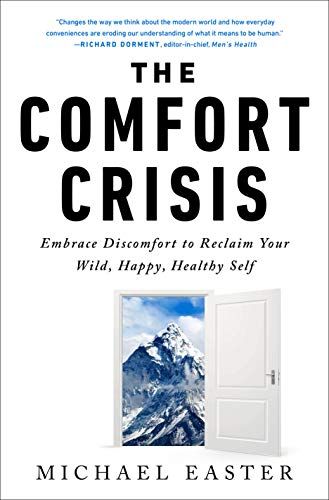
The Comfort Crisis
Introduction
Nova: Picture this. You're sitting in a climate-controlled room at exactly 72 degrees. Your phone is within arm's reach. Your fridge is full. You haven't felt genuinely hungry in years. And yet, somehow, you're more anxious, more depressed, and more disconnected than any generation in human history. What's going on?
Nova: : That's quite the opener, Nova. It sounds like you're describing my Tuesday. But what's the connection between all that comfort and feeling terrible?
Nova: That is the core question of Michael Easter's book, The Comfort Crisis. And here's the wild part — Easter is a journalism professor at UNLV. He's not some guy living off-grid telling us to reject modern life. He spent years researching this, talking to Harvard scientists, Mayo Clinic doctors, Special Forces soldiers, and even Buddhist monks in Bhutan. His conclusion? We are living through a comfort crisis, and it's quietly wrecking us.
Nova: : Okay, but comfort sounds like a good thing. Isn't that what humans have been striving for since forever?
Nova: Exactly. And that drive kept us alive for millions of years. Seeking shelter, eating calorie-rich food when it was available, avoiding unnecessary movement — those instincts made perfect sense when food was scarce and danger was everywhere. But here's the twist. In the last hundred years, we've gotten so good at eliminating discomfort that those same survival instincts are now backfiring. Easter argues that modern comfort is actually making us physically softer, mentally more fragile, and spiritually emptier.
Nova: : So the very thing we've been chasing is the thing that's hurting us?
Nova: That's the paradox. And Easter didn't just write about it from a desk. He went to one of the most remote places on Earth to test his theory. For 33 days, he hunted caribou in the Alaskan Arctic with nothing but what he could carry on his back. That story is the backbone of the book, and it's where we're going to start.
Nova: : I'm already uncomfortable just thinking about that. Let's get into it.
A 33-Day Journey to the Edge
The Alaskan Misogi
Nova: So Michael Easter teams up with a seasoned backcountry bow hunter named Donnie Vincent and heads into the Alaskan Arctic for a caribou hunt. No phone service for a hundred miles. No books. No magazines. Just the gear on their backs and whatever the wilderness throws at them.
Nova: : Let me get this straight. He's a journalist and professor from Las Vegas — not exactly a survival expert — and he just decides to spend a month in the Arctic?
Nova: That's the point. Easter was drawn to this because it's a modern version of something called misogi. Originally, misogi was an ancient Japanese purification ritual — think standing under a freezing waterfall. But Easter and his mentor, Dr. Marcus Elliott, reimagined it as an epic personal challenge. Something so hard it has roughly a 50/50 chance of success. Easter gives two rules for misogi: Rule one, make it really hard. Rule two, don't die.
Nova: : Rule two seems important.
Nova: It is. But the deeper idea is that a misogi forces you to confront uncertainty, vulnerability, and real physical limits. There's no safety net. No Instagram post is the goal. It's a private transformation. And that's what the Arctic became for Easter — a month of grizzly bears, violent storms, brutal cold, and long stretches of waiting for caribou to migrate.
Nova: : Waiting? That sounds almost worse than the bears.
Nova: That's where it gets fascinating. During all that waiting, Easter had nothing to do. No phone. No podcasts. No distractions. He found himself reading the ingredient labels on Clif Bars just to stay sane. And then something shifted. His mind started generating ideas. He came up with magazine story concepts. He wrote parts of the book. He experienced what neuroscientists now confirm: boredom is a kind of evolutionary signal that says, hey, whatever you're doing, the return has diminished — go do something else, something creative.
Nova: : So the boredom that we all run from with our phones actually has a purpose.
Nova: It does. And Easter argues that by constantly escaping boredom through digital media — the average person now spends more than 11 hours a day engaging with screens — we're basically eating junk food for the mind. We never let our brains go inward, and we lose the creativity and clarity that comes from that space.
Nova: : But beyond the mental aspect, what did the physical hardship actually do for him?
Nova: This connects to a concept in psychology called toughening. Research shows that people with too many challenges in life have poor mental and physical health outcomes — no surprise there. But here's the counterintuitive part: people with too little challenge have equally poor outcomes. There's a sweet spot in the middle where humans thrive. Easter's Arctic experience landed him squarely in that zone. By the time he returned, he felt physically harder, mentally tougher, and more spiritually grounded.
How Easy Living Quietly Breaks Us
Comfort Creep
Nova: One of Easter's most powerful concepts is something he calls comfort creep. It works like this: as your life gets more comfortable, your tolerance for even minor discomforts shrinks. You get used to 72 degrees, and suddenly 68 feels freezing. You get used to driving everywhere, and a ten-minute walk feels like a burden.
Nova: : That hits close to home. I literally get annoyed when my phone takes more than two seconds to load an app.
Nova: Exactly. And that's not a personal failure — it's a human wiring problem. Easter points out that our ancestors dealt with genuine life-threatening discomfort every day. Hunger. Cold. Predators. Physical exhaustion. Today, the biggest discomfort many of us face is a slow Wi-Fi connection. The problem is that our brain doesn't downgrade its stress response. It still fires the same ancient alarm systems. So now we get genuinely stressed about trivia because our discomfort threshold has crept so low.
Nova: : So we're essentially hypersensitive because nothing truly hard ever happens to us?
Nova: That's the argument. And Easter backs it up with some staggering data. Kids born after 1990 — the first generation raised with helicopter parenting and without much unsupervised outdoor play — have rates of anxiety and depression two to three times higher than previous generations. We removed challenge from childhood, thinking we were protecting kids, and instead we made them more fragile.
Nova: : But what about the physical side? You mentioned obesity and chronic disease earlier.
Nova: Right. Easter traces how we've engineered movement out of our lives entirely. Our jobs have shifted from physical labor to sitting at desks. Our food system is designed to be hyper-palatable — loaded with salt, sugar, and fat in combinations that never existed in nature. We eat constantly, rarely experiencing true hunger. And we live in temperature-controlled bubbles. Easter argues that one of the biggest drivers of chronic disease today is simply a lack of cardiovascular fitness, because we no longer have to move to survive.
Nova: : So the modern world has essentially removed all the natural stressors that kept our ancestors healthy, and we're paying for it with our bodies and minds.
Nova: That's the comfort crisis in a nutshell. But here's the good news — Easter isn't saying we should burn our possessions and move to a cave. He offers practical, science-backed ways to deliberately reintroduce discomfort into our lives. And that's where things get really actionable.
Hormesis, Fasting, and Cold Exposure
The Science of Good Stress
Nova: Let's talk about hormesis. It's a biological concept that says mild stress can actually boost resilience and health. Think of it like a vaccine — a small dose of something challenging makes you stronger against bigger challenges later.
Nova: : So what counts as good stress?
Nova: Easter focuses on three main areas. First, fasting. Humans evolved in conditions of scarcity. Our bodies are actually designed to go extended periods without food. When you fast for 12 to 16 hours, your body triggers a process called autophagy — essentially cellular cleanup and repair. It's linked to longevity and reduced disease risk. Yet most of us eat constantly, grazing from morning until night, never letting that repair system kick in.
Nova: : I've heard of intermittent fasting, but I always assumed it was just about weight loss.
Nova: It's much deeper than that. Easter also explores cold exposure — things like cold showers or ice baths. The research suggests it can improve circulation, boost mental fortitude, and trigger beneficial stress responses in the body. Our ancestors faced cold regularly. Today, we've eliminated it entirely. Easter argues that occasional, deliberate cold exposure can reawaken dormant resilience mechanisms.
Nova: : And the third area?
Nova: Exercise that mimics ancestral patterns. Easter is a huge advocate for rucking — walking with a weighted backpack. It sounds almost too simple, but it's one of the most primal human activities. For most of history, humans carried things. Food back to camp. Children. Supplies. Rucking builds cardiovascular fitness, strengthens bones and muscles, and burns far more calories than regular walking — all without the joint impact of running. It's low barrier, highly effective, and deeply connected to how our bodies evolved to move.
Nova: : So we're not talking about extreme CrossFit or ultramarathons. These are surprisingly accessible practices.
Nova: That's the beauty of it. Easter isn't advocating for everyone to fly to the Arctic. He's advocating for small, consistent doses of discomfort. Skip a meal occasionally. Take a cold shower. Walk with weight. The goal is to reset your tolerance baseline so that minor inconveniences stop feeling like major crises.
Nova: : And there's actual research behind this?
Nova: Yes. Easter cites a growing body of evidence showing that people who regularly engage in hormetic stressors — intermittent fasting, cold exposure, challenging exercise — show improved markers for longevity, better mental health outcomes, and greater resilience to stress. It's not about suffering for suffering's sake. It's about giving your body and mind the kinds of challenges they were built to handle.
What We Lose When We Never Unplug
Silence, Nature, and the Lost Art of Being Alone
Nova: Here's a paradox Easter highlights: people today are rarely alone, yet we are increasingly lonely. We're surrounded by digital connection, but we've lost the capacity for real solitude.
Nova: : That does sound like a paradox. How does he explain it?
Nova: He traces it to how we've reframed solitude as punishment. Solitary confinement is a punishment. Being alone with no phone feels like a punishment to many people. But Easter argues that building our capacity to be alone actually makes interactions with other people richer and more meaningful. When you're comfortable in your own head, you're less desperate for external validation.
Nova: : What about the nature connection? I know that's a big theme in the book.
Nova: Massive theme. Easter writes that we evolved in nature and have programmed within our genes a need to connect with the natural world. If we don't, we go a little haywire — as if we're missing a necessary nutrient. He talks about the Japanese practice of shinrin-yoku, or forest bathing. Research shows that just walking in nature, surrounded by natural fractals and complex organic patterns instead of urban straight lines, has a measurable calming effect on the psyche.
Nova: : I've heard about the three-day effect too. What's that?
Nova: It's the finding that after about three days immersed in nature, the brain undergoes a noticeable reset. Stress hormones drop. Creative thinking improves. Perspective shifts. Easter experienced this in the Arctic, but you don't need the Arctic. Even a weekend camping trip can trigger it. He also discusses how having plants in an office increases productivity and job satisfaction, and how hospital patients with a view of nature recover faster.
Nova: : And silence? I feel like that's its own category.
Nova: It is. Harvard anthropologist Daniel Lieberman explains that humans evolved in quiet soundscapes. Loud noise, for most of our history, meant danger — a predator, a storm, a threat. So our bodies still release adrenaline and cortisol when exposed to constant noise. The World Health Organization has found that chronic noise exposure is among the key contributors to heart disease, the world's number one killer. It's not just about diet and exercise.
Nova: : That's wild. Noise as a health risk?
Nova: Absolutely. And Easter's prescription is remarkably simple. Dedicate five to ten minutes daily to complete silence. No phone. No music. No podcast. Sit quietly. It will feel uncomfortable at first — that's the comfort crisis in action. But over time, it improves focus, reduces stress, and recalibrates your relationship with stimulation.
Nova: : Between the nature walks, the silence, and the fasting, this is starting to sound like a complete lifestyle overhaul.
Nova: It can be, but Easter is pragmatic. He's not asking for perfection. He's asking for deliberate moments of discomfort. Small, consistent practices that compound over time.
What Bhutan Can Teach Us About Death and Happiness
The Most Uncomfortable Thought
Nova: Let's go to Bhutan. Easter traveled there to investigate something remarkable. Bhutan measures Gross National Happiness instead of GDP. And one of the reasons the Bhutanese report high levels of life satisfaction is their relationship with death.
Nova: : That seems counterintuitive. Thinking about death makes you happier?
Nova: Exactly what Easter set out to understand. In Bhutan, monks told him, you must be curious about your death. You must understand that you don't know how you will die or where you will die — just that you will die. And that death can come at any time. They think about death regularly, not with dread, but as a tool for living more fully.
Nova: : Meanwhile, in the West, we spend billions trying to avoid even thinking about death.
Nova: Right. Easter spoke with Gary Laderman, a death historian at Emory University, who explained that with the rise of modern medicine, Americans began believing science would always save us. We overmedicalize the end of life. Harvard surgeon Atul Gawande notes that 25 percent of all Medicare spending goes to the 5 percent of patients in their final year of life — and most of that money goes to treatments with little lifesaving benefit that often just add suffering.
Nova: : That's a sobering statistic.
Nova: And here's the science backing up the Bhutanese approach. Researchers at the University of Kentucky had one group think about a painful dental visit and another group contemplate their own death. The death thinkers afterward reported being more happy and fulfilled. A study at Eastern Washington University found that thinking about death enhances gratitude. And a study in Psychological Science found that people who contemplated mortality were more likely to show concern for others — donating time, money, and even blood.
Nova: : So contemplating death is like a perspective reset.
Nova: Exactly. Easter now spends a moment each night thinking about his mortality. He calls it the most uncomfortable thought — but also the most powerful. It strips away pettiness. It clarifies what matters. As the philosopher Martin Heidegger said, if I take death into my life and face it squarely, I will free myself from the anxiety of death and the pettiness of life — and only then will I be free to become myself.
Nova: : That's heavy. But I can see how it ties back to the whole comfort crisis idea. We've made even death invisible and distant, and it's costing us.
Nova: That's Easter's argument. Avoiding discomfort — even existential discomfort — doesn't protect us. It numbs us. And embracing these hard realities makes life more vivid, more meaningful, more alive.
Conclusion
Nova: So let's bring this together. Michael Easter's The Comfort Crisis isn't just a critique of modern life. It's a roadmap. He's identified a handful of practices that can gently but powerfully reintroduce discomfort into our over-comfortable lives.
Nova: : Let me see if I can summarize them. Number one, rucking — walking with a weighted backpack as a simple, primal form of exercise.
Nova: Yes. Number two, fasting — giving your body 12 to 16 hours without food to trigger cellular repair. Number three, cold exposure — even just ending your shower with cold water.
Nova: : Number four, spending real time in nature — the wilder the better, but even a park walk counts. Number five, embracing silence and solitude — five to ten minutes a day with no stimulation.
Nova: Number six, contemplating your mortality — not in a morbid way, but as a tool for gratitude and perspective. And number seven, consider a misogi — a once-a-year challenge so difficult it has a real chance of failure. Something that forces you to discover what you're actually capable of.
Nova: : I love that misogi doesn't have to be an Arctic expedition. It could be a long hike, a marathon, learning a brutally hard skill. The point is to face genuine uncertainty.
Nova: Exactly. Easter's ultimate message is that purpose doesn't come from ease. It comes from effort. The best moments of life — the ones we look back on with pride and meaning — almost always involve some form of struggle. The comfort crisis is real, but the solution isn't to reject modern life. It's to deliberately, thoughtfully invite challenge back in.
Nova: : And the irony is, once you start doing these things, they stop feeling like punishment and start feeling like aliveness.
Nova: That's the transformation Easter experienced in the Arctic. He went in seeking discomfort and came out more connected to what matters. He didn't find misery in the cold and hunger. He found himself. And that's available to all of us, in small daily doses or in one big annual challenge.
Nova: : So maybe the question isn't how can I be more comfortable, but what discomfort have I been avoiding that might actually be the key to feeling fully alive?
Nova: That's the question to sit with. And if you want to go deeper, pick up The Comfort Crisis by Michael Easter. It's been adopted by MLB teams, NCAA programs, and universities. It's a New York Times bestseller for a reason. The audiobook is narrated by Easter himself, which brings an extra layer of authenticity.
Nova: : Nova, this has been genuinely perspective-shifting. I'm going to go take a cold shower and contemplate my mortality now.
Nova: Start small. And remember — the cave you fear to enter holds the treasure you seek. This is Aibrary. Congratulations on your growth!