

Redefining Happiness and Finding Solace
Golden Hook & Introduction
SECTION
Nova: Happiness. If I throw that word at you, Atlas, and tell you to give me the first thing that comes to mind, what are you saying?
Atlas: A promotion. A perfectly organized calendar. Maybe hitting that specific revenue target for the quarter. Basically, a checklist of things I’ve finally conquered.
Nova: Right. And that is the exact trap we are here to dismantle today. We are conditioned to treat happiness like a trophy we earn after we cross the finish line of productivity.
Atlas: Which implies that until we cross that line, we’re just, what, in a holding pattern of unhappiness?
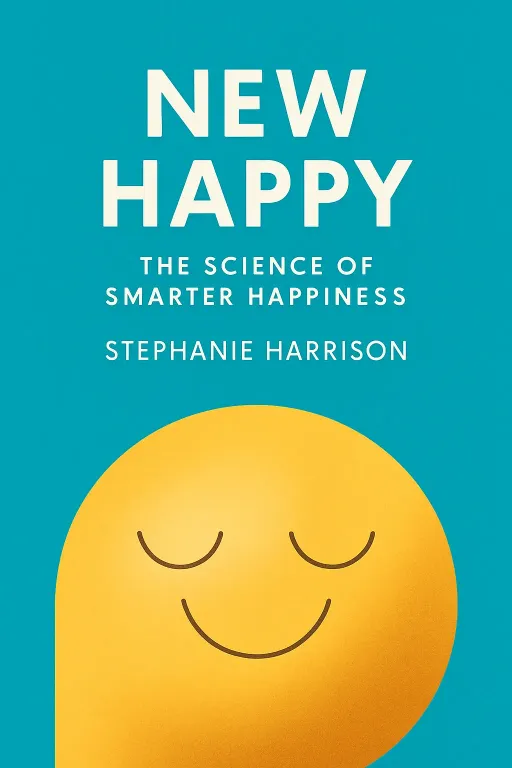
Nova: Precisely. That is the fundamental problem. We are looking at two incredible books today that challenge this entire premise. We are talking about Stephanie Harrison’s New Happy and Matt Haig’s The Comfort Book. These two works, while different in form, are essentially operating on the same frequency. They are trying to pull us out of the cycle of proving our worth through achievement and helping us find a more sustainable way to exist.
Atlas: I am intrigued, but I’m also a little skeptical. Because for someone who wants to build a career and hit goals, the idea of just "existing" sounds like a recipe for stagnation. How do we reconcile the drive to grow with this idea of redefining happiness?
Nova: That is the perfect question to start with. Let’s break it down.
The Achievement Trap vs. The New Happy
SECTION
Atlas: Okay, let’s start with Stephanie Harrison. I’ve heard her described as someone who spent years analyzing the science of well-being, but the premise of New Happy sounds almost counter-intuitive. She’s suggesting that our obsession with "Old Happy"—this idea that we have to prove our worth—is actually what’s killing our happiness.
Nova: That is the core of her argument. She identifies "Old Happy" as this cultural myth that happiness is a reward for achievement. You get the job, you get the house, you get the status, and then, suddenly, you’re happy. But the evidence, and her own research, points to a massive flaw in that logic. When you tie your happiness to external validation, you are essentially outsourcing your sense of worth to other people or circumstances.
Atlas: Which means the moment you hit that goal, the bar moves. It’s like running on a treadmill that someone else is controlling the speed of. You never actually arrive.
Nova: Exactly. And that leads to burnout. It leads to this constant state of "not enough." Harrison proposes a pivot to what she calls "New Happy." It’s not about abandoning achievement; it’s about changing the of your fulfillment. Instead of achievement to prove your worth, she argues for using your unique gifts to help others.
Atlas: Hold on. Let me play devil’s advocate here. I’m an analytical person. I like systems. I like goals. If I shift my focus entirely to "helping others," aren't I just shifting the goalpost? Now, instead of "I need to be the best," I’m pressuring myself to be the "most helpful." Doesn't that just create a new, potentially more exhausting, type of pressure?
Nova: That is a brilliant pushback. The distinction here is between and. Performance is about "Look at me, look what I did, validate me." Contribution is about "Here is what I have, how can this be useful to the people around me?" When you are focused on using your gifts, you aren't doing it to prove you are valuable. You are doing it because your value is already inherent. You are expressing it, not earning it.
Atlas: So, it’s a shift from "I need to do this to be worthy" to "I am worthy, so I will do this."
Nova: That is the structural shift. It changes the psychology of the work. If you are an architect or a strategist, and you approach your work as a way to prove your worth, every mistake feels like a death blow to your ego. But if you approach your work as a mechanism to create value for others, a mistake is just data. It’s just feedback. It’s a tool to refine your service.
Atlas: That actually lowers the stakes in a really healthy way. It turns the work into a craft rather than a performance. But let's talk about the reality of the daily grind. Even if I accept this "New Happy" framework, I still have to pay rent. I still have to deliver results. How do we keep this mindset without becoming passive?
The Comfort Book and the Permission to Just Be
SECTION
Nova: That brings us perfectly to the second half of our discussion: Matt Haig’s The Comfort Book. If Stephanie Harrison is about the active, outward-facing shift in how we approach our purpose, Matt Haig is about the inward-facing safety net. His book is a mosaic—lists, notes, stories, reflections—and it serves as a powerful reminder that we do not have to constantly improve to be worthy of love and peace.
Atlas: I’ve flipped through pages like that before. It feels like a collection of thoughts you’d want to read on a Sunday morning when you’re feeling overwhelmed. But how does that connect to the high-pressure, goal-oriented life we were just discussing?
Nova: It connects because you cannot sustain a life of contribution if you are constantly depleting yourself. Haig’s work acts as a counterweight. He talks about the concept of "staying." Just staying. When the world is loud, when the pressure to be a high-performer is crushing, his book provides a permission structure to simply exist.
Atlas: I like the phrase "permission structure." Because that’s what we lack. We feel guilty if we aren't productive. We feel like we’re wasting time if we’re just sitting there, not "optimizing" our existence.
Nova: And that is exactly what Haig challenges. He points out that our worth is not a function of our utility. You are not a machine that needs to be optimized for maximum output. You are a human being. The "New Happy" model is about how you engage with the world, but "The Comfort Book" is about how you engage with yourself. You need both. You need the outward mission to give you direction, and you need the inward comfort to give you endurance.
Atlas: This feels like the missing piece for the analytical listener. We’re great at building systems for our careers, but we’re terrible at building systems for our own well-being. We treat self-care like another item on the to-do list. "Check: Meditate for 10 minutes. Check: Drink water." It becomes another performance metric.
Nova: That is a spot-on observation. When you turn rest into a KPI, you’ve missed the point. Haig’s book works because it’s not a manual on "how to be better." It’s a collection of reminders on why you are already enough. It’s about accepting the messiness of being human. He writes about the fact that life is a collection of moments, not just a trajectory of progress.
Atlas: So, if I’m trying to synthesize this, the strategy is: Use "New Happy" to define your output—focus on contribution, on using your gifts. And use "The Comfort Book" to define your input—focus on self-acceptance, on rest, on the reality that you don't need to be constantly "fixing" yourself.
Nova: Exactly. It’s a dynamic balance. You need the ambition to serve, and you need the softness to endure. If you only have the ambition, you burn out because your worth is fragile. If you only have the comfort, you might stagnate because you aren't engaging your potential. The sweet spot is the intersection.
Synthesis, Takeaways, and Closing
SECTION
Atlas: This makes a lot of sense, but I want to bring this back to the "Analytical Architect" profile. For the listener who is currently sitting there with a massive to-do list, feeling the weight of the world, how do they apply this tomorrow? What is the actionable blueprint here?
Nova: We start with the "Deep Question" that both these authors implicitly ask: If you didn't have to prove your worth to anyone today, what is one creative or generous thing you would do just for the joy of it?
Atlas: That’s a dangerous question for a strategist. Because my brain immediately goes to: "Okay, how do I monetize that joy? How do I make that creative thing a productivity win?"
Nova: And that is the habit you have to break. The goal is to do the thing without the monetization, without the metrics, without the "growth" angle. Just do it because it uses your gifts and it helps someone else, or simply because it brings you alive.
Atlas: So, just one thing. A tiny experiment.
Nova: A tiny experiment. Maybe it’s mentoring someone without expecting a favor in return. Maybe it’s writing a note of appreciation to a colleague, not because you need them to do something for you, but because you genuinely see their value. Maybe it’s just taking an hour to read something purely for pleasure, not for professional development.
Atlas: I think I can do that. It’s about reclaiming the agency over why I do what I do. It’s not about stopping the work; it’s about changing the motivation.
Nova: That is the ultimate strategy. When you stop working to prove you are enough, you finally start working with the freedom to be excellent. You stop carrying the heavy, unnecessary baggage of "am I good enough?" and you start carrying the light, clear purpose of "how can I be useful?"
Atlas: That’s a profound shift. It takes the pressure off the outcome and puts the focus on the process. It makes the long-term growth sustainable, rather than a sprint to the finish line that doesn't exist.
Nova: And that, ultimately, is the secret. You aren't building a future at the expense of your present. You are building a present that is worth living, which naturally creates a future you want to inhabit.
Atlas: I love that. It’s the perfect way to structure the daily chaos. Focus on the gift, accept the person, and leave the validation at the door.
Nova: Well said. We’ve covered a lot of ground today—from the trap of achievement to the necessity of comfort. But the real work happens when you walk away from this and choose to act on that one creative or generous thing.
Atlas: I’m going to start with that list. I think I’ll write down one thing I’m doing today that is purely for the joy of it.
Nova: That is a strategy I can get behind. Thank you for diving into this with me. This has been a fantastic exploration of what it really means to find solace and happiness in a world that never stops asking for more.
Atlas: It’s been a pleasure. And to our listeners, remember: you don’t need to prove anything to be worthy of your own peace.
Nova: Exactly. This is Aibrary. Congratulations on your growth!









