

Editing Humanity
Introduction
Narrator: In November 2018, a young Chinese scientist named He Jiankui uploaded a series of YouTube videos that sent a shockwave through the world. He proudly announced the birth of twin girls, Lulu and Nana, the world’s first genetically edited babies. Using a revolutionary tool called CRISPR, he had altered their DNA as embryos, attempting to make them immune to HIV. To many, it was a moment of horror—a rogue scientist crossing a sacred ethical line. To others, it was the dawn of a new era, the moment humanity finally took control of its own evolution. This single act brought a long-simmering debate to a boil: now that we have the power to rewrite the code of life, who decides how it should be used?
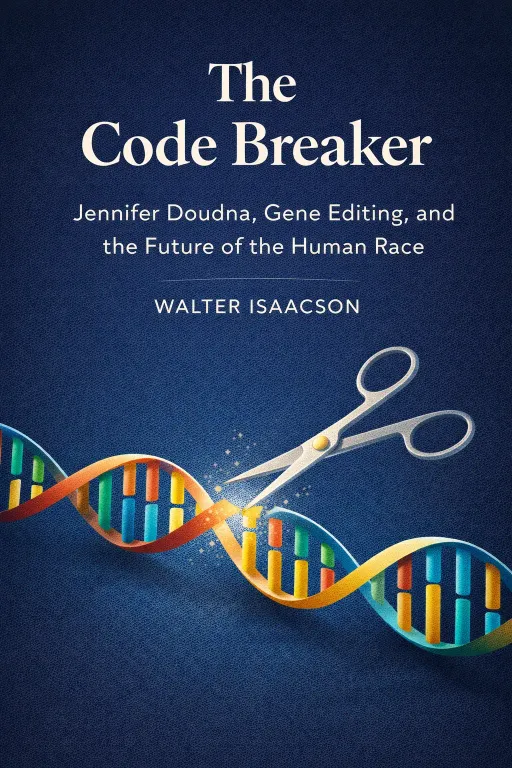
This complex and thrilling story of discovery, rivalry, and profound moral reckoning is the subject of Walter Isaacson’s book, The Code Breaker: Jennifer Doudna, Gene Editing, and the Future of the Human Race. Isaacson chronicles the journey of Nobel laureate Jennifer Doudna, whose life’s work on a curious bacterial defense system unexpectedly handed humanity a tool with the power to cure disease, create designer babies, and forever alter our species.
A Detective Story in a Molecule
Key Insight 1
Narrator: Jennifer Doudna’s path to becoming a revolutionary scientist began not in a state-of-the-art lab, but on a rainy Saturday in Hilo, Hawaii. As a lonely sixth-grader who felt like an outcast, she found solace in books. One day, her father left a used paperback on her bed: James Watson’s The Double Helix. She initially thought it was a detective story, and in a way, it was. The book wasn't a dry textbook but an intensely personal drama about the race to discover the structure of DNA.
For Doudna, it was a revelation. The book’s portrayal of Rosalind Franklin, despite Watson’s condescending tone, showed her that a woman could be a great scientist. More importantly, it ignited a core principle that would guide her entire career: that the shape and structure of a molecule determine its biological function. She realized that science wasn't just about observing nature, but about hunting for the reasons why it worked the way it did. This fundamental curiosity, to understand life at its most basic molecular level, set her on a course to unravel the mysteries of RNA, DNA's less-celebrated sibling, a journey that would ultimately lead her to CRISPR.
From Salt Ponds to an Immune System
Key Insight 2
Narrator: The story of CRISPR's discovery begins not with a flash of genius, but with a persistent, almost obsessive curiosity. In the early 1990s, a Spanish graduate student named Francisco Mojica was studying archaea in the salt ponds of Alicante. He noticed something bizarre in their genetic code: strange, repeating DNA sequences separated by unique "spacers." He thought it was a mistake. But as he found the same pattern in more microbes, he became convinced it had a purpose.
With no online databases to help him, Mojica spent years manually searching through scientific literature, eventually finding a similar observation made years earlier in E. coli. He gave the pattern its name: CRISPR. But its function remained a mystery until 2003. While on vacation, Mojica had a breakthrough. He realized the "spacer" DNA in bacteria perfectly matched the DNA of viruses that attacked them. The conclusion was stunning: CRISPR was a bacterial adaptive immune system. Bacteria were capturing snippets of viral DNA, like molecular mug shots, and storing them in their own genome to recognize and destroy future invaders. Despite its revolutionary implications, Mojica’s paper was rejected by major journals, a frustrating delay that highlights how even the most groundbreaking discoveries can be initially overlooked.
The Partnership That Unlocked the Code
Key Insight 3
Narrator: While microbiologists were figuring out what CRISPR did, biochemists were needed to figure out how it worked. This is where Jennifer Doudna’s expertise became critical. At a 2011 conference in Puerto Rico, she met Emmanuelle Charpentier, a nomadic French biologist. Charpentier had made a key discovery: a previously unknown RNA molecule, which she named tracrRNA, was essential to the CRISPR-Cas9 system. The two scientists, recognizing their complementary skills, immediately decided to collaborate.
Their labs worked across continents, with Doudna's postdoc Martin Jinek in Berkeley and Charpentier's collaborator Krzysztof Chylinski in Vienna. They discovered that the system worked with just three components: the Cas9 enzyme, which acts as molecular scissors; the crRNA, which contains the viral "mug shot"; and the tracrRNA, which acts as a handle to bind the other two together. This led to Doudna’s "oh-my-God moment." They realized if they could fuse the crRNA and tracrRNA into a single, programmable "guide RNA," they could direct the Cas9 scissors to cut any DNA sequence they chose. This transformed CRISPR from a curious bacterial defense into a simple, precise, and powerful gene-editing tool. It was no longer just a discovery; it was an invention.
The Race to Edit Humanity
Key Insight 4
Narrator: The publication of the Doudna-Charpentier paper in June 2012 ignited a furious global race. The critical next step was to prove that this bacterial tool could work in the complex cells of plants and animals, especially humans. The competition was fierce, primarily between Doudna's lab at Berkeley and two labs in Boston: one led by the brilliant and ambitious Feng Zhang at the Broad Institute, and another by the eccentric bio-pioneer George Church at Harvard.
Zhang, who had been secretly working on CRISPR, optimized the system for human cells, developing a more efficient guide RNA and using established techniques to deliver it into the cell's nucleus. Church’s lab took a similar path. The result was a photo finish: in January 2013, Science magazine published papers from both Zhang and Church on the same day, demonstrating CRISPR's success in human cells. Doudna’s lab published its own human cell results just weeks later. This near-simultaneous success became the central issue in a bitter, multi-year patent battle. Doudna’s side argued that adapting the tool to human cells was an "obvious" next step, while Zhang’s side claimed it was a distinct and difficult invention. This rivalry over credit and patents fractured the scientific community, turning collaborators into competitors.
Crossing the Red Line
Key Insight 5
Narrator: As scientists raced to commercialize CRISPR, Doudna was haunted by an ethical nightmare. She dreamed of a meeting with Adolf Hitler, who wanted to understand the technology, forcing her to confront its potential for misuse. This fear became reality with He Jiankui's announcement of the CRISPR babies in 2018. At a tense summit in Hong Kong, He defended his work, claiming he was helping HIV-positive families who faced severe stigma in China.
The scientific community was horrified. Leaders like Doudna and David Baltimore publicly condemned his experiment as irresponsible, unsafe, and medically unnecessary. The gene edits were sloppy, with off-target effects and "mosaicism," meaning not all the babies' cells were successfully edited. He Jiankui had crossed a moral red line, proceeding with heritable human germline editing before any safety standards or societal consensus had been established. The incident was a profound ethical failure, and He was eventually sentenced to three years in a Chinese prison. The scandal forced the world to grapple with the reality that the power to edit humanity was already here.
A Call to Arms
Key Insight 6
Narrator: The story of CRISPR came full circle with the arrival of the COVID-19 pandemic. In March 2020, as the world shut down, Jennifer Doudna felt a "call to arms." She transformed her Innovative Genomics Institute at Berkeley from a gene-editing research center into a high-throughput COVID testing lab. Her team of "volunteer army" scientists worked tirelessly, overcoming bureaucratic hurdles and supply shortages to provide desperately needed testing for their community.
Simultaneously, the CRISPR field pivoted to fight the virus. Both Doudna's and Zhang's labs developed rapid, cheap, CRISPR-based diagnostic tests, named DETECTR and SHERLOCK, which could identify the virus's genetic material. Others began designing CRISPR systems to act as antivirals, directly targeting and destroying the coronavirus RNA inside human cells. The pandemic, in a strange way, softened the debate around gene editing. The idea of editing human genes to provide immunity against deadly viruses suddenly seemed less appalling and a bit more appealing, showcasing how a global crisis can reshape our ethical calculus.
Conclusion
Narrator: Ultimately, The Code Breaker reveals that the discovery of CRISPR is more than a story about a single molecule; it's a story about the nature of scientific discovery itself—a messy, competitive, and deeply human endeavor. The book's most important takeaway is that with great power comes an even greater responsibility for moral imagination. The ability to rewrite the code of life is not just a scientific question, but one of the most profound ethical challenges humanity has ever faced.
As we stand at the dawn of this new life-science revolution, the real question is not whether we can edit our own species, but whether we should. And if we do, who gets to decide what it means to be a "better" human? The answer will require more than just scientific ingenuity; it will demand a deep and collective wisdom that we are only just beginning to seek.