

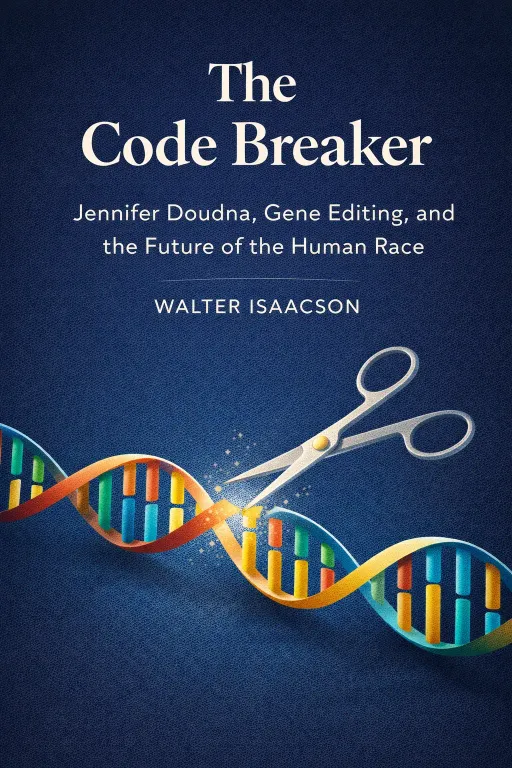
Breaking the Code of Life
Golden Hook & Introduction
SECTION
Christopher: Alright Lucas, I'm going to give you a pop quiz. If I say 'The Code Breaker,' what's the first thing that comes to mind? Lucas: Alan Turing, World War II, a grainy black-and-white movie... definitely not a story that ends with designer babies and a global ethical crisis. Christopher: Exactly. And that's the twist. Today we’re diving into Walter Isaacson's The Code Breaker: Jennifer Doudna, Gene Editing, and the Future of the Human Race. Lucas: Isaacson, the guy who wrote those massive biographies of Steve Jobs and Einstein. He has a type: world-changing geniuses. Christopher: He does. And this book, which was widely acclaimed for making complex science accessible, follows that pattern. It centers on Jennifer Doudna, but it's really about what Isaacson calls the third great revolution of our time: the life-science revolution, following the atom and the bit. Lucas: And knowing Isaacson, it’s not just about the science, it’s about the people. So, if this is a story about geniuses, how much of it is about pure science versus, you know, human drama? Christopher: Oh, it’s almost all human drama. That’s the secret engine of science. And the story of gene editing is a perfect example. It really begins with the race to discover the structure of DNA in the 1950s.
The Human Face of a Scientific Revolution
SECTION
Lucas: The famous double helix. Watson and Crick. Christopher: The very same. But Isaacson paints them as these wonderfully irreverent, almost zany characters. Watson is described as "wickedly smart and cheeky," and he famously opened his own book on the discovery by saying, "I have never seen Francis Crick in a modest mood." They were this perfect pair of ambitious, anti-establishment minds. But their story is completely inseparable from another scientist: Rosalind Franklin. Lucas: Right, I’ve heard her name. She was the one who was overlooked, wasn't she? Christopher: Massively. She was a brilliant X-ray crystallographer who produced the crucial images of DNA. But Watson, in his book, was incredibly condescending towards her. He wrote this shockingly sexist description, focusing on her clothes and lack of lipstick, saying she "might have been quite stunning had she taken even a mild interest in clothes." Lucas: Wow. He actually wrote that? In his book? Christopher: He did. And what's worse is that he and Crick got a peek at her most important data, the famous 'Photograph 51,' without her knowledge. That photo was the key. It showed the clear 'X' pattern of a helix. When Watson saw it, he said it was the 'black cross of reflections which could arise only from a helical structure.' It was the final clue they needed. Lucas: So they basically used her data to get to the finish line first. That’s heartbreaking. Christopher: It is. But here's where the story comes full circle. Decades later, a young girl in Hawaii named Jennifer Doudna is given Watson's book, The Double Helix, by her father. She’s feeling like an outcast, a blonde, blue-eyed 'haole' in a Polynesian community. She said she felt "like a complete freak." Lucas: That sounds incredibly lonely. Christopher: It was. She retreated into books. And when she read The Double Helix, despite Watson's awful portrayal of Franklin, one thing struck her. She said, "what mainly struck me was that a woman could be a great scientist." It was an eye-opener. That flawed, dramatic, human story is what inspired her to become a scientist herself. Lucas: That's incredible. So the tragic story of one female scientist being sidelined is what lit the fire for the next one. Christopher: Exactly. And that inspiration led her down a path to not just read the code of life, like Watson and Crick did, but to finally learn how to write it. And the tool for that came from the most unexpected place imaginable.
From Reading to Writing the Code of Life
SECTION
Lucas: Okay, don't leave me hanging. Where did it come from? Christopher: Bacteria. For over a billion years, bacteria have been fighting a war against viruses. And to survive, they developed this incredibly clever immune system. Think of it like a tiny, molecular police force. Lucas: A police force? Christopher: Yes. When a virus attacks a bacterium, the bacterium’s defense system grabs a snippet of the virus's DNA and stores it in its own genetic code, in these special sections called 'clustered regularly interspaced short palindromic repeats'—or for short, CRISPR. Lucas: That’s a mouthful. So they keep a record of the bad guys. Christopher: Precisely. They create a gallery of genetic mug shots. Then, if that virus ever attacks again, the bacterium uses a copy of that mug shot—a piece of RNA—to guide a protein, an enzyme called Cas9, to find the virus's DNA. And once it finds a perfect match... snip. It cuts the viral DNA to pieces, neutralizing the threat. Lucas: Wait, so it's like a biological 'Find and Replace' function? Or maybe 'Find and Delete'? Christopher: That's a perfect analogy. It’s a programmable, precision-guided molecular missile. For years, scientists like Francisco Mojica in Spain were studying these weird repeating sequences, but it was the collaboration between Jennifer Doudna and a French scientist, Emmanuelle Charpentier, that had the 'oh-my-God moment.' Lucas: What was the moment? Christopher: They realized this bacterial defense system wasn't just for killing viruses. It could be reprogrammed. You could give it any genetic address you wanted. You could design a guide RNA to find a specific gene in a human, a plant, or an animal, and the Cas9 enzyme would go there and cut it. And then, as a final stroke of genius, Doudna and her postdoc Martin Jinek figured out how to fuse the two separate RNA guides into one, creating a 'single-guide RNA.' Lucas: Why was that so important? Christopher: It made the system ridiculously easy and cheap to use. It turned a complex natural phenomenon into a simple, elegant, human-made tool. As Isaacson describes, the author himself went into Doudna’s lab and, with a little guidance, successfully edited DNA in a test tube. It’s become that accessible. Lucas: That’s both amazing and terrifying. If it's that easy to use, the next question is pretty obvious... what happens when someone uses it on a human embryo?
The 'Brave New World' Dilemma
SECTION
Christopher: And that is exactly the question that gave Jennifer Doudna nightmares. She literally had a dream where she was asked to explain CRISPR to Adolf Hitler. She woke up in a cold sweat, realizing she had helped create a tool that could be used for eugenics. Lucas: I can't even imagine that weight. So this was just a theoretical fear? Christopher: It was, until it wasn't. In November 2018, the entire scientific community was rocked. A Chinese scientist named He Jiankui, who had attended Doudna's conferences, secretly used CRISPR to edit the embryos of twin girls. He announced their birth at a major gene-editing summit in Hong Kong. Lucas: That is absolutely chilling. He just... did it? In secret? Christopher: In complete secret. He targeted a gene called CCR5, trying to make the girls resistant to HIV, as their father was HIV-positive. The problem is, the experiment was a complete ethical and scientific disaster. First, it was medically unnecessary—there are simple, effective ways to prevent HIV transmission from father to child. Second, the edits themselves were sloppy. He didn't even get the edit right in one of the twins, and he created other unintended mutations. One scientist called it a "hack job." Lucas: But what was his justification? He must have thought he was doing something good, right? Christopher: He did. When confronted by Doudna and other leaders at the summit, he was emotional. He said, "Jennifer, you don’t understand China. There’s an incredible stigma about being HIV positive, and I wanted to give these people a chance at a normal life." He genuinely seemed to believe he was a hero, comparing his work to the first IVF baby. He was driven by this intense ambition, a hunger for fame, and a belief that he was pushing humanity forward. Lucas: Wow. So the genie is officially out of the bottle. You can't un-invent this. What happened next? Did they ban it? Christopher: That's the billion-dollar question, and it's where the story gets even more complicated. The incident forced a global reckoning.
Synthesis & Takeaways
SECTION
Christopher: Instead of a simple ban, which Doudna and others argued was unrealistic, the debate shifted to finding a "prudent path forward." How do you regulate a technology that is so powerful and so easy to use? Especially when different countries have different rules and different moral compasses. Lucas: It seems like the real code to be broken isn't just DNA, but our own ethical code. We have the tool, but we don't have the user manual. Christopher: That's the core of it. Isaacson's book isn't just a biography of Doudna or a history of CRISPR. It's a profound look at the responsibility that comes with knowledge. We've gone from being creatures shaped by evolution to a species that can direct its own evolution. The story shows that this power was unlocked by flawed, brilliant, competitive, and collaborative human beings. Lucas: And now those same kinds of human beings have to decide what to do with it. Christopher: Exactly. The book leaves you with this enormous, deeply personal question. We see CRISPR is already being used to cure diseases like sickle-cell anemia in living patients, which is a miracle. But the line between therapy and enhancement is blurry. So, it makes you wonder: if you had the power to remove a serious disease from your family line forever, would you do it? Lucas: Of course. I think most people would. Christopher: Okay. What about making your child immune to all future coronaviruses? Or taller? Or smarter? Where do you, personally, draw the line? Lucas: That's a heavy question to end on. It’s not so simple anymore. Christopher: It's not. And that's the world we live in now. Christopher: This is Aibrary, signing off.