

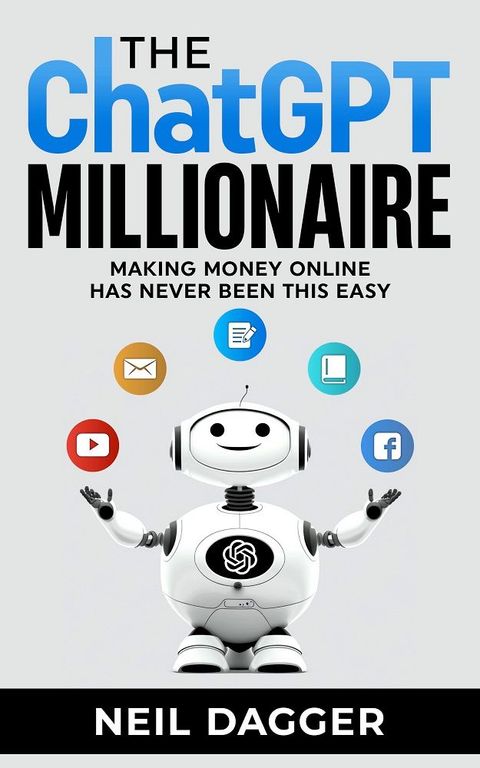
The ChatGPT Millionaire
Making Money Online has never been this EASY (Updated for GPT-4)
Introduction
Nova: Imagine waking up to find that your bank account grew overnight while you were sleeping, all because a piece of software did your work for you. It sounds like a late-night infomercial from the nineties, right? But according to Neil Dagger, this is the new reality of the AI era. Today, we are diving into his bestseller, The ChatGPT Millionaire.
Nova: That is exactly what we are going to find out. Neil Dagger, who actually has a background in computer science from University College London, argues that we are in a unique window of history. He claims that ChatGPT isn't just a toy for writing poems; it is a high-leverage business partner that can handle everything from product creation to marketing and customer service.
Nova: It is surprisingly practical. Dagger focuses on specific workflows and what he calls the secret sauce of the AI world: prompt engineering. He believes that the difference between someone struggling to make a dime and a ChatGPT millionaire is simply how they talk to the machine.
Key Insight 1
The Art of the Prompt
Nova: One of the most important sections of the book is where Dagger breaks down his framework for prompting. He argues that most people get mediocre results because they give mediocre instructions. He uses a four-step method to get high-quality, professional output every time.
Nova: It starts with the Role. You never just ask a question. You tell ChatGPT who it is. For example, Act as a world-class direct response copywriter with twenty years of experience in the health niche. By giving it a persona, you are essentially narrowing down the vast data it has to a specific professional standard.
Nova: Exactly. The second step is the Task. You have to be incredibly specific about what you want. Instead of saying write a blog post, you say write a seven hundred word blog post about the benefits of intermittent fasting for office workers.
Nova: Spot on. Context is where you provide the background info. Who is the audience? What is the tone? Is it for a skeptical scientist or a busy mom? Dagger emphasizes that the more context you provide, the less hallucination or generic fluff you get back.
Nova: It is Constraints and Requirements. This is where you tell it what to avoid or what to include. For instance, do not use jargon, include three bullet points, and end with a call to action to sign up for a newsletter. Dagger shows that when you use this Role-Task-Context-Constraint model, the output goes from sounding like a robot to sounding like a high-paid consultant.
Nova: It does. Dagger moves from the theory of prompting into specific business models, starting with what he calls the Content Factory.
Key Insight 2
The Content Factory
Nova: Dagger is a big proponent of the passive income dream, and he points directly to Amazon Kindle Direct Publishing, or KDP, as a prime target. He explains how you can use ChatGPT to brainstorm, outline, and even draft entire books in a fraction of the time it used to take.
Nova: That is a common criticism, but Dagger argues for a more strategic approach. He focuses on non-fiction niches where people are looking for specific solutions—like cookbooks, self-help guides, or technical manuals. He suggests using ChatGPT to analyze top-selling books in a niche, find out what readers feel is missing from the reviews, and then use the AI to help fill those gaps.
Nova: Dagger addresses that. He suggests a modular approach. You don't ask it to write the whole book at once. You have it outline the chapters, then you work on one section at a time, giving it feedback and asking it to rewrite parts in a more engaging or conversational tone. He also mentions low-content books, like journals or planners, where the AI helps with the prompts and the structure.
Nova: Not at all. He dives into the world of YouTube. He explains how you can use ChatGPT to write scripts for faceless channels—those videos where you see stock footage and hear a voiceover. You use the AI for the script, another AI for the voice, and suddenly you have a content machine that runs without you ever showing your face.
Nova: That is where his next point comes in: the Freelance Revolution. He says the real money right now is in using AI to do service work faster than anyone else.
Key Insight 3
The Freelance Revolution
Nova: Dagger highlights a massive opportunity on platforms like Fiverr and Upwork. He calls it AI-assisted freelancing. The idea is to offer services that usually take hours but can be done in minutes with the right prompts.
Nova: It goes way beyond just articles. Think about SEO descriptions for e-commerce stores. If a company has a thousand products, they need a thousand unique, keyword-rich descriptions. That is a nightmare for a human, but for ChatGPT, it is a Tuesday afternoon.
Nova: Exactly. He also mentions things like email marketing sequences, social media management, and even basic coding tasks. Dagger shares stories of people who have used ChatGPT to write Excel formulas or Python scripts for clients, even if they aren't expert programmers themselves.
Nova: Dagger’s perspective is that the client is paying for the result, not the struggle. If the code works, is secure, and solves the problem, does it matter if it was written by a human or an AI? He argues that we are moving toward a results-based economy where efficiency is the ultimate competitive advantage.
Nova: That is the million-dollar question. Dagger says that most business owners are too busy to learn how to prompt effectively. They want the finished product, not a new hobby. Your value as a freelancer is knowing how to bridge the gap between the business need and the AI's capability. You are the translator.
Key Insight 4
The Reality Check
Nova: We have to talk about the limitations, because Dagger isn't totally blind to them. He warns that ChatGPT can be confidently wrong. It hallucinates facts, it can be repetitive, and it sometimes misses the nuance of human emotion.
Nova: And that is why Dagger insists on the human-in-the-loop model. He says you should never just copy and paste. You have to be the editor-in-chief. You check the facts, you add your own personal stories, and you ensure the tone is right. The AI is the engine, but you are still the driver.
Nova: It is a valid concern. Dagger’s take is that the market will eventually reward quality. If you use AI to create generic garbage, you might make a few bucks in the short term, but you won't build a sustainable business. The real winners will be those who use AI to create genuinely helpful, high-quality content faster than was ever possible before.
Nova: Dagger suggests diversifying. Don't just rely on one platform. Build an email list, create your own website, and use AI to help you manage those assets. He views ChatGPT as a tool to build a foundation, not the foundation itself. It is a way to get off the ground quickly so you can focus on the higher-level strategy.
Conclusion
Nova: As we wrap up our look at The ChatGPT Millionaire, the biggest takeaway is that the barrier to entry for starting a business has never been lower. Neil Dagger’s book serves as a practical manual for anyone willing to learn the language of AI to create value in the world.
Nova: Exactly. Whether you want to write a book, start a freelance side hustle, or just become more efficient at your day job, the principles of structured prompting and AI-assisted creation are going to be essential skills in the coming years.
Nova: Well said. If you are looking for a place to start, Dagger’s book is a great roadmap. It reminds us that while the technology is new, the principles of business—solving problems and providing value—remain the same.
Nova: I can't wait to see what you create. This is Aibrary. Congratulations on your growth!