Unlock AI's True ROI: From Promise to Profit with Strategic Demonstration
Golden Hook & Introduction
SECTION
Nova: Here’s a paradox for you, Atlas: we see brilliant AI solutions, truly cutting-edge technology, that fail to gain traction. They languish, not because they’re technically flawed, but because their sheer genius isn't enough to convince the world.
Atlas: Oh, I like that. It’s like a super-smart inventor who can’t explain their invention in a way that makes anyone actually to buy it. You're saying technical merit isn't the finish line, it’s just the starting gun?
Nova: Precisely! The cold, hard fact is that many brilliant AI solutions fail not because they lack technical merit, but because their value isn’t clearly articulated. We’re going to talk about shifting from selling features to selling measurable impact, proving the return on investment to truly win over clients.
Atlas: That makes me wonder, for anyone developing or selling AI, how do you even begin to bridge that gap? It feels like you’re speaking two different languages: one of algorithms and the other of bottom lines.
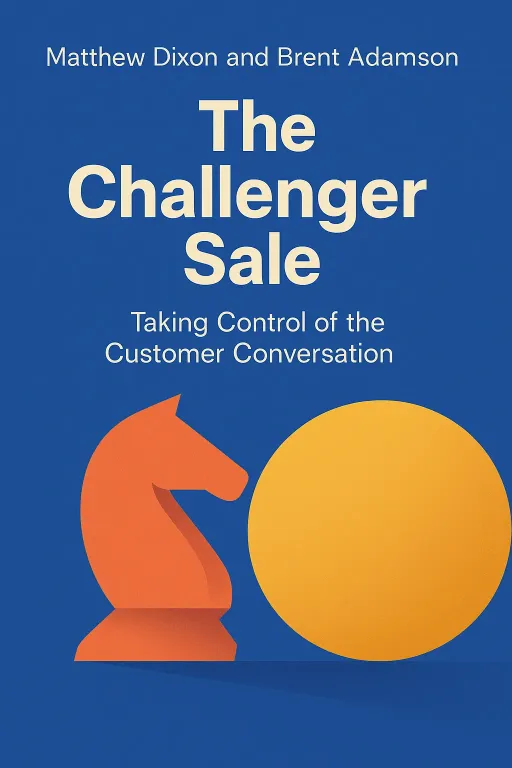
Nova: And that’s exactly where we turn to some foundational insights. Today, we’re tapping into the wisdom of two titans of business strategy: "The Challenger Sale" by Matthew Dixon and Brent Adamson, and "Crossing the Chasm" by Geoffrey A. Moore. These aren't just business books; they're blueprints for making your innovation irresistible.
Atlas: Ah, Matthew Dixon and Brent Adamson are known for their extensive research into what actually makes a salesperson successful, not just what they makes them successful. And Moore, of course, is the pioneer who mapped out the treacherous journey of bringing disruptive tech to the mainstream. Seems like we've got the perfect guides for this particular chasm.
Nova: Absolutely. These insights fundamentally shift your focus from product-centric selling to client-centric value creation. It's about making your AI offerings not just desirable, but undeniably profitable.
From Features to Financials: The AI ROI Imperative
SECTION
Atlas: Okay, so let's start with "The Challenger Sale." What does it mean to challenge customer assumptions when you're trying to sell them a complex AI solution? Isn't that a bit confrontational?
Nova: It’s not about being confrontational, Atlas; it's about being profoundly insightful. Dixon and Adamson's research showed that the most successful salespeople don't just build relationships or solve stated problems. They their customers something new about their own business – something the customer didn't realize they needed to know. They directly link their solutions to tangible gains, often by revealing a hidden cost or opportunity.
Atlas: So basically, you're exposing a blind spot. Can you give me an example of how an AI solution, perhaps something that optimizes a supply chain, might use this "Challenger" approach?
Nova: Certainly. Imagine you're selling an AI-powered supply chain optimization platform. A traditional salesperson might talk about its advanced algorithms, its real-time data processing, its predictive analytics. Those are features. A Challenger salesperson, however, would walk into a client meeting and say, "Did you know that your current inventory management system, while functional, is likely costing you 15% more in carrying costs due to suboptimal routing and demand forecasting errors than industry best practices? Our AI doesn't just improve efficiency; it's designed to reclaim that 15% directly into your profit margin, translating to an X million dollar saving annually."
Atlas: Wow. That's a completely different conversation. You're not just selling a tool; you're selling a solution to a problem the client didn't even fully grasp, and you're putting a hard number on it. That’s powerful.
Nova: Exactly. You've reframed their current state as a problem they can no longer ignore, and your AI is the precise, quantifiable answer. It challenges their assumption that their current system is "good enough" by showing them the hidden cost of "good enough." It moves the conversation from "what does this AI do?" to "what does this AI?"
Atlas: I see. It's about making the invisible costs visible, and then presenting your AI as the undeniable, numerically justified solution to that newly illuminated problem. That's going to resonate with anyone who's struggled to get buy-in for innovative, but initially abstract, AI projects.
Crossing the Chasm & Proving ROI to Early Adopters
SECTION
Nova: And this concept of quantifiable value leads us directly to the wisdom of Geoffrey Moore and "Crossing the Chasm." Once you've challenged assumptions and articulated value, how do you then get your AI past the initial innovators and early adopters to the mainstream market?
Atlas: Okay, so how does proving ROI help cross this chasm? My understanding is that early adopters are usually risk-takers, the ones excited by new tech for its own sake. Do they really care about ROI as much as the pragmatists who come later?
Nova: That's a great question, and it's a common misconception. While early adopters are indeed more risk-tolerant, they are also incredibly discerning. They're not just buying the tech; they're buying the for a significant competitive advantage. And for that potential to be realized and, crucially, to serve as a bridge to the mainstream market, it needs to be. They need to be able to show peers and leadership that this innovative AI, and worked in a way that produced tangible, measurable results.
Atlas: So the ROI isn't just for the mainstream, it's the the early adopters tell to the mainstream. It’s the proof of concept, backed by data.
Nova: Precisely. Moore emphasizes that you need to demonstrate compelling value propositions to early adopters. Think of an early AI tool designed for predictive maintenance in manufacturing. Instead of just saying, "Our AI uses machine learning to predict equipment failures," a company effectively crossing the chasm would highlight how their AI accurately predicted a critical turbine failure for an early adopter, saving them an estimated $2 million in potential downtime, emergency repairs, and lost production.
Atlas: Whoa. That’s not just a feature; that’s a validated, quantifiable success story. That early adopter becomes your most powerful advocate, armed with hard numbers. It’s no longer just about the AI being "smarter," but about it being "smarter and saving millions."
Nova: Exactly. That success story, backed by concrete ROI, becomes the foundation for gaining trust with the more pragmatic majority. It bridges the gap between innovative technology and mainstream market acceptance with clear, undeniable evidence. It’s about creating a compelling narrative of success that isn't just anecdotal, but financially grounded.
Atlas: So, the Challenger Sale gives you the playbook for articulating the value, and Crossing the Chasm tells you why you absolutely turn that potential into, measurable value with your very first clients. This really shifts the AI conversation from 'what it does' to 'what it you' or 'what it you.'
Synthesis & Takeaways
SECTION
Nova: That’s it in a nutshell, Atlas. These insights fundamentally shift your focus from product-centric selling to client-centric value creation, making your AI offerings irresistible. It's about moving beyond the fascination with the technology itself and focusing on the profound impact it can have on a business's bottom line.
Atlas: Honestly, that sounds like a massive mindset shift for a lot of people in the tech world. It’s not just about building better mousetraps; it’s about proving how many dollars that mousetrap is going to save them from a mouse infestation they didn't even know they had.
Nova: Beautifully put. And the tiny step we recommend for our listeners this week is exactly that: identify one AI solution you’re currently working on. Now, articulate its value in terms of a quantifiable business outcome for a, not just its features.
Atlas: I love that. Don't just say, "It processes data faster." Say, "For a mid-sized e-commerce company, this AI will reduce customer service response times by 30%, leading to a 10% increase in customer satisfaction scores and a 5% reduction in churn, which translates to X dollars saved annually." Put a number on it.
Nova: Exactly. Start connecting those technical capabilities directly to profit, savings, or revenue generation. It's the difference between a cool demo and an undeniable investment. When you can speak that language, your AI doesn't just promise; it delivers.
Atlas: That's powerful. It transforms AI from a cost center or an experiment into a strategic asset. Thank you, Nova, for making this complex, yet crucial, shift so clear.
Nova: My pleasure, Atlas. It's a game-changer for anyone looking to unlock AI's true ROI.
Atlas: This is Aibrary. Congratulations on your growth!