

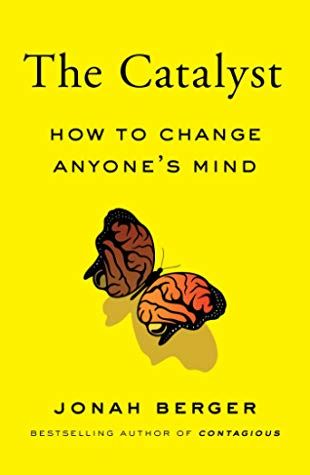
The Catalyst
How to Change Anyone's Mind
Introduction: The Futility of Pushing Harder
Introduction: The Futility of Pushing Harder
Nova: Welcome back to the show! Today, we're diving into a book that flips the script on persuasion. If you’ve ever tried to convince a stubborn client, a resistant team member, or even a family member to adopt a new idea, you know the feeling: the harder you push, the more they dig in their heels. It feels like hitting a brick wall.
Nova: Exactly. Berger, a Wharton professor famous for his work on virality in 'Contagious,' shifts the focus entirely. He posits that most people aren't opposed to change itself; they are opposed to the of changing. They are stuck in inertia. And our job, as change agents, is not to be a battering ram, but a catalyst.
Nova: Not at all. It’s far more strategic. Berger’s core insight is that people are already moving in a direction—usually the direction of the status quo. To get them to move to your new idea, you don't need to create new motivation; you need to identify and eliminate the specific psychological roadblocks that are keeping them stuck. It’s a diagnostic approach to influence.
Nova: The parking brake, every single time. And Berger gives us a powerful framework to identify those brakes. We’re going to break down the five major psychological roadblocks that stop change in its tracks. Ready to diagnose some resistance, Alex?
From Pushing to Removing Inertia
The Core Philosophy: Diagnosing the Roadblocks
Nova: Let's start with the big picture. Berger emphasizes that when we present a new idea, the listener’s brain immediately goes into defense mode. It’s not about the merits of your proposal; it’s about self-preservation. This is where the concept of inertia comes into play.
Nova: You trigger the first major roadblock: Reactance. Berger defines Reactance as the unpleasant feeling we get when our freedom to choose is threatened. When you push too hard, people don't just disagree with your idea; they resist trying to control them. It’s a primal defense mechanism.
Nova: Precisely. Berger suggests that instead of demanding compliance, a catalyst frames the change as an opportunity for the other person to a better path. You have to make them feel like the decision is still theirs, even if you’ve subtly guided them there. You have to ease the pressure.
Nova: That’s the foundation. If you don't address Reactance, the next four roadblocks we discuss won't even matter because the listener has already shut down. It’s the gatekeeper to all other influence.
Nova: And this leads us directly into the second major barrier, which is deeply tied to how we value things we already possess: The Endowment Effect.
Barriers 2 & 3: Overcoming Ownership and Gaps
The Endowment Effect and Perceived Distance
Nova: The Endowment Effect means we value things we own more highly than things we don't. When you propose a change, you are essentially asking people to give up something they already 'own'—their current process, their current belief, their current habit. Even if the new thing is objectively better, the pain of giving up the old thing feels greater than the pleasure of gaining the new one.
Nova: Berger suggests framing the change not as a loss, but as an or a that preserves value. Or, even better, frame the status quo as something they are by adopting the new thing. You shift the endowment. You make them feel like they already own the benefits of the new idea.
Nova: Exactly. Now, let’s tackle the third barrier, which is related to how far away the change feels: Distance. This is the perceived gap between where someone is now and where you want them to be.
Nova: Right. Big, sweeping changes trigger massive uncertainty and feel overwhelming. A catalyst shrinks that distance by breaking the change down into small, manageable steps. Think of it like building a bridge one plank at a time, rather than demanding someone jump across a canyon.
Nova: That small win is crucial. It proves the path exists. It makes the destination feel reachable. You’re not asking them to cross the canyon; you’re asking them to take one easy step onto the first plank. That step is so small it bypasses Reactance and makes the Endowment loss negligible.
Barriers 4 & 5: Making it Safe and Validating the Leap
Uncertainty and the Need for Proof
Nova: We’ve covered the internal resistance to loss and threat. Now we move to the cognitive barriers: Uncertainty and the need for external validation.
Nova: Berger notes that uncertainty isn't just about the outcome; it’s about competence. People worry, 'Can I actually this?' To combat this, catalysts make the path to competence clear. This often involves providing training, mentorship, or, crucially, modeling.
Nova: Exactly. And this ties directly into the final major barrier: Corroborating Evidence. This is where many people trying to persuade others make their biggest mistake. They think evidence is the most important.
Nova: And the listener thinks, 'Of course think it’s good; you created it.' Berger stresses that evidence from the change agent is exponentially more powerful. It bypasses Reactance because it’s not coming from the person threatening their freedom.
Nova: That’s the catalyst move. You are leveraging social proof. You are showing them that others—people they respect, people who are similar to them—have already taken the leap and survived, even thrived. This external validation neutralizes the internal doubt.
Nova: Think about it this way: If you tell your friend a restaurant is great, they might be skeptical. If three other friends they trust independently rave about it, they’re booking a table tonight. That’s the power of Corroborating Evidence over self-generated persuasion.
Synthesis and Application
Putting REDUCE into Practice: The Catalyst Mindset
Nova: That’s a perfect summary. The Catalyst mindset is fundamentally about shifting your focus from 'What do I need to say?' to 'What is stopping them from agreeing?' It’s about diagnosis before prescription.
Nova: Exactly. You are looking for the specific roadblock. Maybe they fear losing control. Maybe they fear the time it takes to learn. Maybe they just love the old system’s familiarity.
Nova: It’s about making the path of least resistance the path toward your goal. Berger’s research shows that when you successfully remove these barriers, people often don't even realize they were influenced. They feel like they arrived at the conclusion all on their own, which is the ultimate win for a catalyst.
Nova: A great example Berger uses, which I found striking, relates to health initiatives. Simply telling people the risks of smoking or the benefits of exercise rarely works long-term. But framing the change in a way that reduces Reactance—say, by focusing on the immediate social benefits of quitting, or by providing a very small, achievable first step—that’s where the real movement happens.
Conclusion: Becoming the Agent of Change
Conclusion: Becoming the Agent of Change
Nova: We’ve covered a lot of ground today, Alex. The main takeaway from Jonah Berger’s The Catalyst is that influence isn't about adding persuasion; it’s about subtracting resistance. We must stop seeing ourselves as salespeople and start seeing ourselves as psychological engineers.
Nova: And remember, the most powerful evidence doesn't come from you. It comes from peers, experts, or successful case studies that validate the new path. Make the leap feel safe, small, and validated by others.
Nova: Indeed. The world is full of brilliant ideas waiting for the right catalyst to remove the psychological barriers holding them back. Think less about convincing, and more about clearing the way.
Nova: My pleasure, Alex. Listeners, take this framework and apply it this week. See how diagnosing the resistance changes your results.
Nova: This is Aibrary. Congratulations on your growth!