Navigating Your Career Landscape: Strategy and Vision
Golden Hook & Introduction
SECTION
Nova: Most career advice tells you to climb the ladder, right? Get the promotion, aim for the next rung. But what if that ladder is leaning against the wrong building entirely? What if all that effort, all that striving, takes you further away from where you truly want to be?
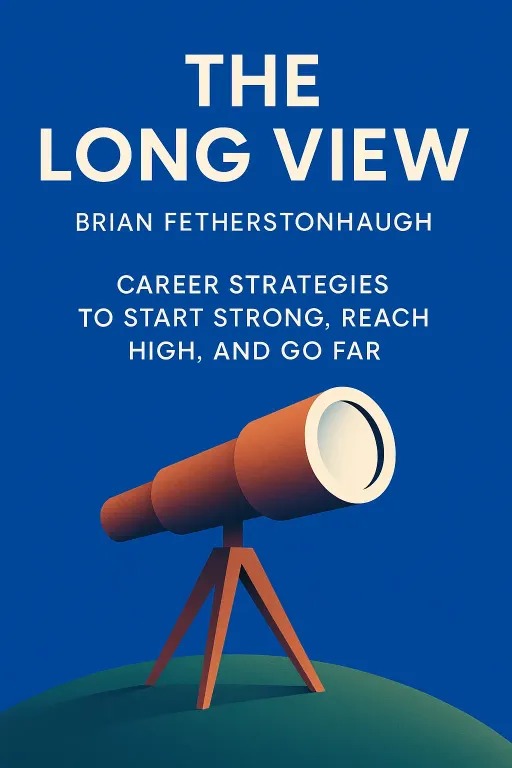
Atlas: Oh, I love that image, Nova. It immediately brings to mind that feeling of professional success mixed with a nagging sense of "is this?" For our listeners who are constantly pushing for growth and mastery, but also feel the squeeze of time, that question hits hard. It's exactly what Brian Fetherstonhaugh, a seasoned executive and global CEO, dives into in his book, "The Long View," challenging us to rethink how we navigate our professional lives.
Nova: Absolutely, Atlas. Fetherstonhaugh's work really makes you question the default settings of career progression. And to complement that big-picture vision, we're also looking at "The Career Playbook" by James M. Citrin, which gives us the tactical, actionable steps to actually that aligned career. It’s the perfect blend of strategy and execution.
Atlas: So, it’s not just about dreaming big, it’s about having the map and the tools to get there. I’m already intrigued.
The "Career North Star" - Navigating by Purpose
SECTION
Nova: Exactly. Let's start with Fetherstonhaugh's core concept: the "Career North Star." He argues that instead of just chasing the next promotion or salary bump—which is essentially just climbing a ladder—we should be defining an ultimate purpose. Think of it like a sailor navigating by a fixed star, rather than just drifting from one buoy to the next. That North Star is your ultimate purpose, your guiding light for every career decision.
Atlas: But for our listeners who are already swamped with daily responsibilities, leading teams, and trying to master new skills, how do you even begin to this North Star? Isn't it just another abstract concept for people with too much time on their hands? I mean, it sounds great, but where do you start when you're just trying to get through your inbox?
Nova: That’s a brilliant question, Atlas, and it gets to the heart of why this concept is so powerful. It's not about taking a year off to meditate on a mountaintop. It’s about intentional reflection. The North Star isn't necessarily a specific job title, but rather the you want to make, the you want to solve, or the you want to embody throughout your working life. It's a deep understanding of what truly energizes and fulfills you, beyond the superficial markers of success.
Atlas: So, it’s about defining your personal mission statement for your career, rather than just letting opportunities define you? That makes sense. I imagine a lot of our listeners, especially those in leadership, have felt the pressure to take roles that look good on paper but don't necessarily align with their deeper motivations.
Nova: Precisely. Let me give you a hypothetical, but very real-world scenario. Imagine Sarah, a brilliant marketing executive. She climbed the corporate ladder with incredible speed, reaching Vice President by her late 30s. On paper, she was a resounding success – corner office, great salary, prestigious company. But deep down, she felt a gnawing emptiness. Her North Star, she realized after much reflection, wasn't about selling more products, but about fostering creativity and empowering young talent. Her current role, while successful, was leading her further away from that intrinsic purpose.
Atlas: Wow. That’s kind of heartbreaking, actually. I can see how that would resonate with many high-achievers. So, what did Sarah do? Did she just quit and become an art teacher? Because that’s a big leap, and not always feasible for everyone.
Nova: That's the beauty of it. She didn't quit immediately. Instead, she started making micro-alignments. She began volunteering to mentor junior colleagues, she initiated an internal program to foster innovative marketing approaches, and she started exploring non-profit boards focused on arts education. These were small, intentional "plays" within her existing structure that allowed her to steer her career subtly towards her North Star. Eventually, she transitioned into a leadership role at a creative agency that specifically focused on social impact campaigns, a perfect convergence of her skills and her purpose.
Atlas: That’s a perfect example. It shows that finding your North Star isn't necessarily about a radical overhaul, but about making those strategic, incremental shifts. For our action-oriented listeners, that’s a much more tangible approach than just a vague "find your purpose."
"The Career Playbook" - Mastering Tactical Moves
SECTION
Nova: Absolutely. And once you have that clearer sense of direction, the next question is, how do you actually there? How do you make those micro-alignments, or even larger strategic pivots, a reality? That's where James Citrin's "The Career Playbook" becomes an indispensable guide. He provides the tactical advice for navigating crucial career transitions and opportunities.
Atlas: Okay, so we have the vision from "The Long View." What are the actual "plays" we need to run from "The Career Playbook"? Is it just about updating your LinkedIn profile and practicing interview questions? Because I imagine our listeners are looking for something a bit more strategic, especially if they’re aiming for leadership roles or significant career shifts.
Nova: That’s a great way to put it, Atlas. It goes far beyond the basics. Citrin emphasizes critical skills like strategic networking, proactive skill development, and negotiation as continuous processes. Take networking, for instance. It’s not just about collecting business cards at an event. It’s about building genuine, reciprocal relationships with people who can offer different perspectives, mentorship, or even just information that helps you refine your North Star. It’s about giving as much as you get.
Atlas: That makes me wonder, can you give me an example of someone who this strategic networking, not just for a job, but for an entire career pivot or to build a new skill set? Because for leaders, building a strong network is paramount, but often feels like another chore.
Nova: Certainly. Think of David, an engineer who realized his North Star was in sustainable technology, a field his current company wasn't deeply involved in. He didn't just fire off resumes. Instead, he started attending industry meetups, not just to find a job, but to learn. He actively sought out conversations with people working in sustainable tech, offering his engineering insights on their challenges, and genuinely listening to theirs. Through one of these conversations, he connected with a consultant who later became a mentor, and eventually, helped him land a pivotal role at a startup focused on renewable energy solutions. It was a long game of relationship building, driven by his North Star, not just a job hunt.
Atlas: That’s a brilliant example of how it’s not just about who you know, but you nurture those connections, and for what purpose. It sounds like a skill that needs constant development, just like any other leadership competency. And what about negotiation? Is that only for salary discussions, or does it apply more broadly to career growth and well-being?
Nova: It applies far more broadly! Citrin frames negotiation not as a battle, but as a continuous dialogue. It's about advocating for your role, your resources, your team, and even your work-life balance. For our pragmatic leaders, mastering negotiation means being able to articulate your value, understand your leverage, and find win-win solutions, whether it's for a promotion, a new project, or even more flexible working arrangements to protect your mental clarity and well-being. It’s about shaping your role to better align with your North Star, rather than passively accepting what's offered.
Atlas: So, these aren't just job-hunting tactics, they're fundamental skills for leadership, continuous growth, and personal well-being. It’s about being proactive in shaping your career, not just reactive. That’s going to resonate with anyone who wants to optimize their growth and achieve holistic success.
Synthesis & Takeaways
SECTION
Nova: Precisely, Atlas. When you bring "The Long View" and "The Career Playbook" together, you get a powerful framework. The North Star provides the "why" and the ultimate "where" you're heading, giving every decision purpose. The Playbook then gives you the practical "how-to" guide, the tactical moves – like strategic networking, skill mastery, and continuous negotiation – to actually reach that destination. It’s an iterative process, not a one-time fix.
Atlas: So, this brings us back to that deep question we posed at the beginning: How does your current career path align with your long-term vision, and what immediate "plays" can you make to steer it more intentionally? For someone who values self-growth but struggles with time, what’s the most efficient first step?
Nova: That's the million-dollar question, isn't it? And for our pragmatic leaders, I'd say the first "play" is simply to schedule that non-negotiable 20 minutes a day, not just for learning, but for. Use that time to quietly ask yourself: What truly energizes me? What problems do I genuinely want to solve? What impact do I want my work to have, beyond the immediate deliverables? Even small steps forward are still steps forward. That initial clarity is the first step towards aligning your trajectory.
Atlas: I love that. It’s about embracing imperfection and just starting. It’s not about having all the answers at once, but committing to the journey of discovery and intentional action. That’s a powerful blend of vision and practicality.
Nova: Absolutely. It’s about designing a career that truly serves your purpose and well-being, not just your resume.
Atlas: Fantastic insights, Nova. This has been incredibly illuminating.
Nova: Thank you, Atlas. This is Aibrary. Congratulations on your growth!