Decoding the Hidden Pressures of Modern Achievement
Golden Hook & Introduction
SECTION
Nova: I saw a headline yesterday that claimed we are currently living in the most productive era in human history, yet we are also the most exhausted. It feels like a glitch in the system, doesn't it?
Atlas: That is the perfect way to frame it. It feels like we are running a race where the finish line keeps moving further away, and the worst part is, we are the ones holding the map. We keep drawing the path longer.
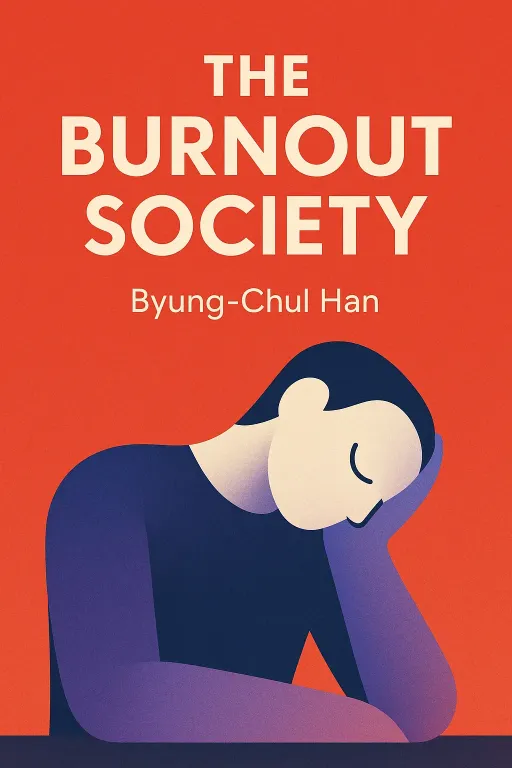
Nova: Exactly. And that brings us to two thinkers who really saw this coming. Today we are looking at The Burnout Society by the philosopher Byung-Chul Han, and we are pairing it with a classic, the Dialectic of Enlightenment by Max Horkheimer and Theodor W. Adorno.
Atlas: Those are heavy hitters. I remember reading a bit of the Frankfurt School in college, and it always felt like they were warning us about the future we are currently living in.
Nova: They really were. Byung-Chul Han is fascinating because he writes these short, sharp books that feel like laser beams cutting through modern culture. He actually moved to Germany from South Korea to study philosophy and eventually became one of the most widely read cultural critics in Europe. He has this unique ability to diagnose our current psychological state with just a few pages. And Horkheimer and Adorno? They wrote their masterpiece while in exile during the 1940s, trying to understand how a civilization could use its own intelligence to essentially engineer its own downfall.
Atlas: It sounds grim, but I suspect it is actually the clarity we need. If we are feeling the pressure to constantly optimize our lives, maybe these thinkers can tell us why we feel that way.
The Myth of Voluntary Freedom
SECTION
Nova: Let’s start with Han’s core argument in The Burnout Society. He suggests that we have moved past the era of the disciplinary society. In the past, you had a boss, a factory, or a rigid social structure that told you what to do. You were an obedience-subject. You did your job because you had to.
Atlas: Right, that makes sense. It was external. You had a supervisor, or a teacher, or a parent, and you obeyed the rules to avoid punishment.
Nova: Exactly. But Han argues that we have shifted into the achievement-society. Now, we are achievement-subjects. Nobody has to tell us to work harder, or to optimize our morning routines, or to learn a new skill on the weekend. We do it to ourselves. We have internalized the boss.
Atlas: That is a chilling thought. So you are saying that the pressure hasn't disappeared, it has just moved inside our heads?
Nova: Precisely. We are now the exploiter and the exploited at the same time. We feel like we are exercising our freedom when we sign up for that extra project or optimize our sleep for better performance, but Han would argue that this is a form of self-exploitation disguised as self-actualization.
Atlas: I can see how that lands for anyone listening who feels that nagging sense of guilt on a Sunday evening. You feel like if you are not doing something productive, you are failing. But I have to ask, isn't that just ambition? Is it really exploitation if I want to grow?
Nova: That is the crucial distinction. Growth is about expansion and learning. Exploitation is about extraction. When we operate from that achievement-subject mindset, we are extracting value from ourselves like a machine. We view our own time, our own energy, and our own cognition as resources to be mined. And the problem is, a machine can be repaired, but a human spirit, once it hits that wall of burnout, takes a lot more than a software update to fix.
Atlas: I like that distinction. It’s like the difference between a garden and a coal mine. In a garden, you nurture the soil so things can grow. In a mine, you just take what you need until the resource is gone.
Nova: That is a beautiful analogy. And the tragedy is that we think we are being free. We think, I chose to work this hard, I chose to take this course, I chose this side hustle. But Han suggests that this is a voluntary servitude. We are so obsessed with the idea of being able to do things—the "yes, we can" mentality—that we lose the ability to say no. We lose the capacity for contemplation, for boredom, and for the things that actually make life meaningful.
Atlas: It makes me wonder about the cost of that freedom. If we are constantly saying yes to every opportunity because we feel like we can and should, are we actually losing the freedom to just exist without having to produce something?
Nova: You hit the nail on the head. That is the trap. We have confused being busy with being alive. And that leads us directly into the second part of our discussion, which is how we use our tools to keep this cycle spinning.
The Trap of Instrumental Rationality
SECTION
Atlas: Okay, so we are self-exploiting. But why are we so obsessed with doing it? Why can’t we just stop? Is it just social pressure, or is there something deeper in how we think?
Nova: That is where Horkheimer and Adorno come in with the Dialectic of Enlightenment. They talk about something called instrumental rationality. This is the idea that we have become so good at using reason to achieve specific goals that we have forgotten how to ask if those goals are actually worth achieving.
Atlas: Give me an example of that. It sounds a bit abstract.
Nova: Think about how we handle our daily schedules. We use apps, data, and tracking to optimize our time. We track our steps, our sleep, our reading speed, our focus minutes. We are applying instrumental rationality to our own existence. We treat ourselves like an engineering problem. The goal is efficiency. But Horkheimer and Adorno would ask, what happens to the human experience when the only thing that matters is the output?
Atlas: It feels like we are optimizing for a version of ourselves that doesn't actually exist. We are optimizing for a data point. I see this with people who are obsessed with productivity hacks. They spend more time setting up the system than they do actually doing the work.
Nova: Exactly. And that is the paradox. The very tools we created to liberate us—our technology, our systems, our data—have become the bars of our cage. When you apply logic and efficiency to everything, you eventually strip away the mystery, the playfulness, and the spontaneity of life. Everything becomes a means to an end. You read a book not to enjoy the story, but to extract insights. You go for a walk not to clear your head, but to hit a step count.
Atlas: That is such a harsh reality check. I have definitely been guilty of that. I’ve listened to podcasts at 2x speed just to get through them, and then realized I didn't actually enjoy the content. I just wanted the completion marker.
Nova: We all do it. And that is the core insight from Horkheimer and Adorno. They were looking at how the Enlightenment, which was supposed to free humanity from superstition and fear, ended up creating a world where everything is calculated and controlled. They saw that reason, when it becomes the only way we relate to the world, actually turns against us. It makes the world cold and predictable, but not necessarily better.
Atlas: It makes me think about the difference between a strategist and a technician. A technician wants to solve the problem as efficiently as possible. A strategist, or a true architect of their own life, has to ask, what is this for? If I optimize my day to be 10% more productive, what am I going to do with that extra 10%? If the answer is just "do more work," then I haven't actually gained anything.
Nova: That is the shift we need to make. We need to move from instrumental rationality—which asks "how can I do this faster?"—to a more intentional way of being that asks "why am I doing this, and does it align with who I want to be?"
Atlas: It sounds like we need to reclaim our right to be inefficient.
Nova: I love that phrase. Reclaiming the right to be inefficient. Because true creativity, deep connection, and genuine insight often happen in the spaces where we are not being productive. They happen in the pauses, in the boredom, in the detours.
Synthesis & Takeaways
SECTION
Atlas: So, if we pull these two ideas together—Han’s self-exploitation and Horkheimer and Adorno’s optimization trap—what is the path forward? We can't just stop working. We have responsibilities. But how do we change the internal narrative?
Nova: The first step is awareness. We have to recognize that when we feel that pressure to perform, it isn't necessarily an external force. It is often us, acting as our own taskmaster. We have to start asking ourselves: Am I doing this because I truly want to grow, or am I doing this to prove that I am a high-functioning, optimized human being?
Atlas: That is a tough question to answer honestly. But I think it is the only way to break the cycle.
Nova: It is. And the second step is to practice what we might call "intentional friction." We need to deliberately introduce things into our lives that cannot be optimized. Read a book that has no practical application. Go for a walk with no phone and no step tracker. Have a conversation where the goal is just to connect, not to network or gain information.
Atlas: I like that. It is like an act of rebellion against the system. By refusing to optimize every second, you are reclaiming your humanity.
Nova: Precisely. And remember, this is not about quitting your goals. It is about changing the relationship you have with your goals. The goal should serve you; you should not be serving the goal.
Atlas: I think that is the perfect note to land on. We are the architects of our own lives, not the employees of our own ambition. It is okay to step back, breathe, and remember that we are more than the sum of our outputs.
Nova: That is exactly it. We are not machines to be optimized. We are people to be lived. And that is the most productive thing we can do.
Atlas: This has been a great conversation. I feel like I have a bit more permission to just be, rather than always do.
Nova: That is the goal. Thank you for diving into this with me. This is Aibrary. Congratulations on your growth!