Unlocking Your Brain's Full Potential: The Neuroscience of Peak Performance
Golden Hook & Introduction
SECTION
Nova: Most people believe their brain is a fixed entity, a hard drive that’s pretty much set from childhood. But what if I told you that every single thought, every new skill, every physical movement you master, literally remodels the very structure of your brain? That your brain is less like a hard drive and more like a constantly evolving, self-sculpting supercomputer?
Atlas: Whoa. That’s a bold claim, Nova. I mean, we talk about 'muscle memory' all the time, especially in physical disciplines, but you’re saying it’s not just the muscles remembering, it’s the brain physically changing? That’s kind of mind-blowing, to be honest. It challenges the whole idea of inherent talent versus learned skill.
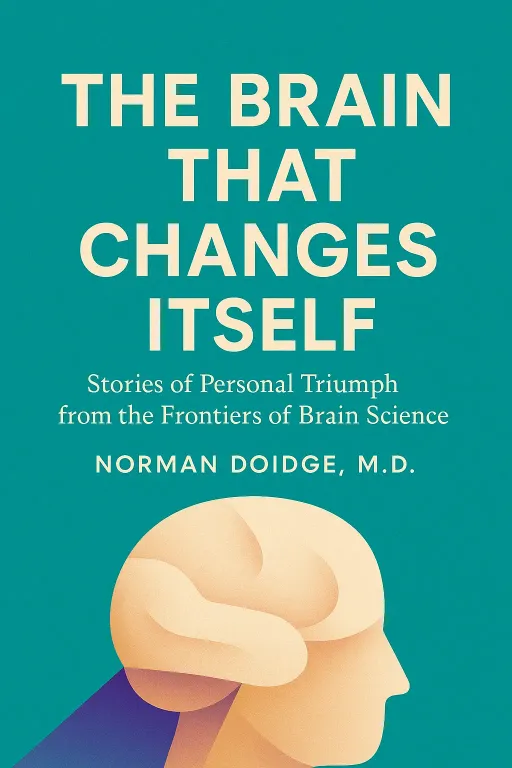
Nova: Absolutely. And that’s precisely what we’re diving into today, drawing insights from two groundbreaking books. First, "The Brain That Changes Itself" by the remarkable Norman Doidge, a psychiatrist and psychoanalyst who brought the concept of neuroplasticity into the mainstream in a truly accessible way. And then, we’ll layer that with "Spark: The Revolutionary New Science of Exercise and the Brain" by John J. Ratey, a clinical professor at Harvard Medical School, who scientifically quantifies how physical activity is essentially brain fertilizer.
Atlas: So, we’re talking about a genuine biological revolution here, not just some self-help platitude. This isn't just about 'thinking positive,' it's about the physical architecture of our minds? How does this even begin to relate to someone trying to master something as incredibly demanding as, say, a complex gymnastic routine, or just trying to build real self-confidence in their abilities?
The Mind-Body Superhighway: How Your Brain Rewires for Excellence
SECTION
Nova: Precisely, Atlas. It's about fundamental biology. Doidge’s work on neuroplasticity is a game-changer because it proves that the adult brain is not a static organ. It's constantly reorganizing itself, forming new neural connections, and even shifting functions from one area to another. Imagine the brain as a highly adaptable city, where new roads are built, old ones are rerouted, and entire districts can be repurposed based on demand.
Atlas: That’s a great analogy. So, if I’m trying to nail a triple backflip, for example, my brain isn’t just 'learning' it; it’s actually changing its wiring to performing that specific, incredibly complex movement? It’s not just about repetition; it’s about physically embedding that skill?
Nova: Exactly. Every time you practice, every time you focus, you're literally strengthening specific neural pathways and weakening others. It's a continuous process of neural sculpting. Doidge shares incredible stories of people recovering from major brain injuries, or learning to 'see' with their tongue using sensory substitution devices, all thanks to this inherent neuroplasticity. It demonstrates the brain's almost miraculous capacity for self-repair and adaptation. For an aspiring acrobat, this means every single training session, every single focused thought about a movement, is physically altering your brain to make that movement more efficient, more precise, and ultimately, more automatic.
Atlas: Wow, that’s actually really inspiring. It means that mastery isn't just about raw talent, but about the consistent, deliberate effort to reshape your own neural landscape. But wait, how does physical movement itself play into this? Is it just about practice, or is there something more fundamental happening when we move our bodies?
Nova: That’s where John Ratey’s "Spark" comes in. He makes an undeniable case for exercise being one of the most powerful tools for brain health and cognitive function. He details how physical activity directly impacts mood, memory, and attention. When you exercise, you're not just building muscle; you're triggering a cascade of neurochemicals and growth factors in your brain. Things like BDNF—Brain-Derived Neurotrophic Factor—which he calls 'Miracle-Gro for the brain.'
Atlas: 'Miracle-Gro for the brain'? I love that! So, my gymnastics practice isn't just about getting stronger or more flexible; it's actively making my brain healthier, sharper, and more capable of learning new skills? That’s a powerful motivator. It’s not just a means to an end for physical performance; it’s a direct investment in my cognitive well-being and mental resilience.
Nova: Precisely. Ratey shows that regular aerobic exercise actually increases the size of your hippocampus, which is crucial for memory and learning. It improves your executive function, your ability to focus, plan, and regulate emotions. So, yes, when you're flipping and twisting and balancing, your body is doing the work, but your brain is essentially getting a full-body workout too, making it more receptive to learning, more resilient to stress, and better equipped to handle the intense focus required for peak performance. Understanding this mind-body connection empowers you to optimize both your training and your mental state, building that self-confidence from the ground up because you know you're literally building a better brain.
Atlas: That makes so much sense. It connects the dots between the physical exertion and the mental clarity I sometimes feel after a really good training session. It’s not just endorphins, it’s literally growth factors feeding my brain. But if our brains are so adaptable, and exercise is so good for them, what's a concrete, daily action we can take, beyond just physical training, to harness this neuroplasticity for specific goals, like mastering a new routine or overcoming performance anxiety?
Visualization: Your Brain's Secret Weapon for Peak Performance
SECTION
Nova: That's an excellent question, and it leads us directly to one of the most potent tools derived from this understanding: visualization. If your brain can rewire, and physical activity stimulates that, then focused mental activity can also sculpt those pathways. The actionable insight we want to leave listeners with today is to dedicate just 10 minutes each day to focused visualization.
Atlas: Okay, so visualization. I’ve heard of it, but sometimes it sounds a bit... 'woo-woo' to me. Like just 'wishing' something to happen. How does mentally rehearsing a routine actually prime neural pathways? Is it just positive thinking, or is there a hard science behind it?
Nova: There's absolutely hard science behind it, and it's far from 'woo-woo.' Neuroscientific studies have shown that when you vividly imagine performing an action, your brain activates many of the same neural pathways as if you were actually performing it. It's called 'motor imagery' or 'mental practice.' Your motor cortex, your cerebellum, your basal ganglia – all these areas involved in movement execution light up.
Atlas: So you’re saying my brain can’t really tell the difference between me actually doing a double layout and me just doing a double layout? That’s wild!
Nova: Not perfectly, but significantly enough to build and strengthen those neural connections. When you mentally rehearse every movement, every sensation – the feel of the apparatus, the subtle shifts in balance, the exact timing, the successful landing – you are, in essence, running a simulation. You're building a 'mental blueprint' of success. This primes your neural pathways, making the actual physical execution smoother, more confident, and more automatic when you step onto the mat. It reduces the neural 'friction' of learning a new skill.
Atlas: That’s fascinating. For someone driven by personal growth and overcoming limits, this sounds like a shortcut, but a legitimate, scientifically-backed one. It’s like getting extra practice reps without the physical wear and tear. But for someone who struggles with self-confidence, how do you make sure your visualization isn’t just imagining failure? How do you make it truly effective for priming success?
Nova: That's a crucial point. Effective visualization isn't just about 'seeing' the successful outcome; it's about it. It involves all your senses. You need to immerse yourself in the experience. Feel the tension in your muscles, the air rushing past you, the sound of your landing, the surge of accomplishment. And crucially, it must always end with successful execution. If you stumble in your mental rehearsal, you mentally correct it and re-run the sequence until it’s perfect. This isn't just about seeing; it's about experiencing the journey to success, building that neural confidence. It’s a powerful tool for overcoming the neurobiology of fear because you're repeatedly 'showing' your brain that this complex, potentially scary movement is, in fact, achievable and safe.
Atlas: So, it's not just a passive daydream, it's an active, deliberate mental workout. And that 10 minutes daily isn't just a suggestion, it's a dedicated training session for your brain, building the resilience and precision that translates directly to the physical world. That makes so much sense for anyone looking to master a skill, whether it’s a gymnast or someone learning a new language.
Synthesis & Takeaways
SECTION
Nova: Absolutely. What Doidge and Ratey illuminate is that our brains are not fixed. They are dynamic, adaptable, and profoundly influenced by our actions, both physical and mental. Understanding your brain's capacity for change, and its intimate link with physical activity, empowers you to optimize both your training and mental state. It's about recognizing that you hold the power to literally sculpt your own neural architecture, fostering self-confidence and overcoming what once seemed like insurmountable limits.
Atlas: It truly reframes the idea of personal growth, doesn't it? It’s not just about willpower; it's about working your brain's inherent design. The simple act of dedicating 10 minutes a day to focused visualization, to mentally rehearsing success, isn't just a trick; it's a scientifically validated way to prime your entire being for peak performance. It’s about building mastery from the inside out.
Nova: Exactly. It's about embracing the journey of continuous neural development. So, we encourage all our listeners, whether you're an aspiring acrobat or just seeking to unlock more of your own potential, to commit to that daily 10-minute visualization. See yourself succeeding, feel yourself mastering, and watch your brain literally rewire itself for excellence.
Atlas: That's a powerful call to action. It’s a testament to the fact that our greatest tool for growth is often the one we carry between our ears, waiting to be properly understood and utilized.
Nova: Indeed. For those who want to dive deeper into the science behind this, we highly recommend picking up "The Brain That Changes Itself" by Norman Doidge and "Spark: The Revolutionary New Science of Exercise and the Brain" by John J. Ratey. They'll give you an even richer understanding of this incredible mind-body connection.
Atlas: And we'd love to hear how this daily brain training impacts your journey. Share your experiences with us!
Nova: This is Aibrary. Congratulations on your growth!