The Neuroplasticity Edge: Rewiring Your Brain for Enhanced Creativity and Learning.
Golden Hook & Introduction
SECTION
Nova: Forget what you think you know about your brain. That grey matter between your ears? It's not a finished product, a static machine you're stuck with. It's more like a constantly evolving, self-rewiring supercomputer.
Atlas: Whoa, Nova. That's a bold claim. I think most people, myself included, have this ingrained idea that once you hit a certain age, your brain is pretty much set. Like a finished sculpture.
Nova: Exactly, Atlas! And that's precisely the "blind spot" we're tackling today. For centuries, even in scientific circles, the adult brain was largely viewed as fixed, its neural pathways laid down, making fundamental change or recovery from significant injury seem almost impossible. This perspective, honestly, has limited so much of our thinking around learning, rehabilitation, and even our own potential.
Atlas: So, you're saying that long-held belief is… well, wrong? What shifted it?
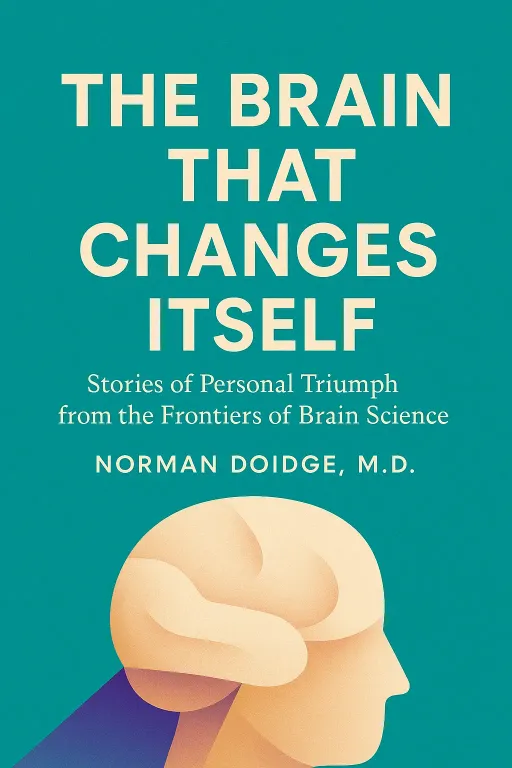
Nova: It's not just wrong; it's been revolutionized by the science of neuroplasticity. And a huge part of bringing this to the forefront was the groundbreaking work of psychiatrist and psychoanalyst, Norman Doidge. In his book, "The Brain That Changes Itself," Doidge didn't just theorize; he meticulously documented the scientific revolution proving our brains are far more plastic than we ever imagined. He challenged centuries of scientific dogma by showing how the brain can reorganize itself throughout life, adapting and healing in ways we once thought impossible.
Atlas: That’s fascinating. I imagine that kind of revelation, coming from a psychiatrist, must have completely upended the medical and psychological communities. It sounds like it moved from theory to tangible, real-world proof.
Nova: It absolutely did. Doidge's work really brought to light the practical implications of this scientific shift, showing us that the brain's ability to change is not just a childhood phenomenon, but a lifelong capacity.
Atlas: So, if the brain isn't a finished sculpture, but more like a constantly re-molding clay, what does that mean for us? For our learning, our habits, our potential? That feels like a massive philosophical shift in how we view ourselves.
The Myth of the Fixed Brain: Unlocking Neuroplasticity's Power
SECTION
Nova: That’s the core of it, Atlas. This revelation fundamentally redefines human potential. For so long, the prevailing wisdom, especially in neuroscience, was that once childhood ended, the brain’s structure was largely set. You had your neural hardware, and that was that. If you suffered a stroke, for example, the damage was often considered permanent, with limited recovery possible.
Atlas: I can see how that would lead to a sense of resignation, both for patients and for educators. If the brain is fixed, then our capacity for fundamental change is also fixed. Where did this idea come from, and what was the first crack in that belief?
Nova: Well, the idea of a fixed brain was deeply entrenched, partly because adult brains stable and partly due to early neurological observations that didn't yet have the tools to see dynamic changes. The first cracks really appeared through observation of remarkable comebacks. Doidge's book is filled with these incredible stories. Take the case of Michelle Mack, for instance. She was born with only half a brain, literally missing her left hemisphere.
Atlas: Wait, only half a brain? How is that even possible? I mean, the brain is so complex, how could someone function, let alone thrive, with such a significant part missing?
Nova: It sounds impossible, right? But Michelle defied all expectations. Her remaining right hemisphere, through sheer necessity and an incredible capacity for neuroplastic adaptation, reorganized itself to take over the functions normally handled by the left side. She developed language skills, could read and write, and lived a relatively normal life, though not without challenges. Her brain literally rewired to compensate for what was missing.
Atlas: That's astonishing. So, her brain didn't just make do; it actively roles? That's a level of adaptability I wouldn't have imagined. It's like a small town that loses its main factory, and suddenly the bakery starts making car parts.
Nova: Precisely! Or consider cases of stroke patients. For decades, the prognosis for a paralyzed limb was often grim. But Doidge highlights therapies like Constraint-Induced Movement Therapy, or CIMT. Patients with a paralyzed arm would have their arm constrained, forcing them to use the affected limb.
Atlas: That seems counterintuitive. Why force something that isn't working? Wouldn't that just lead to frustration?
Nova: That's what many thought. But the idea is that after a stroke, the brain often "learns" to not use the affected limb, a phenomenon called learned non-use. By constraining the good arm, the patient's brain is forced to find and strengthen dormant or new pathways to control the weakened limb. Over time, with intensive, repetitive practice, many patients regained significant function. Their brains were literally rewiring around the damaged area, creating new maps for movement.
Atlas: That's incredible. It's not just about healing; it's about the brain actively problem-solving and finding alternative routes. So, the brain is far more like play-doh than concrete, even as adults? What’s happening at a fundamental level when this rewiring occurs?
Nova: That’s a perfect analogy, Atlas. At the simplest level, it’s about neurons – our brain cells – and their connections, called synapses. When you learn something new, or practice a skill, the neurons involved in that activity fire together. And the old adage is true: "neurons that fire together, wire together." The more they fire, the stronger their connection becomes. This isn't just about strengthening existing connections; the brain can also sprout new ones, or even prune away unused ones. It's an ongoing, dynamic process of creation and refinement.
Atlas: So, it's a constant construction site up there, not a finished building. And if we don't "use it," we genuinely "lose it" in terms of those neural pathways?
Nova: Absolutely. The "use it or lose it" principle is key. If certain neural pathways aren't activated, the brain can reallocate those resources to other, more active functions. This constant remodeling is the essence of neuroplasticity.
Rewiring for Resilience: Practical Strategies for Enhanced Learning and Creativity
SECTION
Nova: So, if the brain is constantly changing, the real, profound question becomes: how do we direct that change for better learning, enhanced creativity, and greater resilience? If we know our brain is plastic, how do we mold it purposefully?
Atlas: That's the million-dollar question for anyone trying to foster profound learning, whether in children or adults. It fundamentally shifts our educational philosophy. It’s not just about filling a bucket; it’s about reshaping the bucket itself. What does this mean for how we teach or even how we approach personal growth?
Nova: Exactly, Atlas. It means we have immense power to shape our own cognitive landscape. The strategies for leveraging neuroplasticity often revolve around four key principles: focused attention, novelty, challenge, and repetition. Focused attention is crucial because the brain prioritizes what we pay attention to. If you’re distracted, your brain isn't forming strong, stable connections. Novelty, new experiences, surprise – these all grab the brain's attention and signal that something important is happening, stimulating the release of neurochemicals that enhance plasticity.
Atlas: So, you're saying that new, engaging, and challenging experiences, when approached with focused intent, are like fuel for brain change? That feels incredibly empowering for educators. It transforms the classroom from rote memorization to an active brain-sculpting workshop.
Nova: It absolutely does. And then there's challenge: pushing yourself just beyond your current capabilities. This creates what's called "desirable difficulty," forcing the brain to adapt and grow. And finally, repetition. Not mindless repetition, but deliberate practice, which solidifies those new neural pathways. Think about learning a new language or mastering a musical instrument. It requires focused effort, new patterns, overcoming difficulty, and consistent practice.
Atlas: That makes perfect sense. You mentioned repetition and challenge. For kinesthetic learners, or in disciplines like dance, sports, or even learning a complex craft, is there a unique way neuroplasticity applies there? Is it more direct, given the physical engagement?
Nova: Oh, absolutely, Atlas! Kinesthetic learning is a prime example of neuroplasticity in action. When you learn a new physical skill – say, a complex aerial maneuver, or a new dance routine – your brain isn't just sending signals to your muscles. It's literally creating and refining new "motor maps" in your cerebral cortex. The more you practice, the more precise and efficient these maps become. It's why a beginner looks clumsy, but a master moves with fluid grace – their brain has extensively rewired to execute those movements with minimal conscious effort. Every twist, every balance, every subtle muscle engagement is strengthening and optimizing those neural circuits.
Atlas: So, the physical act of learning isn't just muscle memory; it's a direct, tangible rewiring of the brain's physical control system. That's a powerful connection between the physical and the intellectual, which I imagine resonates deeply with many. What about creativity? Does this mean we can literally "rewire" ourselves to be more innovative, or to break free from old analytical patterns?
Nova: Yes, in a profound way. Creativity often involves making novel connections between disparate ideas or breaking free from rigid thought patterns. Neuroplasticity suggests that by actively exposing ourselves to diverse experiences, learning new skills, and engaging in divergent thinking exercises, we can literally encourage our brains to form new, unexpected connections. It's about building a richer, more interconnected neural network, which then gives us more raw material and more flexible pathways for creative thought. It's about actively cultivating an adaptable mind, not just a knowledgeable one.
Synthesis & Takeaways
SECTION
Nova: So, what we're really talking about here is a paradigm shift. Neuroplasticity isn't just about recovery from injury; it's about the incredible, ongoing potential for growth, learning, and self-transformation throughout our entire lives. It means that a "growth mindset" isn't merely a nice idea; it's a biological imperative, deeply ingrained in our very gray matter. Our choices in how we engage with the world, the challenges we embrace, and the attention we give, literally shape the physical structure of our brains.
Atlas: That's a huge insight. It means the idea that we can always learn, always grow, isn't just wishful thinking; it's a scientific reality. It fundamentally shifts our understanding of human potential, moving us from a fixed destiny to an active, ongoing creation. It reinforces that our educational philosophies should be dynamic, ever-evolving, and deeply responsive to this inherent adaptability.
Nova: Exactly. Think of it this way: every time you learn something new, every time you challenge yourself, every time you practice a skill with focused attention, you are physically, tangibly altering your brain. Studies have shown, for example, that just a few weeks of learning a new skill can lead to measurable changes in brain structure. It's a powerful feedback loop.
Atlas: That's such a hopeful way to look at it. If your brain is constantly changing, what one deeply ingrained habit or skill would you choose to actively rewire or cultivate this week, knowing its profound impact? I think that's the question we should all be asking ourselves.
Nova: A brilliant challenge, Atlas. It's about recognizing that the power to evolve isn't just metaphorical; it's a biological reality waiting for us to engage with it. So, consider your own "blind spots," those areas where you thought you were stuck, and ask how you can begin to leverage your brain's incredible capacity for change.
Nova: This is Aibrary. Congratulations on your growth!