

The Art of Asking: Crafting Questions for Deeper Learning and AI Interaction
Golden Hook & Introduction
SECTION
Nova: Atlas, quick, first word that comes to mind: "Learning!"
Atlas: Struggle!
Nova: Okay, how about "AI"?
Atlas: Potential… and maybe a little fear.
Nova: And "Questions"?
Atlas: Hmm… underutilized superpower. Definitely.
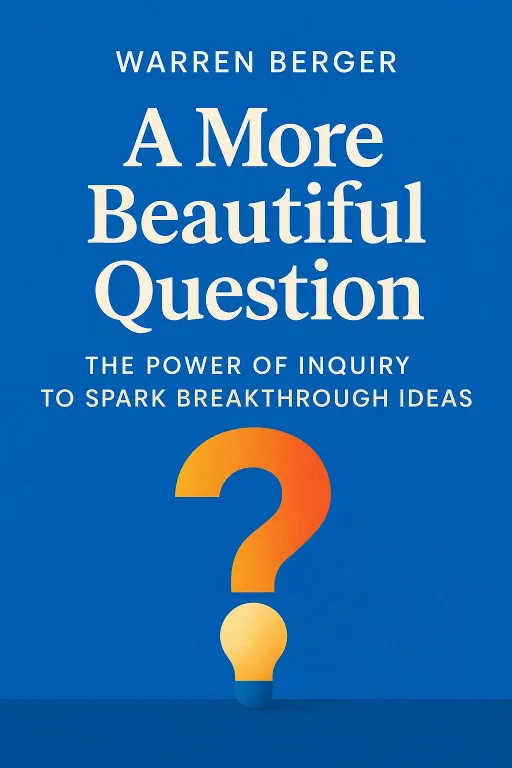
Nova: Underutilized superpower! I absolutely love that, and it's the perfect launchpad for our conversation today because we are diving deep into the profound impact of thoughtful inquiry, inspired by the brilliant work of Warren Berger. Specifically, his seminal books, "A More Beautiful Question" and its practical follow-up, "The Book of Beautiful Questions." Berger, an acclaimed journalist, has spent his career dissecting the power of inquiry, showing us that the questions we ask are often far more important than the answers we seek. His ability to distill complex ideas into actionable frameworks has made his work highly regarded across innovation, business, and, crucially, education.
Atlas: Right? And it’s not just about asking question, is it? It's about crafting questions that actually unlock something deeper. I mean, for anyone focused on the future of learning, particularly with AI in literacy, this feels like foundational territory. We're not just talking about getting better answers; we're talking about sparking genuine curiosity.
Nova: Exactly! That’s the core feeling Berger taps into. True learning isn't just about absorbing information; it often sparks from genuine curiosity, from that innate human desire to to know more. It's an emotional drive. Yet, in education, and sometimes even in how we design our AI interactions, we inadvertently stifle this natural human impulse with what I call "rote questioning."
The Power of Genuine Curiosity: Beyond Rote Questioning
SECTION
Atlas: Okay, but isn't it hard for educators, or even for AI, to move beyond just testing knowledge? I mean, how do you even begin to cultivate that of curiosity when the entire system, historically, has been geared towards providing and validating correct answers? Especially for our listeners who are aiming for equitable outcomes across diverse learning environments, this feels like a monumental shift.
Nova: It is a monumental shift, but a vital one. Think about it this way: imagine a traditional classroom. The teacher asks, "What year did Columbus sail the ocean blue?" Students provide the date. End of interaction. Now, imagine a different scenario. The teacher asks, "If you were Columbus, facing an unknown sea, what three questions would you ask your crew before setting sail, and why?" Or, an AI literacy tool that, instead of quizzing on character names, asks, "If this character could ask one question to their future self, what would it be, and what does that tell us about their deepest fears?"
Atlas: Whoa. That's a completely different energy. In the first example, it's about recall. In the second, it's about empathy, critical thinking, and imagination. It’s like the difference between a quiz and a philosophical debate. So, you're saying an AI could make me to learn more, not just tell me what to learn?
Nova: Precisely. Berger argues that the ability to ask powerful questions is essential for innovation and deeper understanding. For AI in literacy, this means moving beyond simple recall questions to prompts that encourage critical thinking, problem-solving, and creative exploration. An AI designed with this philosophy isn't just a knowledge base; it's a Socratic partner, nudging the learner towards their own discoveries. It's about designing for the 'why' and 'what if,' not just the 'what.'
Atlas: I see how that would be a game-changer for engagement. But how do you actually an AI to ask these kinds of questions? It sounds like it requires a whole new mindset, not just for the programmers, but for everyone involved in curriculum development. It's almost like teaching an AI to be a thoughtful human, which is a lofty goal.
Crafting 'Beautiful Questions' for Deeper Engagement and AI Design
SECTION
Nova: And that leads us perfectly into the 'how-to,' because Berger doesn't just identify the problem; he gives us the playbook in "The Book of Beautiful Questions." He provides practical frameworks for crafting impactful questions in various contexts. Applying these to your AI design can transform passive learning into active inquiry, aligning perfectly with goals of personalization and deeper engagement.
Atlas: Can you give me a tangible example? For someone designing an AI in literacy, what's a 'beautiful question' they could program their AI to ask that would really push a learner beyond surface-level comprehension? Something that makes them like a strategist, not just a recall machine.
Nova: Absolutely. Let's take a simple text. Instead of an AI asking, "Summarize the main events of this chapter," which is recall, a beautiful question might be, "If you could rewrite one pivotal moment in this chapter to drastically change the outcome for the main character, what would it be, and how would that alter the story's core message?" Or, "What unasked question do you think the author was grappling with while writing this passage, and what clues in the text lead you to that conclusion?" These questions don't have one right answer; they invite interpretation, creativity, and a deeper connection to the material.
Atlas: Wow. That's actually really inspiring. It forces the learner to step into the author's shoes, to engage with the narrative on a meta-level. It’s not just about understanding the story; it's about understanding the of storytelling and the underlying themes. For our listeners who are continuously seeking advanced strategies, this is gold. It transforms the AI from a tutor into a co-creator of knowledge.
Nova: Exactly. By focusing on the quality of questions, we're not just enhancing student learning; we're literally refining how AI interacts, making it less of a data-delivery system and more of a true partner in discovery. It's about moving from an AI that assesses what you to an AI that helps you discover what you and. This is where the future-forward leader truly innovates, grounding their AI in a philosophy that fosters genuine intellectual growth.
Atlas: That's a huge shift. And it goes right back to the idea of cultivating, not just managing. It's about fostering continuous improvement in a learner's ability to think, not just their ability to recall.
Synthesis & Takeaways
SECTION
Nova: Absolutely. The true art of asking lies in fostering curiosity and driving deeper engagement, whether with humans or AI. It's about understanding that the quality of our questions directly correlates with the depth of our insights and the richness of our learning experiences. This isn't just about education; it's about fostering innovation and understanding in every field.
Atlas: So, for our listeners, especially those deeply involved in educational innovation and AI design, what's one immediate, actionable step they can take to start applying this? If they're looking at their current AI and its prompts, or even just their own teaching methods, how might they rephrase question to spark more genuine curiosity, more personal exploration, and ultimately, more equitable outcomes?
Nova: Here’s a simple challenge: take one "what" question that your AI or your curriculum currently uses, and try to reframe it as a "how" or "why" question. Or, add a layer of personal reflection: instead of "What is the definition of X?", try "How might understanding X change the way you approach Y in your own life?" This small shift can unlock a universe of deeper thought. It’s about moving from instruction to inspiration.
Atlas: That's a fantastic actionable insight, Nova. It’s about moving from passive reception to active inquiry. For anyone aiming to be an empathic innovator, this approach ensures that technology serves human curiosity, not the other way around. What a powerful way to rethink our interactions.
Nova: Indeed. It's about recognizing that the most profound learning often begins not with an answer, but with a beautifully crafted question.
Atlas: And that's a question we should all keep asking ourselves.
Nova: This is Aibrary. Congratulations on your growth!