Timeless Wealth and Unshakable Wisdom
Golden Hook & Introduction
SECTION
Nova: There is a specific kind of suffering that only comes from having exactly enough money to be comfortable, but not enough to be secure. It is the anxiety of the middle lane, where you are doing everything right on paper, yet the ground feels like it is shifting beneath you every time the market dips or the news cycle churns.
Atlas: That is the exact spot where most people get stuck. They are running hard on the treadmill of modern finance, checking their apps, worrying about the next big trend, and wondering why the harder they run, the more anxious they feel. It is a strange paradox where the more information we have about our money, the less peace we seem to have.
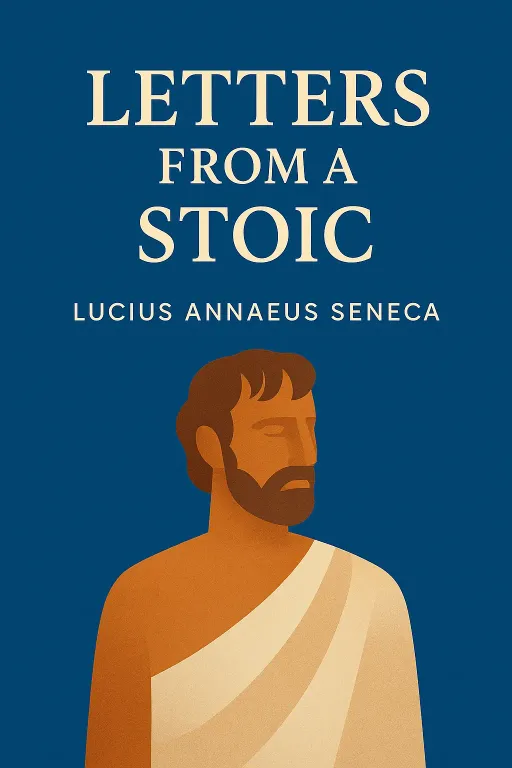
Nova: We are going to dismantle that anxiety today. We are looking at the intersection of two very different, but strangely compatible, worlds. On one side, we have the ancient wisdom of Seneca, the Roman philosopher who wrote Letters from a Stoic. On the other, we have the modern, hyper-rational financial blueprint found in The Bogleheads' Guide to Investing, written by Taylor Larimore, Mel Lindauer, and Michael LeBoeuf.
Atlas: Putting a Roman philosopher and a group of index-fund enthusiasts in the same room sounds like a recipe for a very strange dinner party. But I am curious. Seneca was living in the first century, dealing with emperors and exile. The Bogleheads are dealing with 401ks and expense ratios. How do these two actually talk to each other?
Nova: They are speaking the same language, just in different dialects. Seneca provides the mental architecture, the "why" of wealth, and the Bogleheads provide the construction manual, the "how." The goal isn't just to have a larger number in your bank account; it is to reach a point where your financial life is so simple and so robust that it stops demanding your attention.
Atlas: That sounds like the holy grail. Most people I know feel like their money demands their attention every single day. Let’s dive into how we stop that cycle.
The Stoic Mindset of Wealth
SECTION
Nova: Let’s start with Seneca. It is important to remember that Seneca was not some ascetic living in a cave. He was one of the wealthiest men in Rome. He was a statesman, a playwright, and a tutor to the Emperor Nero. He knew exactly what it was like to have everything. And yet, his core argument in his letters is that true wealth is not about the accumulation of possessions, but about the mastery of desires.
Atlas: That is the classic counter-argument to every financial plan ever made. People hear "master your desires" and they assume it means "live in poverty." But if Seneca was as rich as you say, he clearly wasn't suggesting we all move into a shack.
Nova: Exactly. He wasn't advocating for poverty; he was advocating for self-sufficiency. He argued that if you are dependent on your possessions for your happiness, you are not a free person. You are a slave to your own stuff. If you lose your wealth, you lose your mind. The Stoic goal is to build a mental fortress where your internal stability is decoupled from your external account balance.
Atlas: I see the appeal. It is the difference between having a lot of money and being controlled by the fear of losing it. But let’s play devil’s advocate. In the modern world, we have real-world pressures. Rent, tuition, inflation. It is easy for a philosopher to talk about "mastering desires" when he has a palace. For the listener who is just trying to hit their savings goals, isn't that a bit abstract?
Nova: It is abstract until you apply it to the social comparison trap. Seneca constantly warned about measuring yourself against others. Think about the modern investor. Why do people panic-sell during a market correction? It is rarely because they need the cash for rent that afternoon. It is because they look at their neighbor, or a headline, or a social media feed, and they feel like they are falling behind. They are comparing their internal progress with someone else’s external highlight reel.
Atlas: That hits home. The social comparison aspect is the silent killer of wealth. You feel like you are doing great until you see someone else’s vacation photos or their "crypto gains" post. Suddenly, your disciplined, slow-and-steady strategy feels like failure.
Nova: That is the social comparison Seneca warned us about two thousand years ago. He said that the man who is rich in his own mind is never poor, but the man who is constantly looking at what others have will always feel empty. The anxiety doesn't come from the lack of money; it comes from the excess of comparison.
Atlas: So, the Stoic solution to financial anxiety is to stop looking at the scoreboard of others and focus on your own game. But how does that translate into the actual, boring work of investing? Because knowing that I shouldn't compare myself to others doesn't make my portfolio grow.
The Mechanics of Simplicity
SECTION
Nova: That is the perfect segue to the Bogleheads. If Seneca is the philosophy, the Bogleheads are the practice. The authors of The Bogleheads' Guide to Investing—Larimore, Lindauer, and LeBoeuf—took the complex, noisy, chaotic world of Wall Street and stripped it down to its bones. They advocate for a strategy that is essentially "Stoicism in a spreadsheet."
Atlas: I have read about them. They are famous for being, well, boring. They don't chase the hot stocks, they don't try to time the market, and they definitely don't listen to the talking heads on financial news channels.
Nova: That "boring" quality is exactly why it works. It is a deliberate rejection of the noise. The Bogleheads’ strategy is built on low-cost, broad-market index funds. You buy the whole market, you hold it for decades, and you ignore the day-to-day fluctuations. It requires the exact same mental discipline Seneca talked about. You have to be indifferent to the market's mood swings.
Atlas: Wait, let me connect those dots. You’re saying that when the market crashes 20 percent, the Stoic doesn't panic because they aren't tied to the external outcome, and the Boglehead doesn't panic because they know the strategy is long-term. They are the same person.
Nova: Exactly. The Boglehead philosophy is built on the premise that you cannot predict the future, so you should stop trying. You accept the reality of the market, you automate your savings, and you focus on what you can control. And what can you control? Your savings rate, your asset allocation, and your reaction to the noise. You cannot control the Fed, you cannot control global politics, and you cannot control the next market crash.
Atlas: This is where the pragmatic architect in our listeners comes alive. It is a blueprint. It’s not about guessing; it’s about building a foundation. But let’s be honest about the emotional side. When your account balance drops by thousands of dollars in a week, "ignoring the noise" is a lot harder than it sounds. How do you actually train yourself to do that?
Nova: That is the daily practice. Seneca would suggest a technique called "premeditatio malorum," or the premeditation of evils. You imagine the worst-case scenario. You don't do it to be miserable; you do it to neutralize the fear. You sit down and think, "What if my portfolio drops by 50 percent? What would I do?" If you have a plan—if you are a Boglehead—the answer is, "I do nothing. I stay the course." Because you have already run the simulation in your head, the reality loses its power to terrify you.
Atlas: That is a brilliant synthesis. You are basically using the Stoic practice of mental rehearsal to bulletproof your financial strategy. It turns the fear into a known variable. Most people are terrified because they are walking into the unknown. If you have already decided that a 50 percent drop is just part of the ride, you aren't surprised when it happens.
Nova: You are not surprised, and more importantly, you are not reactive. The most expensive mistakes in investing are caused by emotional reactions. It is the panic-sell at the bottom or the FOMO-buy at the top. The Boglehead approach removes the need for those decisions. You take the human ego out of the equation.
Atlas: It is interesting that you mention ego. Because the Boglehead strategy is an act of humility. It is admitting, "I am not smarter than the market. I cannot pick the winning stock." That is a very Stoic realization. It is the acceptance of one's own limitations.
Nova: That is the key. The arrogance of thinking you can beat the market is the financial equivalent of thinking you can control the weather. It is a recipe for disaster. The Bogleheads acknowledge that the market is a complex, uncontrollable system, and the only way to thrive in it is to align yourself with its long-term growth.
Synthesis & Takeaways
SECTION
Atlas: So, we have a clear picture now. Seneca gives us the mental framework to stop comparing ourselves to others and to stop basing our security on external validation. And the Bogleheads give us the practical, low-cost, set-it-and-forget-it system to build wealth without having to obsess over it.
Nova: And when you combine them, you get something that is genuinely unshakable. You have a portfolio that is designed to survive, and a mind that is designed to endure. You aren't just rich in money; you are rich in time and attention. That is the true goal.
Atlas: I think that is the most important takeaway for our listeners. If you are constantly checking your stocks, you are technically working for your money, even if you are just staring at a screen. True wealth is when your money works for you, and your attention is free to be directed toward things that actually matter—like your work, your family, or your own personal growth.
Nova: Think about the depth of that. Seneca would argue that the richest person is the one who has the most time to pursue wisdom. If your financial life is a chaotic, high-stress, high-maintenance mess, you are poor, regardless of your net worth.
Atlas: That’s a powerful reframing. It shifts the metric of success from "how much do I have" to "how little do I have to worry about it."
Nova: Exactly. As you move forward, I want our listeners to ask themselves the deep question we touched on earlier: How much of your current financial anxiety stems from genuine material need, and how much is driven by the social comparison Seneca warned us about?
Atlas: That is a question that requires some honest reflection. It is easy to blame the economy or the market, but it is much harder to look at our own desires and acknowledge where we are creating our own stress.
Nova: And the practical step is simple. If you haven't yet, look into the Boglehead philosophy. It is not about getting rich quick; it is about getting rich, period. It is about building a foundation that doesn't require you to be a genius or a fortune teller. It just requires you to be disciplined and patient.
Atlas: It sounds like the best way to live a Stoic life is to automate your finances so you don't have to think about them.
Nova: That is exactly right. Automate the process, focus on your craft, and let the compound interest do the heavy lifting. You will find that when you stop trying to control the uncontrollable, you finally gain control over your own life.
Atlas: This has been a great reminder that the most sophisticated strategy is often the simplest one. Thank you for walking us through that, Nova.
Nova: It has been a pleasure. Remember, the goal is not just to build wealth, but to build a life that is worth living while you do it.
Atlas: I love that. For our listeners, take that challenge: look at your financial life this week, identify one area where you are chasing noise, and cut it out. Keep it simple, keep it disciplined, and keep it Stoic.
Nova: This is Aibrary. Congratulations on your growth!