The Body's Blueprint: Unlocking Mindset and Motivation
13 minGolden Hook & Introduction
SECTION
Prof. Eleanor Hart: Bailey, have you ever felt like you're pushing a boulder uphill? You have the goal, the motivation, the plan... but some invisible force just keeps you stuck or pulls you back into old habits. It's one of the most frustrating parts of striving for personal growth.
Bailey: Absolutely, Eleanor. It’s that feeling of one step forward, two steps back. You can have all the right intentions, read all the right books on mindset, but something under the surface seems to have its own agenda.
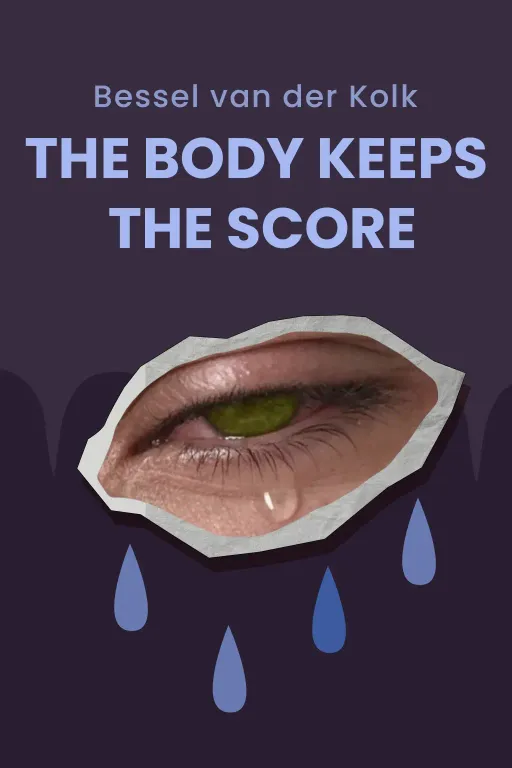
Prof. Eleanor Hart: Exactly. And what if that invisible force wasn't a weakness of character, but a biological echo of the past, literally wired into your nervous system? That's the revolutionary idea at the heart of Bessel van der Kolk's "The Body Keeps the Score." It’s less a book about what’s ‘wrong’ with people and more a user’s manual for the human operating system.
Bailey: I love that framing. It’s like understanding the hardware that our "mindset software" is running on.
Prof. Eleanor Hart: Precisely. And today, we're going to unpack it from two powerful angles. First, we'll explore the hijacked brain, and why our rational mind can be silenced by our survival instincts. Then, we'll uncover the 'ghost in the machine'—the reason we get stuck in self-sabotaging patterns, and how to break free.
Deep Dive into Core Topic 1: The Hijacked Brain
SECTION
Prof. Eleanor Hart: Let's start with that idea of the hijacked brain. We love to believe we're rational beings, especially in fields you're interested in, Bailey, like finance or technology, which are built on logic. But van der Kolk shows us something startling using brain-imaging technology.
Bailey: This is where it gets really fascinating for me. When you can see the data, it moves from theory to fact.
Prof. Eleanor Hart: It really does. Imagine this scene from his research. He has people lie in a PET scanner, a machine that shows brain activity, and he asks them to recall their most traumatic memory. As they do, he watches their brain light up on his screen.
Bailey: What did he see?
Prof. Eleanor Hart: Something profound. The first thing he noticed was that a crucial part of the brain, called Broca's area, went dark. It essentially shut down. Now, Broca's area is our speech center. It’s what we use to put our thoughts and feelings into words, to create a coherent story.
Bailey: So, the part of the brain that tells stories just… goes offline.
Prof. Eleanor Hart: Completely. And at the very same moment, the right hemisphere of the brain, the emotional, non-verbal, intuitive part, was blazing with activity. Specifically, a tiny, almond-shaped structure called the amygdala—the brain's smoke detector—was lit up like a fire alarm. Van der Kolk calls this "speechless terror." The body is physiologically re-experiencing the event, but the part of the brain that makes sense of it and says, "This happened in the past, but I am safe now," is offline.
Bailey: Wow. So it's not that they talk about it, it's that they neurologically in that moment. The hardware for language has been temporarily disconnected by the overwhelming emotional response.
Prof. Eleanor Hart: Exactly. The survival brain takes absolute precedence. It prioritizes feeling over thinking, sensation over language. It’s a "bottom-up" takeover, where the body's alarm system hijacks the "top-down" rational mind.
Bailey: That has huge implications for leadership and high-pressure performance. When a team is in crisis mode, or an individual is facing extreme stress, trying to use logic and reason—that 'top-down' approach—might be completely ineffective if their collective 'bottom-up' survival brain is screaming "danger!"
Prof. Eleanor Hart: You've hit the nail on the head. You can't reason with a smoke alarm. You have to deal with the fire—or, more importantly, the of fire.
Bailey: So, as a leader, the first job in a crisis isn't to present a logical plan. It's to create a sense of safety. To do something that calms that physiological alarm system so that the rational, problem-solving parts of your team's brains can come back online. That’s a major shift in perspective from just telling people to 'stay calm and think clearly.'
Prof. Eleanor Hart: It is. It acknowledges that we are biological creatures first. And this idea of the brain being stuck in a 'fire alarm' state is the perfect bridge to our next point. It explains why we don't just get overwhelmed in the moment, but can get stuck for years.
Deep Dive into Core Topic 2: The Ghost in the Machine
SECTION
Prof. Eleanor Hart: That idea of the brain being stuck in a 'fire alarm' state leads us directly to our second point: this 'ghost in the machine' that causes us to get stuck in self-defeating patterns.
Bailey: This is the part that I think everyone can relate to. Why do we, as smart, motivated people, sometimes act so clearly against our own best interests? It feels like self-sabotage.
Prof. Eleanor Hart: Van der Kolk would argue it's not a failure of willpower, but a physiological script being replayed. He highlights a classic, and admittedly dark, experiment on what's called "learned helplessness." It perfectly illustrates the concept. In the 1960s, researchers put dogs in a cage and administered mild, but inescapable, electric shocks. The dogs couldn't do anything to stop it.
Bailey: Okay, that's grim, but I see where this might be going.
Prof. Eleanor Hart: It is grim, but the finding was revolutionary. Later, they put those same dogs in a different cage. This time, one side of the floor was electrified, but the door to the safe, unelectrified side was left wide open. A normal dog, one that had never been shocked before, would feel the shock and immediately jump to the safe side. But the traumatized dogs?
Bailey: Let me guess. They didn't move.
Prof. Eleanor Hart: They didn't even try. They just lay down on the electrified grid and whimpered. They had that nothing they did mattered. Their nervous system had concluded that escape was futile, even when the evidence—the open door—was right in front of them.
Bailey: That's a powerful and heartbreaking metaphor for human behavior. It explains why people stay in bad jobs, bad relationships, or bad financial situations long after they should have left. It's not that they don't see the open door; it's that their system has learned that 'escape is futile.' They've given up trying on a biological level.
Prof. Eleanor Hart: And here's the most critical part of the experiment for our discussion, Bailey. The researchers then tried to figure out how to get the dogs to save themselves. Yelling at them didn't work. Offering treats from the safe side didn't work. The only thing that worked was when the researchers physically got into the cage and dragged the dogs, again and again, to the safe side. They had to give them the of success to overwrite the neurological map of helplessness.
Bailey: That is a massive insight for motivation, for leadership, for any kind of change. It's not enough to give a pep talk or show someone the logical path forward. If they're in a state of learned helplessness from past failures, you have to engineer a small, tangible win for them. You have to, metaphorically, the first time to prove to their nervous system that it's possible.
Prof. Eleanor Hart: You have to create a new physical memory of 'I can do this.' The book also tells the story of a patient named Julia, who was brutally assaulted. Afterward, she found herself repeatedly drawn to dangerous and abusive partners. It wasn't a conscious choice; her system was replaying a familiar, albeit terrifying, dynamic. It was the only way she felt 'alive.' Both are examples of the body running a program without the conscious mind's consent.
Bailey: So it’s two sides of the same coin. Either you're stuck in inaction, like the dogs, or you're stuck in a loop of reenactment, like Julia. Both are driven by this 'ghost in the machine'—the body's memory.
Prof. Eleanor Hart: Precisely. And in both cases, the path to healing wasn't through talking alone, but through new, corrective experiences that directly contradicted the trauma.
Synthesis & Takeaways
SECTION
Prof. Eleanor Hart: So, as we bring this together, we've seen these two incredibly powerful ideas from "The Body Keeps the Score." First, that under threat, our rational brain can be completely hijacked by our body's survival instincts.
Bailey: And second, that the imprint of past experiences can leave us stuck in patterns of helplessness or self-sabotage, not out of weakness, but as a physiological echo.
Prof. Eleanor Hart: And the common thread, as you pointed out so well, Bailey, is that the way out isn't just through thinking. It's not just 'mind over matter.' It's through new experiences. Through action, and through creating a sense of physical safety that allows the mind to come back online.
Bailey: The book really makes a case that true self-mastery is about integrating the top-down and bottom-up systems. You need the wisdom of the mind and the wisdom of the body working together.
Prof. Eleanor Hart: So for our listeners, especially those like you, Bailey, who are so focused on growth, innovation, and leadership, the takeaway isn't to abandon mindset work. It's to augment it. The next time you feel stuck, anxious, or unmotivated, don't just ask 'What should I be thinking right now?'
Bailey: You should also ask, 'What is my body feeling right now?' Is my heart racing? Is my stomach tight? Am I holding my breath? Just noticing that, without judgment, is the first step.
Prof. Eleanor Hart: That simple act of what the book calls 'interoception'—sensing your internal state—is the beginning of taking back control.
Bailey: Right. And maybe the follow-up question is, 'What's one small action I can take to give my body a new experience of control?' It could be as simple as taking a deep breath, stretching, organizing one drawer, or making one phone call. It's about proving to your own nervous system, in a very real and physical way, that the cage door is, in fact, open.
Prof. Eleanor Hart: A perfect, practical synthesis. It's about becoming the master of your own ship, as van der Kolk says, by learning to navigate the currents of your own body. Thank you, Bailey, this has been an illuminating conversation.
Bailey: Thank you, Eleanor. It’s given me a lot to think about.