The 'Antifragile' Advantage: Thriving in Uncertainty, Not Just Surviving It.
Golden Hook & Introduction
SECTION
Nova: We've all heard the saying, "What doesn't kill you makes you stronger." It's a mantra, a badge of honor, right? But what if that's not just wrong, but actively dangerous advice for building anything truly robust in today's world?
Atlas: Whoa, hold on. You're telling me everything I thought I knew about resilience, about bouncing back, is actually hindering me? That's a bold claim, Nova.
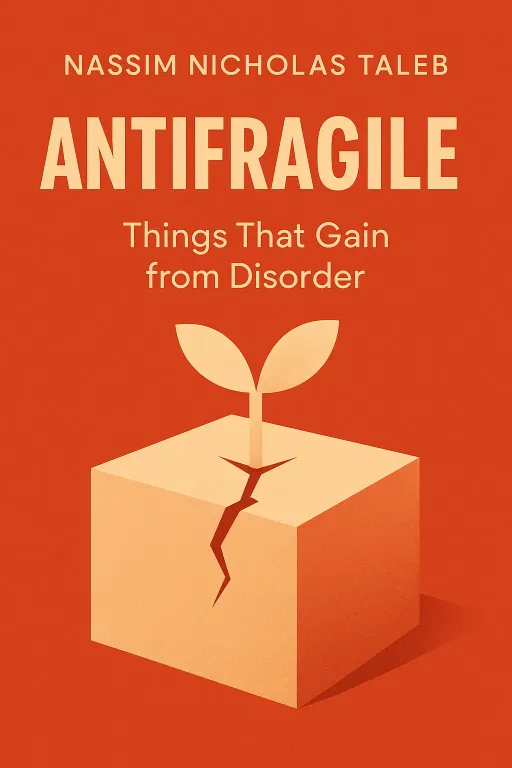
Nova: It absolutely is, Atlas. And it's the radical, paradigm-shifting insight at the heart of today's mind-bending discussion. We're diving deep into the world of Nassim Nicholas Taleb, a man whose unique background as a former options trader, risk manager, and philosophical essayist gives him an unparalleled perspective on uncertainty and randomness. His books, "Antifragile" and "The Black Swan," challenge how we think about risk in finance, economics, and honestly, virtually every aspect of life.
Atlas: So, he’s not just some academic theorizing from an ivory tower. He’s been in the trenches, playing with the very unpredictability he writes about. That gives his work a different kind of weight.
Nova: Exactly. And his core message is a profound one: we need to move beyond merely surviving shocks, beyond just being resilient, to actually from disorder. He calls this quality "antifragility." It’s a concept that flips our conventional understanding of strength on its head.
The Antifragile Mindset: Gaining from Disorder
SECTION
Atlas: Okay, antifragility. It sounds almost like a superpower. Most of us are just trying to keep things from breaking, maybe bounce back if they do. What's the difference between being resilient and being antifragile?
Nova: It’s a crucial distinction. Imagine three types of packages: The first is labeled "fragile." You drop it, it shatters. It hates disorder. The second is "resilient" or "robust." You drop it, it's fine. It withstands the shock; it doesn't change. It’s back to its original state.
Atlas: So, it can take a hit. That sounds pretty good to me, honestly. That's what most leaders are aiming for with their teams and products—stability.
Nova: It good, but it's not optimal. Now, imagine a third package, Atlas. One that not only survives being dropped, but actually with rough handling. It gets stronger, more durable, perhaps even more valuable with every jolt. That's antifragile. It loves volatility, stress, randomness, and uncertainty because it uses them as fuel for growth.
Atlas: Wow. That's a bit out there. So, for a growing product team, or even for a leader trying to cast a vision, what's a 'shock' you'd actually want to gain from? How does that look in the real world, beyond a hypothetical package?
Nova: Think about biological systems, Atlas. Our immune systems, for instance. They don't become stronger by being protected from every germ; they become stronger by being exposed to pathogens, by fighting them off, by learning and adapting. Or consider bone density: it increases with stress and weight-bearing exercise. If you put an astronaut in zero gravity for too long, their bones actually weaken. They need the stress of gravity to thrive.
Atlas: I know that feeling. So, the body challenges to grow. That makes sense on a biological level. But how do you for that in a business, or within a team? Most leaders are trying to eliminate stress, trying to create predictable environments, not invite disorder.
Nova: Exactly! That’s the blind spot Taleb identifies. He argues that our obsession with optimization and efficiency often makes us fragile. To be antifragile, you design systems with redundancy, with optionality, and often, with decentralization. You build in slack, you embrace experimentation, you allow for small failures. These aren't inefficiencies; they are precisely what creates opportunities for positive shocks. It's about having many small bets, so when one pays off big, you benefit disproportionately, and when many small ones fail, the damage is contained.
Navigating Black Swans: The Unpredictable Advantage
SECTION
Nova: This idea of gaining from disorder becomes even more critical when you consider the kind of events Taleb calls 'Black Swans.'
Atlas: Ah, the Black Swan. I've heard that phrase thrown around a lot since the pandemic. It’s like, a major unexpected event, right? But how does it connect to antifragility?
Nova: It’s the very reason antifragility is so necessary. A Black Swan is a rare, unpredictable event that has an extreme impact. Crucially, after it happens, we tend to rationalize it, making it seem retrospectively predictable. Think about 9/11, the 2008 financial crisis, or the sudden rise of a technology like the internet or smartphones. No one truly predicted these with any accuracy, but afterward, analysts could explain them perfectly.
Atlas: So, are we talking about something like the rise of social media completely upending traditional advertising, or a sudden market crash that wipes out entire industries? How do you even prepare for something you can't predict? That sounds like a strategist's nightmare!
Nova: It is, if you’re focused on prediction. Taleb's point is that we spend too much time trying to predict the unpredictable. The reality is, our predictive models are inherently flawed, especially for complex systems. The real danger isn't that we don't know what will happen; it's that we we know, which makes us complacent and fragile.
Atlas: So, if we can't predict them, what's a strategist supposed to? Just cross their fingers and hope for the best? For leaders trying to build a vision and acquire talent, this sounds like paralysis.
Nova: Not at all! This is where antifragility becomes your strategic superpower. The antifragile approach isn't about predicting specific Black Swans; it’s about building systems that are structured to from any Black Swan, positive or negative. It's about minimizing your downside exposure while maximizing your upside optionality.
Atlas: In other words, you can't know when the next big thing will hit, or when the next crisis will emerge, but you can build your team, your product, your entire organization in a way that allows it to not just survive, but potentially from that event. That's actually really inspiring.
Synthesis & Takeaways
SECTION
Nova: Precisely. Antifragility and Black Swans are two sides of the same coin. One describes the ideal state—what you want to be—and the other describes the reality of the world that makes that ideal state so utterly necessary. For the "Architect," the "Connector," the "Strategist" listening right now, this means a fundamental shift.
Atlas: Okay, so for the leaders listening, the ones trying to cast a vision and build a dream team, what's the one actionable shift they can make in their thinking right now? How do they start building this antifragile advantage?
Nova: It starts with consciously designing for optionality and redundancy, even when it feels "inefficient." It means building a team that isn't afraid of small failures, but learns and adapts from them. It's also about trusting your inner compass, as your growth recommendations suggest. Your vision is your north star, but the path to it will be anything but straight. An antifragile team embraces that winding path, seeing every bump as an opportunity.
Atlas: That makes sense. It's about letting go, as you said in the growth recommendation, allowing others to rise, and creating a decentralized structure where innovation can emerge from unexpected places, rather than trying to micromanage every variable. It's about empowering your team to become antifragile themselves.
Nova: Exactly. Because in a world that’s constantly throwing the unexpected at us, the real advantage isn't in avoiding the storm, it's in learning how to surf it, and maybe even how to make your board stronger with every wave. What small area of your life or your work could you make more antifragile this week?
Atlas: That’s a powerful question. It definitely challenges me to look at 'problems' not as things to avoid, but as opportunities to evolve.
Nova: Absolutely.
Nova: This is Aibrary. Congratulations on your growth!