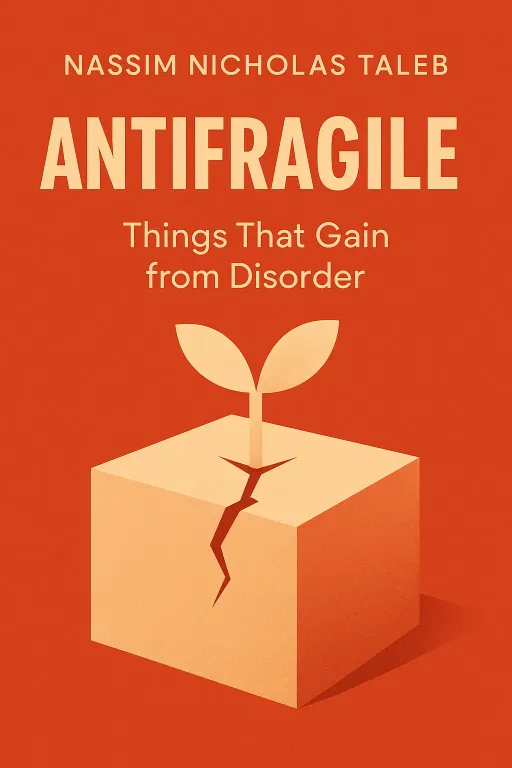
The 'Antifragile' Advantage: Thriving in Uncertainty, Not Just Surviving
Golden Hook & Introduction
SECTION
Nova: Alright, Atlas, five words to describe Nassim Nicholas Taleb’s incredible work, Antifragile. Go!
Atlas: Chaos-loving, growth-hacking, fear-smashing, life-upgrading.
Nova: Ooh, I love that. Mine: Embrace the mess, get stronger.
Atlas: That’s a great way to put it. Because, honestly, mess is often what we try to avoid at all costs.
Nova: Exactly! And that's precisely what we're challenging today. We're diving into "Antifragile: Things That Gain from Disorder" by Nassim Nicholas Taleb, a book that truly reshapes how we think about strength and stability. Taleb, with his background as a former options trader and risk analyst, brings this incredibly unique, practical perspective to understanding uncertainty. He's not just theorizing; he's seen firsthand how systems react to the unpredictable.
Atlas: Right, like, he’s actually put his money where his mouth is when it comes to risk. So, what’s the big idea here? Are we talking about just being super tough?
Nova: Actually, it’s far beyond tough, Atlas. The core of our podcast today is really an exploration of how to not just survive, but actively thrive and grow from the unpredictable chaos of life and work. Today we'll dive deep into this from two perspectives. First, we'll explore what it truly means to be 'antifragile' and how it differs from simply being strong. Then, we'll discuss how to harness the power of 'Black Swan' events, turning uncertainty into your greatest advantage.
Antifragility: Beyond Robustness, Beyond Resilience
SECTION
Nova: Most systems, and frankly, most people, are designed to be either robust or resilient. Think about it. A robust system is like a granite block. It can withstand immense pressure, but it doesn't really change or get better from it. It just... endures.
Atlas: I can see that. Like a well-built bridge designed to handle heavy traffic. It’s strong.
Nova: Exactly. Then you have resilience. That’s like a rubber band. You stretch it, it deforms, but then it snaps back to its original shape. It recovers.
Atlas: Oh, I know that feeling. After a crazy week at work, you bounce back, right? You recover.
Nova: Precisely. But here’s the mind-bending part: Taleb introduces antifragility. This is the ability to not just survive or recover from shocks, but to actually and when exposed to volatility, stress, and disorder. It's the opposite of fragile. Fragile things break under stress. Robust things resist. Resilient things recover. Antifragile things.
Atlas: Wait, hold on. Gain from disorder? That sounds a bit out there. Like, who actively more stress to get better? Isn’t the whole point to minimize problems? For anyone trying to build something stable, that sounds counterintuitive.
Nova: It absolutely is counterintuitive, but think of it this way: our bodies. When you lift weights, you're intentionally putting stress on your muscles. They don't just resist; they tear slightly, then they repair themselves stronger than before. That's antifragile. Or, consider the immune system. Exposure to pathogens doesn't just make it recover; it makes it and more prepared for future attacks.
Atlas: That’s a great example. So, it's like a system that learns and evolves of the challenges, not in spite of them. But is that really applicable to, say, a startup or a career path?
Nova: Absolutely. Take the early internet. It wasn't designed to be robust; it was designed to be decentralized and redundant. If one node went down, the information just rerouted. And because it was constantly under stress, constantly being poked and prodded, it evolved at an incredible rate, gaining capabilities it never would have developed in a stable, controlled environment. The very disorder made it adaptable and powerful.
Atlas: So basically, you’re saying that constant, often small, failures or disturbances aren't just things to be endured, but actually fuel for improvement. That’s actually really inspiring for anyone who struggles with setbacks.
Harnessing Black Swans: Turning Uncertainty into Opportunity
SECTION
Nova: And that naturally leads us to the second key idea we need to talk about, which often acts as a counterpoint to what we just discussed: how antifragility leverages the truly unpredictable. Taleb, in his book "The Black Swan," introduces these events as highly improbable, unpredictable, and having massive impact, yet we tend to rationalize them only after they've happened.
Atlas: Ah, Black Swans. So, like the 2008 financial crisis, or the sudden rise of TikTok. Things no one saw coming, but then everyone has a theory about after the fact.
Nova: Exactly. And most systems are extremely fragile to these kinds of events. They collapse. But an antifragile system is designed to benefit from them. It's not about predicting the Black Swan; it's about structuring yourself so that when the unexpected happens, you have more to gain than to lose.
Atlas: So you’re saying we should for disaster? That sounds a bit out there for someone trying to plan a career or launch a product. How does a person actually cultivate this mindset? Like, what's the first step for someone who wants to embrace this chaos and actually from a Black Swan event?
Nova: It’s not about hoping for disaster, Atlas. It's about positioning yourself. Think of it like optionality. Imagine a venture capitalist. They invest in many small, risky ventures. Most will fail – small losses. But one or two might become massive, unpredictable successes – huge gains. They have limited downside and unlimited upside. That’s an antifragile strategy. They don't know which one will be the Black Swan success, but they're positioned to benefit when one emerges.
Atlas: I see. So, it's not about predicting random thing will happen, but making sure you're set up to win big from random thing that happens to be positive, while limiting your exposure to negative ones. That makes me wonder, how does this translate into a personal strategy? For someone in a rapidly evolving field, how do you build that kind of optionality?
Nova: You build it in several ways. One is through diversification – don't put all your eggs in one basket. Another is by making small, low-risk experiments. You try many things, knowing most won't work, but one might lead to an unexpected breakthrough. It's about having "skin in the game" for the upside, but limiting your "skin" for the downside. It’s also about constantly learning and adapting, building a broad skill set that makes you adaptable to unforeseen changes in your industry.
Atlas: That’s a practical insight. So, instead of trying to predict the future, you're essentially building a personal or professional ecosystem that's ready to pivot and profit from whatever wild card the future deals you.
Synthesis & Takeaways
SECTION
Nova: Precisely. Antifragility isn't about magical immunity; it's a strategic posture that sees volatility as fuel. It's about designing systems—and lives—with built-in optionality and a bias for action in the face of the unknown. It’s a profound shift from merely protecting against failure to actively seeking ways to benefit from it, transforming chaos into opportunity.
Atlas: That’s actually really inspiring. It redefines what it means to be strong. Instead of just surviving the storm, you're building a ship that gets faster with every wave.
Nova: Exactly. It's about transforming perspective, from merely recovering from setbacks to actively seeking ways to gain from them. It’s about building a life and career that isn't just resilient but actually grows more powerful with every challenge.
Atlas: So, for all our listeners, consider a recent setback in your work, or even in your personal life. How could you have designed your approach to gain from that disturbance, rather than just recover? What small optionality could you have created? What little experiment could you have run to turn that stress into a stepping stone?
Nova: It's a powerful question, Atlas, and it's one that can truly change your trajectory. Embracing this mindset can profoundly transform how you approach every challenge, preparing you not just for survival, but for exponential, unexpected growth.
Atlas: This is Aibrary. Congratulations on your growth!