Stop Chasing Trends, Start Building Antifragility: Your Business Shield.
Golden Hook & Introduction
SECTION
Nova: You know, Atlas, most of us spend our lives trying to avoid stress, avoid chaos, avoid getting hurt. We build fortresses against the unexpected. But what if that's exactly the wrong approach? What if the secret to true strength is actually the chaos in?
Atlas: Oh, I like that! Inviting chaos? My first instinct is to run screaming from chaos. So you're saying my carefully constructed bubble of stability is actually a weakness? That’s quite the proposition.
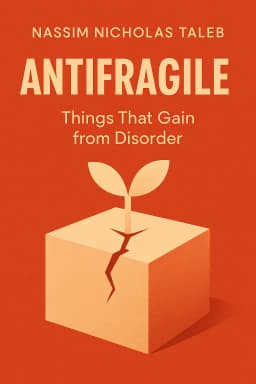
Nova: It is! And it's at the heart of the revolutionary ideas from Nassim Nicholas Taleb. Today, we're diving into his seminal works, "Antifragile: Things That Gain from Disorder" and "The Black Swan: The Impact of the Highly Improbable." Taleb, a former options trader turned philosophical essayist, has truly reshaped how we think about risk, uncertainty, and resilience. His unique perspective challenges the very foundations of how we plan and predict.
Atlas: Right. For anyone who's ever felt their meticulously crafted plans crumble in the face of an unexpected market shift, or a sudden, global event, this is going to resonate. We're all conditioned to seek stability, to minimize risk. So, the idea that something can actually from disorder feels almost… counter-intuitive, even a little dangerous.
Nova: Exactly! And that's where we start our journey.
The Antifragile Mindset: Gaining from Disorder
SECTION
Nova: So, Taleb introduces three categories: the fragile, the robust, and the antifragile. Think of a delicate glass vase. That's fragile. You drop it, it breaks. Then you have a rubber ball. That's resilient. You drop it, it bounces back to its original shape. It resists the shock.
Atlas: Okay, I can see that. Most of us probably aim for 'resilient' in our businesses and lives. We want to bounce back.
Nova: Precisely. But Taleb argues there's a third, far more powerful category: the antifragile. This isn't just about resisting shocks or recovering from them. This is about because of them. When an antifragile system experiences stress, it actually gets stronger, better, more capable. Think of the mythical Hydra – cut off one head, and two grow back.
Atlas: Whoa. That’s a fundamentally different way of looking at the world. So you’re saying instead of just enduring hardship, we can actually from it? Can you give me a more concrete example, maybe from a business context? How does a company become a Hydra?
Nova: A perfect example is the human immune system. It needs stressors – exposure to bacteria and viruses – to grow stronger and more effective. If you live in a completely sterile environment, your immune system actually weakens. In business, an antifragile system might involve redundancy and options. Instead of optimizing for maximum efficiency, which often creates brittleness, you build in slack, multiple pathways, and decentralized decision-making.
Atlas: But isn't redundancy just wasteful? Every business book preaches lean operations, cutting out anything extra. You're telling me we should actively build in what looks like inefficiency?
Nova: It's a strategic inefficiency, Atlas. The goal isn't to be inefficient, but to be robust against large, unpredictable shocks. Small, controlled failures, or minor stresses, are key. Think of a tech company that constantly experiments with small-scale features, knowing many will fail, but those failures provide invaluable data and lead to breakthrough innovations. Or a supply chain that deliberately uses multiple, slightly more expensive suppliers, rather than a single, cheapest one. The small 'cost' of redundancy prevents a catastrophic collapse if one supplier goes down.
Atlas: I see. So it's about strategically inviting small failures to prevent catastrophic ones, and in the process, learning and evolving. It's like lifting weights – small stresses make your muscles grow.
Nova: Exactly! It’s the opposite of trying to smooth out every bump in the road. It’s embracing the bumps as opportunities for growth and innovation.
Black Swans and Hidden Resilience: Preparing for the Unpredictable
SECTION
Nova: Now, this concept of antifragility becomes even more critical when we talk about another of Taleb's famous ideas: "Black Swans." These are highly improbable, high-impact events that are impossible to predict, yet often seem obvious in hindsight. The 2008 financial crisis, the rise of the internet, or the COVID-19 pandemic are all classic examples.
Atlas: Oh man, the pandemic was definitely a Black Swan. It hit like a meteor, and suddenly everyone was scrambling. How do you even begin to prepare for something that’s impossible to predict? Traditional risk models certainly didn't see that coming.
Nova: They rarely do. Taleb argues that traditional risk management often focuses on predictable, quantifiable risks, completely missing the truly impactful, unexpected ones. The problem isn't just that we predict Black Swans; it's that our models often give us a false sense of security, blinding us to the very real possibility of the unplannable.
Atlas: So if you can't predict them, what's the solution? Just cross your fingers and hope for the best? That doesn't sound like a strategy for our listeners trying to build robust businesses.
Nova: Far from it! The solution isn't prediction; it's about building optionality and robustness into your systems so you can benefit from these unforeseen events. It's about designing your business to gain from volatility. Imagine a company that diversified its revenue streams, not just for growth, but so that if one market segment collapses due to an unpredictable event, the others provide a buffer, and perhaps even an opportunity to pivot and expand into new areas.
Atlas: Right, like that restaurant that had a robust online ordering system and delivery infrastructure already in place before the pandemic hit. While others were scrambling to adapt, they were already positioned to thrive. They didn't predict the Black Swan, but they were antifragile to it.
Nova: Precisely. Taleb's insight is that understanding Black Swans helps you build resilience, not by avoiding them, but by designing systems that can turn those threats into opportunities. It's about having options, being prepared for multiple scenarios, and not putting all your eggs in one fragile basket.
Atlas: That makes me wonder about the psychological aspect too. It's not just about business structures, but about our own mindset. If we expect the unexpected, and even welcome it as a chance to grow, it changes everything.
Nova: Absolutely. It’s a profound shift from a defensive posture to an offensive one against uncertainty.
Synthesis & Takeaways
SECTION
Nova: So, the core link between "Antifragile" and "The Black Swan" is clear: antifragility isn't just a nice-to-have; it's the ultimate response to the reality of Black Swans. It’s about cultivating an environment where the unexpected doesn't break you, but actually makes you better, stronger, and more innovative.
Atlas: That’s actually really inspiring. For our listeners who are constantly navigating dynamic environments, this isn't about fearing the unknown. It's about seeing every curveball as a potential growth catalyst. It moves us from merely surviving to actively thriving.
Nova: Indeed. And for a tiny step to get started, I'd encourage everyone to identify just one area in their current business or even personal life where a small failure could lead to a large gain. How can you intentionally expose it to minor stresses? Could it be testing a new product feature with a small group, or trying a new workout routine that challenges your body in a different way?
Atlas: That’s a thoughtful invitation. It's about letting go of the illusion of control and embracing the dynamic nature of reality, then designing for it. It's a huge mindset shift, from dreading chaos to dancing with it.
Nova: A dance that leads to strength. Thank you for joining us on this deep dive into antifragility and Black Swans. This is Aibrary. Congratulations on your growth!