Stop Chasing Perfection, Start Building Resilience: The Guide to Antifragile Systems
Golden Hook & Introduction
SECTION
Nova: We're constantly told to build resilience, to bounce back from failure. We hear it everywhere: "Bounce back stronger!" But what if "bouncing back" isn't enough? What if the goal isn't just to the challenges, but to actually and because of them?
Atlas: Oh, I love that. It’s like, not just surviving the storm, but coming out with a new, stronger sail, or even a totally new ship, built specifically for that kind of weather.
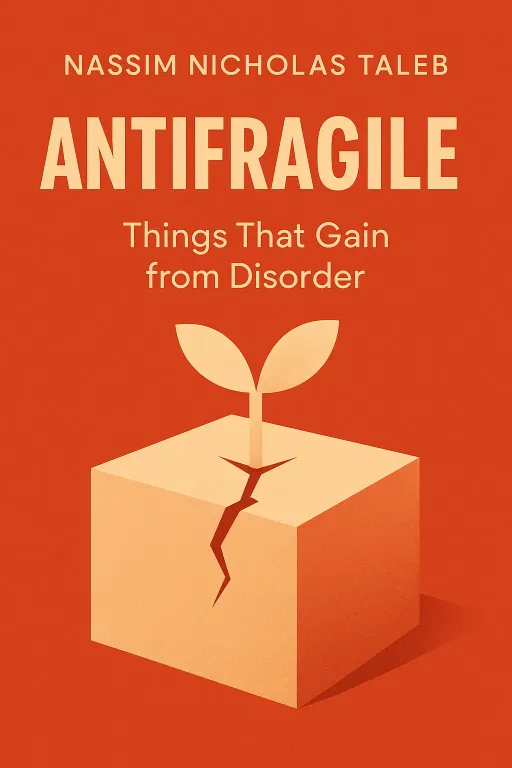
Nova: Exactly! That's the essence of what we're dissecting today, through the groundbreaking work of Nassim Nicholas Taleb, particularly his seminal concepts from "Antifragile" and "The Black Swan." Taleb, a former options trader and risk analyst, brings a fiercely practical, real-world perspective to these ideas. He's not just theorizing from an ivory tower; he's navigated extreme unpredictability in financial markets, where the stakes are incredibly high.
Atlas: That's fascinating. So, his insights aren't theoretical musings; they're forged in the fire of real-world chaos. I'm curious what he actually means by this idea of 'antifragile,' because it sounds like a superpower, something beyond what we usually talk about.
Nova: It kind of is! Today we'll dive deep into this from two perspectives. First, we'll explore what it truly means for something to be 'antifragile' and how it fundamentally differs from 'resilience,' then we'll discuss practical ways to intentionally engineer systems, even our own learning and AI, to gain from disorder.
Antifragility: Beyond Resilience and Robustness
SECTION
Nova: Let's start with what Taleb calls "The Blind Spot." We're conditioned to seek stability, to avoid failure at all costs. We build robust systems, resilient processes, hoping they'll withstand any shock. But Taleb argues this very focus on failure can paradoxically make us brittle, or fragile. Think of it this way: a delicate wine glass is fragile; drop it, it shatters. A plastic cup is robust; drop it, it might bounce, it resists shocks, but it doesn't fundamentally change.
Atlas: So, it just returns to its original state. It’s like, it can take a hit, but it’s still the same cup.
Nova: Precisely. But what about something that from being dropped? Something that gets stronger, smarter, or more capable when exposed to volatility, randomness, and stressors?
Atlas: Like a muscle getting stronger after a workout? Or a vaccine introducing a small stress to build immunity? Those are perfect examples.
Nova: Absolutely. Those are classic examples of antifragility. Fragile things break under stress. Robust things resist stress, they simply return to baseline. Antifragile things under stress. Taleb famously uses the myth of the Hydra: cut off one head, and two more grow back. It's not just surviving; it's growing stronger, evolving from the attack. This isn't about bouncing back; it's about bouncing in a significantly improved state.
Atlas: That’s a great way to put it. So, a system that's merely resilient just returns to its original state after a shock. But an antifragile one actually and because of that shock. That resonates with me because I imagine a lot of our listeners, especially those building complex AI architectures and pioneering new learning frameworks, are constantly trying to build robust systems. What's the subtle trap in that robust-only mindset?
Nova: The trap is in optimizing for predictability and stability. If you design a system, an algorithm, or even a business model purely for peak efficiency in conditions, it becomes highly vulnerable to anything those conditions. Think of a hyper-optimized supply chain that works perfectly until a "Black Swan" event—a rare, unpredictable, high-impact event like a global pandemic—hits. Suddenly, its very efficiency, its lack of redundancy, becomes its undoing. It's incredibly fragile to the unexpected. Taleb's work, especially "The Black Swan," highlights how these rare events have profound impacts, making the case for systems that benefit from, rather than merely survive, the unpredictable.
Atlas: That’s actually really inspiring, because it shifts the entire paradigm from defensive protection to proactive growth. So, if we’re building learning systems, for example, we shouldn’t just be trying to make them perfect and error-free, but actually design them to from their errors in a meaningful way, to grow from the disruption?
Nova: Precisely. Consider the evolution of life itself. It's an inherently antifragile process. Organisms face constant environmental stressors—predators, climate changes, resource scarcity. These aren't just resisted; they drive adaptation, mutation, and ultimately, stronger, more complex life forms. If life only aimed for "resilience," we'd still be single-celled organisms, just constantly bouncing back to single-celled. But because of stress, because of volatility, we diversified, we became more complex. That's antifragility in action, writ large across billions of years.
Engineering Antifragile Systems: Intentional Stressors and Learning
SECTION
Atlas: That makes me wonder, how do we intentionally introduce these 'beneficial mistakes' or 'small stressors' into our projects without just inviting utter chaos? Because I imagine a lot of our listeners are thinking, "I don't want to break my AI system just to make it stronger," or "I can't just intentionally fail my projects." There must be a method to the madness.
Nova: That's the million-dollar question, and it's where Taleb's insights become truly actionable. It's about intelligently differentiating between stressors that destroy and stressors that inform and strengthen. For instance, in modern software development, the concept of "chaos engineering" is a direct application of antifragile strategy. Instead of waiting for a system to fail catastrophically in production, engineers intentionally introduce small, controlled failures—like randomly bringing down a server, injecting network latency, or simulating a sudden spike in traffic—to see how the system responds.
Atlas: So it's like a controlled burn in a forest. You introduce a small fire to prevent a much larger, uncontrollable one later. That’s a great analogy for managing risk. For someone building advanced cognitive architectures, or even for personal growth in a demanding field, this could mean designing AI that actively seeks out novel, slightly challenging data points, or even deliberately introduces small perturbations into its own learning process.
Nova: Exactly! Think about how a well-designed neural network benefits from "dropout" during training. You randomly ignore a percentage of neurons during each training step. This is a deliberate stressor, an intentional introduction of randomness. It prevents the network from becoming overly reliant on any single feature, forcing it to learn more robust, generalized patterns. The system becomes stronger, more intelligent, not despite the randomness, but of it. It learns to cope with missing information.
Atlas: Wow. That gives me chills. So, it's about actively seeking out the edges of performance, rather than just staying in the comfort zone, or trying to create a perfectly sterile environment. This isn't just about code; it's about a fundamental mindset shift for the teams building these systems and for the individuals leading them.
Nova: Absolutely. It’s also about creating environments where small, localized failures are not just tolerated, but as learning opportunities. Imagine a team that's constantly running small experiments, knowing that many will "fail" in the traditional sense, but each failure provides crucial data to make the next iteration stronger. This is a direct application of antifragility to organizational learning and continuous improvement. It’s a shift from a "zero-defect" mentality to a "zero-learning-opportunity-missed" mentality.
Atlas: Oh, I like that. Zero-learning-opportunity-missed. So, rather than seeing a bug or an unexpected result as just a problem to be fixed, it's a prompt for the system, and the people behind it, to adapt and grow. That completely reframes how we approach development, innovation, and even personal setbacks. It also makes me think about resilience psychology – how individuals can become antifragile.
Nova: That’s a perfect connection, and it directly relates to the "Resilience Psychology" our visionary listeners are exploring. For humans, it means embracing discomfort, seeking out varied experiences, and actively learning from setbacks, rather than just enduring them. If you only ever stay in your comfort zone, if you only ever expose yourself to what you already know, you become fragile to anything outside that narrow band of experience. But by intentionally stepping into moderately stressful situations, by taking on new challenges, by exposing yourself to new ideas, you build mental toughness, adaptability, and broaden your skillset in an antifragile way. It's the difference between avoiding all potential failure and seeing moderate failure as a necessary input for growth.
Synthesis & Takeaways
SECTION
Atlas: This has been incredibly insightful, Nova. So, if we distill it down for our listeners, especially those who are constantly synthesizing new frameworks, building for impact and longevity, and seeking profound meaning in their work, what’s the core message they should carry forward from antifragility?
Nova: The core message is this: True strength doesn't come from avoiding chaos, but from designing yourself and your systems to from it. Stop chasing an illusion of perfect control and start building for profound adaptability. Recognize that many things—from biological systems to well-designed algorithms and even your own cognitive architectures—don't just resist damage; they use damage as information to become better. It’s about cultivating environments, whether for AI, for human learning, or for innovation teams, where small, intentional shocks lead to outsized growth and enhanced capability.
Atlas: That’s such a hopeful and empowering way to look at the inherent unpredictability of the world. It’s not about bracing for impact, but about positioning yourself to be elevated by it, to emerge more capable and robust on the other side. For our listeners who are aiming to transform insight into sustained growth, this is a powerful invitation to rethink their entire approach to innovation and personal development.
Nova: Precisely. So, our challenge to you, the Visionary Architects and Cognitive Alchemists out there, is to ask yourself: where in your current projects and even in your own learning journey, could you intentionally introduce small stressors, small tests, small 'failures' not to just check for resilience, but to actually make your system stronger, more intelligent, and more antifragile? Reflect on that.
Atlas: That's a powerful question to end on. It's about designing for evolution, not just survival.
Nova: Absolutely. This is Aibrary. Congratulations on your growth!