

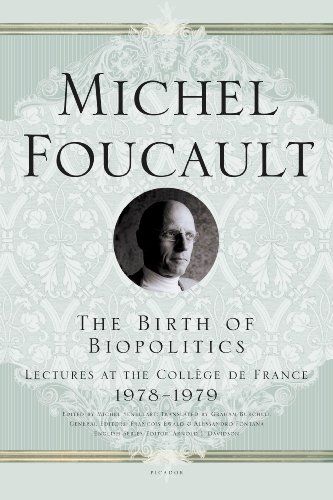
The Birth of Biopolitics
Lectures at the College de France, 1978--1979
Introduction
Nova: Imagine a book called The Birth of Biopolitics that barely mentions biopolitics. I'm not kidding. Michel Foucault delivers thirteen lectures at the Collège de France in 1978 and 1979, announces he's going to talk about biopolitics, and then spends almost the entire course on something else: liberalism, neoliberalism, and the history of how we govern ourselves through the idea of the market. And it turns out, that detour might be one of the most important things he ever wrote.
Nova: : Wait, so the book is famous for not being about what it says it's about?
Nova: Exactly, and that's precisely what makes it so fascinating. Foucault begins the first lecture saying he had planned a course on biopolitics, but then realizes you can't understand biopolitics without first doing a genealogy of liberal governmentality. So he sets off on this incredible journey through eighteenth-century English liberalism, German ordoliberalism after World War Two, and the American Chicago School neoliberalism of the 1960s and 70s. The lectures weren't even published until 2004 in French and 2008 in English, which means we've only had access to this thinking for about two decades. And in those two decades, it's become one of the most cited and debated texts for understanding the world we live in right now.
Nova: : Okay, I'm intrigued. But what's the big idea that holds all this together?
Nova: Here it is: Foucault argues that we've been asking the wrong question about liberalism. We usually think of liberalism as a political philosophy about freedom. But Foucault says, look at it as a practice of government that is constantly asking itself, am I governing too much? It's a form of governmental self-limitation. And then he traces how that self-limitation paradoxically produces new and more intensive forms of control. The market stops being just a place where people exchange goods and becomes the site where truth itself gets produced. Truth about what's natural, what's efficient, what's optimal. And that truth then governs everything else.
Nova: : So this is a book about how we came to believe the market tells the truth about who we are.
Nova: That's exactly right. Let's dig in.
Veridiction and the Birth of Liberal Reason
The Market as Truth-Machine
Nova: Let's start with a question that sounds almost absurd: when did the market start telling the truth? Foucault has this fascinating historical argument. In the Middle Ages, he says, the market was understood as a site of justice. It was heavily regulated to ensure fair prices, to prevent fraud, to protect the buyer. The market was a juridical space. But something changes around the middle of the eighteenth century.
Nova: : What changes?
Nova: The market becomes what Foucault calls a site of veridiction. That's a term he coins, from the French véridiction, meaning truth-speaking. The market is no longer a place where justice needs to be enforced. It becomes a place where truth naturally reveals itself. The price of a good isn't just what someone will pay. It's the truth about that good's value. The market mechanism itself, through supply and demand, supposedly reveals a natural order. Foucault traces this shift to the early English liberals, thinkers like Adam Smith. Political economy replaces law as the basis for limiting government action. The government shouldn't intervene not because it's unjust, but because it's incompetent. The market knows better.
Nova: : So it's almost like a theological shift. The market becomes an oracle.
Nova: That's a brilliant way to put it. Foucault uses the word veridiction deliberately. He's talking about a regime of truth. Something that produces what counts as true and false. Think about how we talk today: markets are efficient, markets are rational, the market has spoken. These aren't just descriptions, they're claims about truth. And Foucault's key move is to say, this is the deep logic of liberalism. Not freedom for its own sake, but freedom because the free market produces truth, and that truth should govern us.
Nova: : But I want to push back. Isn't there genuine liberation in letting markets work instead of having some king set prices by decree?
Nova: Of course, and Foucault isn't saying liberalism is bad. He's not making a moral judgment in that way. He's describing a transformation in rationality. The liberal art of government emerges as a critique of what he calls the police state, the Polizeiwissenschaft of the seventeenth and eighteenth centuries, where the state had unlimited ambition to govern every minute aspect of daily life. Liberalism says: stop. Let things be. There's a natural order. But here's the twist Foucault wants us to see: this self-limitation doesn't mean the state governs less. It means the state governs differently, and often more intensively, precisely because it now governs through the truths that the market reveals.
German Ordoliberalism and the American Nightmare
Two Neoliberalisms, One Logic
Nova: Foucault makes a crucial distinction that a lot of readers miss. He says there isn't one neoliberalism. There are at least two, and they're very different. The first is German ordoliberalism, developed by thinkers like Walter Eucken and others in the 1930s through 1950s. These thinkers faced a unique problem after World War Two: Germany had no legitimate state. The Nazi regime had destroyed any basis for political legitimacy. So the ordoliberals proposed something radical: build the state from the economy up.
Nova: : Build the state from the economy? What does that even mean?
Nova: Foucault captures it in this incredible passage. He says in contemporary Germany, the economy produces sovereignty. Economic growth produces political legitimacy for the state. There's a permanent genesis of the state from the economic institution. The ordoliberals framed the social market economy not as one policy among many, but as the very foundation of the state's right to exist. If the economy grows, if people prosper, they consent to the state. This is what Foucault calls a permanent consensus. And crucially, the ordoliberals still believed in some social protections. They argued that people's health, housing, and basic security were conditions for a functioning market. They had to compromise with Germany's welfare culture.
Nova: : So the German version had guardrails.
Nova: It did. And then Foucault turns to American neoliberalism, and his tone shifts. He calls it anarcho-capitalism at one point. The American version, centered on the Chicago School and thinkers like Gary Becker, does something much more radical. It extends market logic into every domain of human life. Not just the economy. Marriage, crime, education, health, everything becomes analyzable through economic categories. And unlike the German version, American neoliberalism aggressively opposes any welfare state guarantees. It is, as Foucault describes it, dogmatic in its insistence that competitiveness is an absolute social good, applied universally, without justification.
Nova: : And this is where Foucault gets really worried.
Nova: Exactly. Because once you extend market logic to all of life, you allow for extreme differences in people's quality of life, their life expectancy, their access to basic goods. The inequalities aren't a bug. They're a feature. They're the truth the market tells. And Foucault, who spent his career studying how power operates, sees this as a new and particularly insidious form of government.
How Neoliberalism Reinvented the Human Being
The Entrepreneur of the Self
Nova: This is where Foucault's analysis gets truly unsettling. He argues that neoliberalism doesn't just change economic policy. It changes what it means to be a human being. In classical liberalism, homo economicus was a partner of exchange. You have needs, I have goods, we trade. Simple. But in neoliberalism, Foucault says, homo economicus becomes an entrepreneur of himself. You are your own capital. You are your own producer. You are the source of your own earnings.
Nova: : So I'm not a worker selling my labor anymore. I'm a business called Me.
Nova: That's exactly it. And Foucault traces this particularly through the work of Gary Becker, the Chicago School economist who won the Nobel Prize. Becker develops human capital theory. Every decision you make, from getting an education to raising children to choosing a partner, is an investment in your human capital. You're constantly calculating returns. And here's the truly radical move Becker makes, according to Foucault. Becker says economic analysis doesn't even require rational behavior. It only requires that your conduct responds to reality in a non-random way. Any conduct that accepts reality, that responds systematically to changes in the environment, can be analyzed economically.
Nova: : Wait, so even irrational behavior is economic?
Nova: Yes. Because if you respond systematically to changes in your environment, you reveal a pattern, and that pattern can be modeled and predicted. And this is Foucault's most chilling insight. He says this new homo economicus is someone eminently governable. Think about that word: governable. The classical liberal subject was supposed to be the limit on government. You can't touch my natural rights. But the neoliberal subject, the entrepreneur of the self, is someone who responds to incentives, to environmental modifications. You can be steered. You are, Foucault writes, the correlate of a governmentality which will act on the environment and systematically modify its variables.
Nova: : So we're not free. We're just governable in a more sophisticated way.
Nova: That's the devastating conclusion. From being the intangible partner of laissez-faire, homo economicus now becomes the person who is perpetually responsive to modifications in the environment. The freedom to choose becomes the mechanism through which you are managed. And this isn't some conspiracy theory. This is the logic of the system working exactly as designed.
Why More Freedom Means More Control
The Great Paradox
Nova: Here's the paradox that Foucault wants us to sit with, and it's deeply uncomfortable. Neoliberal governmental intervention, he writes, is no less dense, frequent, active, and continuous than in any other system. Let that sink in. The system that preaches limited government, free markets, individual liberty, actually involves just as much intervention as any other system of power. It's just a different kind of intervention.
Nova: : How is that possible? If the government steps back, how is it intervening more?
Nova: Because the intervention changes form. Foucault gives this remarkable example. He talks about how the great age of disciplinary techniques, of panoptic surveillance, of controlling people's behavior day by day and in fine detail, is exactly contemporaneous with the age of freedoms. Economic freedom and disciplinary techniques are, in his words, completely bound up with each other. Bentham's Panopticon, that model prison where everyone is constantly watched, isn't some separate phenomenon. It's the other face of liberalism. As freedom expands in the economic sphere, control intensifies in the social sphere.
Nova: : So it's like a seesaw. More market freedom over here means more surveillance and discipline over there.
Nova: Exactly. Foucault points to the paradox of what's sometimes called neoliberal penalty. The United States is the land of laissez-faire and also the land of mass incarceration. This isn't a contradiction. It's the system working as intended. The freedom of the market requires an enormous apparatus of control to manage those who can't or won't play the game. Foucault traces this all the way back to the birth of liberal governmentality in the eighteenth century, not just to the 1970s. The connection between freedom and discipline is structural.
Nova: : And the final lecture of the course brings all this together through the concept of civil society.
Nova: Yes. Foucault ends by analyzing civil society, particularly through Adam Ferguson's 1787 essay. Civil society, Foucault argues, functions as the necessary mediating concept between the governed and the government. It's the space where free agents, homo economicus subjects, supposedly come together to deliberate and form norms. But Foucault is deeply skeptical. Civil society is the justificatory framework that makes the whole system seem natural and voluntary. It's the story we tell ourselves about how we're free even as we're being managed through market mechanisms. The lectures end not with a solution, not with a political program, but with an urgent demand: understand this logic, because it's the water we're swimming in.
Conclusion
Nova: So let's take stock. Foucault's The Birth of Biopolitics gives us a genealogy of how we came to be governed through the market, through the idea that the market tells the truth, through the transformation of ourselves into entrepreneurs of our own human capital. He shows us that German ordoliberalism built the state from the economy up after the catastrophe of Nazism, and that American neoliberalism then radicalized that logic by extending market reasoning into every corner of human existence. And he reveals the fundamental paradox: the age of freedom is also the age of discipline. They grow together.
Nova: : What I find most striking is how much this describes our world today. The gig economy worker who's told to be their own boss. The student calculating return on investment for a college degree. The constant optimization of our lives through apps and metrics. We've all become little enterprises.
Nova: And here's the thing Foucault would want us to remember. He wasn't writing a manifesto. He wasn't telling us what to do. He was trying to make the familiar strange. To take something we take for granted, the market as the natural order of things, and show us it has a history. It was made. And if it was made, it can be unmade, or remade differently. The Birth of Biopolitics ends with civil society because that's where Foucault saw the terrain of struggle. Not in some revolutionary overthrow, but in the constant questioning of how we are governed, what truths we accept, and what it might mean to refuse being the entrepreneur of oneself.
Nova: : So the book isn't really about biopolitics at all. It's about the conditions that make biopolitics possible.
Nova: Exactly. And that's why it matters more than ever. Because to understand how our lives, our health, our populations became objects of political management, you have to first understand how the market became the truth-teller. How homo economicus became the only subject who matters. And how freedom itself became the most effective tool of control. Foucault spent thirteen lectures mapping this terrain. The question he leaves us with is: what are we going to do with this knowledge?
Nova: : This is Aibrary. Congratulations on your growth!