

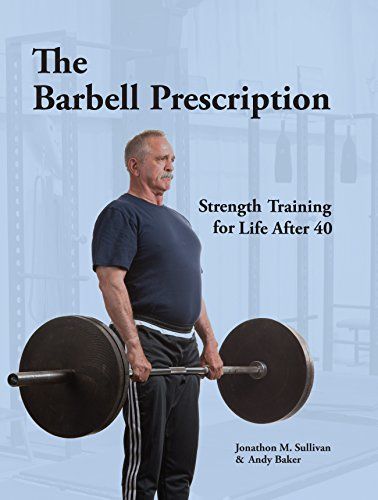
The Barbell Prescription
Strength Training for Life After 40
Introduction
Nova: Imagine you are an emergency room doctor at a level-one trauma center. Every day, you see people in their sixties, seventies, and eighties coming in after a fall. But they are not just there for a broken hip. They are there because their bodies have essentially become fragile glass. Their muscles have wasted away, their bones are brittle, and their metabolism is a wreck.
Nova: Well, that is exactly what Dr. Jonathon Sullivan thought until he started looking at the data. He is an MD and a PhD in physiology, and he realized that what we call normal aging is actually a disease state he calls the Sick Aging Phenotype. He teamed up with coach Andy Baker to write The Barbell Prescription, and their argument is radical: the best medicine for aging isn't a pill. It is a heavy barbell.
Nova: It does, right? But Sullivan argues that for the aging adult, strength is not a luxury. It is a survival requirement. Today, we are diving into why lifting heavy things might be the only way to truly stay young.
Key Insight 1
The Sick Aging Phenotype
Nova: To understand the cure, we have to understand the disease. Sullivan calls it the Sick Aging Phenotype. It is a cluster of conditions that we usually just shrug off as getting old. We are talking about sarcopenia, which is muscle wasting, and osteopenia, which is bone loss.
Nova: It is faster than you think. After age forty, if you are sedentary, you can lose about one to two percent of your muscle mass every single year. By the time you are seventy, you might have lost half of the muscle you had in your prime. And it is not just about looking toned. Muscle is a massive metabolic organ.
Nova: It is! It is your primary site for glucose disposal. When you lose muscle, you lose your ability to manage blood sugar, which leads to insulin resistance and type two diabetes. Sullivan points out that this creates a downward spiral. You get weaker, so you move less. You move less, so you lose more muscle. Your balance goes, your bones get thin, and suddenly, a simple trip over a rug becomes a life-threatening event.
Nova: Because walking does not provide the necessary stress to stop the rot. If you want to change your biology, you have to give it a reason to change. You need a stimulus that is powerful enough to trigger a systemic response. Walking is great for your heart, but it does not tell your bones to get denser or your muscles to grow back. For that, you need the barbell.
Key Insight 2
The Medicine of the Barbell
Nova: Sullivan is very specific about this. He calls the barbell the ultimate delivery system for exercise medicine. There are three main reasons. First, barbells allow you to use the most muscle mass possible in a single movement. Think about a squat. You are using your legs, your back, your core, even your arms to stabilize.
Nova: Exactly. Second, barbells allow for the longest effective range of motion. And third, they allow for the greatest weight to be moved. This is the kinetic chain. When you stand on your own two feet and move a weight, you are training balance, coordination, and structural integrity all at once.
Nova: Sullivan addresses this head-on. He argues that it is far more dangerous for an eighty-year-old to be too weak to get off a toilet. That is the real danger. The barbell is infinitely scalable. You don't start with five hundred pounds. You might start with a light broomstick or a ten-pound bar. But the movement pattern is the same.
Nova: He calls them the Big Four: the Squat, the Deadlift, the Overhead Press, and the Bench Press. These four movements cover every major muscle group and every functional human movement. The deadlift, for example, is just the technical version of picking up a heavy grocery bag or a grandchild. If you can deadlift, you are functionally independent.
Key Insight 3
The Science of Hormesis
Nova: It comes down to a concept called hormesis. This is the idea that a biological system can benefit from a stressor, provided the dose is right. When you lift a heavy weight, you are creating tiny amounts of damage and metabolic stress. This triggers a process called the Stress-Recovery-Adaptation cycle, or SRA.
Nova: Precisely. But for older adults, the chemistry is fascinating. Lifting triggers the release of myokines, which are signaling molecules produced by muscle fibers. These myokines have anti-inflammatory effects throughout the entire body. They even help with brain health and cognitive function.
Nova: Absolutely. There is a strong link between grip strength and lower risks of dementia. Then there is the bone density aspect. To get bones to grow, you need to put them under a load. This is Wolff's Law. The compression of the barbell on your shoulders during a squat tells your osteoblasts to lay down more bone mineral. You are literally armor-plating your skeleton.
Nova: That is exactly it. Sullivan often says that the body is an incredibly efficient accountant. If you don't use the muscle and bone, the body will stop paying the metabolic tax to keep them. It will literally dissolve your own tissues to save energy. The barbell is the signal that tells the accountant to keep the lights on and the factory running.
Key Insight 4
The Four Pillars of Fitness
Nova: The four pillars are Strength, Power, Mobility, and Conditioning. Strength is the foundation because it makes everything else possible. But Power is the one people often forget, especially as they age.
Nova: Strength is how much force you can produce, period. Power is how fast you can produce it. Think of it as the difference between a slow, heavy push and a quick jump. For seniors, power is what saves you from a fall. If you trip, you need to be able to move your foot fast enough to catch yourself. That is power.
Nova: Sullivan has a bit of a controversial take here. He argues that if you perform the big barbell lifts through a full range of motion, you are already doing the best mobility work possible. A full-depth squat requires and builds incredible hip and ankle mobility. You don't necessarily need to spend hours stretching if you are moving heavy loads through those ranges.
Nova: Yes, but he prioritizes High-Intensity Interval Training, or HIIT, over long, slow cardio for the Master Athlete. Why? Because HIIT preserves muscle mass while improving heart health. Long-distance running can actually be catabolic, meaning it can contribute to muscle loss if you are not careful. For someone over fifty, every ounce of muscle is precious. You don't want to burn it off on a treadmill if you don't have to.
Key Insight 5
Programming for the Master Athlete
Nova: This is where Andy Baker's expertise comes in. The biggest difference for the Master Athlete is recovery. As we age, our ability to recover from intense stress slows down. A twenty-year-old can lift heavy five days a week and be fine. A sixty-year-old might only be able to do it two or three times a week.
Nova: Exactly. Sullivan and Baker emphasize that you want the smallest amount of stress that will still trigger an adaptation. You don't want to beat yourself into the ground. They use a modified version of the Starting Strength linear progression. You start very light, and you add a tiny bit of weight every single time you lift. Maybe it is only two pounds, but over a year, that adds up to over a hundred pounds of progress.
Nova: It really is. They even talk about the importance of the training log. If you don't track it, it is not medicine, it is just recreation. For the Master Athlete, this is a clinical intervention. You are dosing the weight, the sets, and the reps to achieve a specific physiological outcome: a stronger, more resilient human being.
Nova: It changes everything. Instead of looking at your sixty-fifth birthday as the beginning of the end, you look at it as a new season of training. You are training for the most important competition of your life: the rest of your life.
Conclusion
Nova: We have covered a lot today, from the dangers of the Sick Aging Phenotype to the biological magic of the barbell. The core message of The Barbell Prescription is that while aging is inevitable, the frailty and decay we associate with it are largely optional.
Nova: Dr. Sullivan often says that strength is the foundation of everything else. It is the quality that allows you to enjoy your hobbies, travel, play with your grandkids, and remain independent until the very end. If you are over forty, the best time to start was yesterday. The second best time is today.
Nova: It really is a life-changing perspective. Thank you for joining us on this deep dive into The Barbell Prescription. This is Aibrary. Congratulations on your growth!